





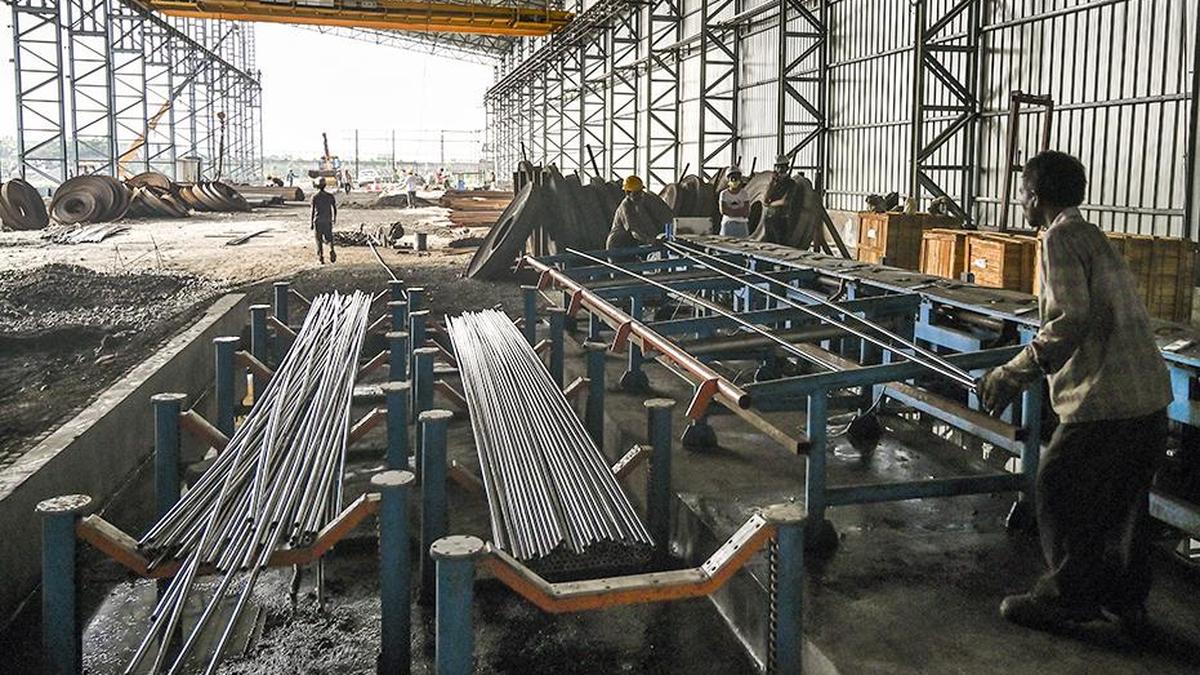
Given the rapid pace of innovation and consequent technological obsolescence in industrial production structures, the more than a decade old base now poses problems of systemic errors and flawed statistical representation of the true picture | Photo Credit: mantosh
Timely and quality statistics are the backbone of sound public policies, as also for shaping business strategies. They help reduce information asymmetries in the macro-financial system thereby contributing to nation building by supporting informed decision making. In quest of this, MoSPI puts in a colossal effort to track countless data points that result in widespread dissemination on the state of the economy. As many as 68 press releases are planned in its Advance Release Calendar 2025-26. Every one of these releases directly or indirectly touch upon industrial activity.
Therefore, notwithstanding the stylised fact that industry loses its share in aggregate output as part of structural transformation process as countries grow and develop, the Index Number of Industrial Production (IIP), retains its critical importance.
Countries have, for long, tracked factory output. Yet, it was only in 1920s that the US Fed for the first time made concentrated effort for compiling monthly industrial production giving rise to the worldwide adoption of IIP as the high (monthly) frequency volume indicator to track activity levels. India was amongst the earliest countries to follow suit. It set 1937 as base year more than a decade before international recommendations emerged on compiling such an index.
Since then, its base year has been revised nine times. The last base change was done to 2011-12 in 2014. Given the rapid pace of innovation and consequent technological obsolescence in industrial production structures, more than a decade old base now poses problems of systemic errors and flawed statistical representation of the true picture. Therefore, in September 2024, MoSPI constituted this Technical Advisory Committee for Base Year Revision on the Index of Industrial Production (TAC-IIP) with a wide remit to not only change the base but also bring about conceptual and methodological improvements. The TAC, which I had the privilege to Chair, submitted its report this mid-month and it is now in the public domain.
The key improvements recommended include: (i) introduction of chain-linked IIP in addition to the fixed base index, (ii) substitution and augmentation of factories to address the problems of creative destruction of firms and products amid changing production lines that imparts a downward bias to output measurement, (iii) selection of item basket to capture updated production structure with a better treatment of items not elsewhere classified (n.e.c), (iv) preparation of the new weighting diagram in line with the contemporary production structure, (v) greater granularity in electricity index between non-renewable and renewable energy, (vi) shift from arithmetic mean to geometric mean based linking factors at the level of broad aggregates for its better statistical properties, (vii) moving towards homogenous methodology and fuller coverage of state-level IIPs in alignment with methodology for all-India IIP, and (viii) introduction of gas supply, water supply and sewerage & waste management as part of the IIP in line with the international recommendations of IIP.
Certain recommendations of the TAC-IIP are forward-looking that may take time to implement but are nevertheless important. These include: (i) developing a de-seasonalisation unit with MoSPI to start disseminating de-seasonalised data series as soon as may be possible, (ii) developing indices for unincorporated sector by considering an industry level indicator in ASUSE survey, and (iii) developing business registries through the use of GST data with potential to significantly improve IIP. TAC-IIP suggested using GST data as a parallel exercise for one to two years before taking a view on the robustness of the information to capture it for activity levels.
Two main considerations guided our work. First, if we want to deliver information leaps and not just the new base, we need to fix the problem of the IIP getting unrepresentative over time. So, we looked beyond standard methodologies followed for years. In doing so, we were mindful of maintaining comparability with the series of earlier bases but were not bogged down by what needs to be done additionally.
Second, while searching for methodological improvements, we kept in mind the best international practices in line with the International Recommendations for the Index of Industrial Production (IRIIP). So, we pushed for the coverage of minor minerals with the State governments and gas, water supply and sewerage with the administrative ministries with the help of MoSPI. Simultaneously, we also realised that electricity as aggregate did not do justice to the sector.
We suggested disaggregation with types of electricity generated to capture the energy transition from non-renewables to renewables that the country is expeditiously making, both in the interest of climate goals and our own energy security. Once information on the unincorporated establishments is covered under ASUSE and eventually QBUSE, the index will be in a position to bring in timely information for unincorporated sector.
We recognise that our recommendations are far reaching and will add to the workload of MoSPI. It may also pose some dataflow difficulties in the short run. Our assessment is that it will not affect the quality of IIP. Dataflows can quickly stabilise with the extraordinary enthusiasm and dedication shown by the MoSPI staff and the cooperation shown by the administration ministries once a buy-in was generated with the help of Dr Saurabh Garg, Secretary MoSPI. The TAC has expressed its gratitude to him.
I have interacted with the Ministry time and again for more than three decades. We note his contribution towards bringing in a new whiff in the Ministry — one of dynamism and quest for improving the statistical system with much transparency. It enabled us to pursue our philosophy, which was simple — no change occurs in a statis; any change causes temporary disturbance; this only helps to quickly fix the difficulties. So, we are confident that as our recommendations get phased-in, we will have better coverage with better data quality. This journey will begin on June 1st when the April 2026 IIP gets released on the new base providing new weighting pattern for the new item basket and sectors. As I said in my final remarks to the MoSPI staff, “Every stone they turn will build into a credible edifice of the Indian statistical system.”
The writer is Professor, IIM Kozhikode and the Chairman of TAC-IIP. Views are personal
Published on May 26, 2026
此内容由惯性聚合(RSS阅读器)自动聚合整理,仅供阅读参考。 原文来自 — 版权归原作者所有。