






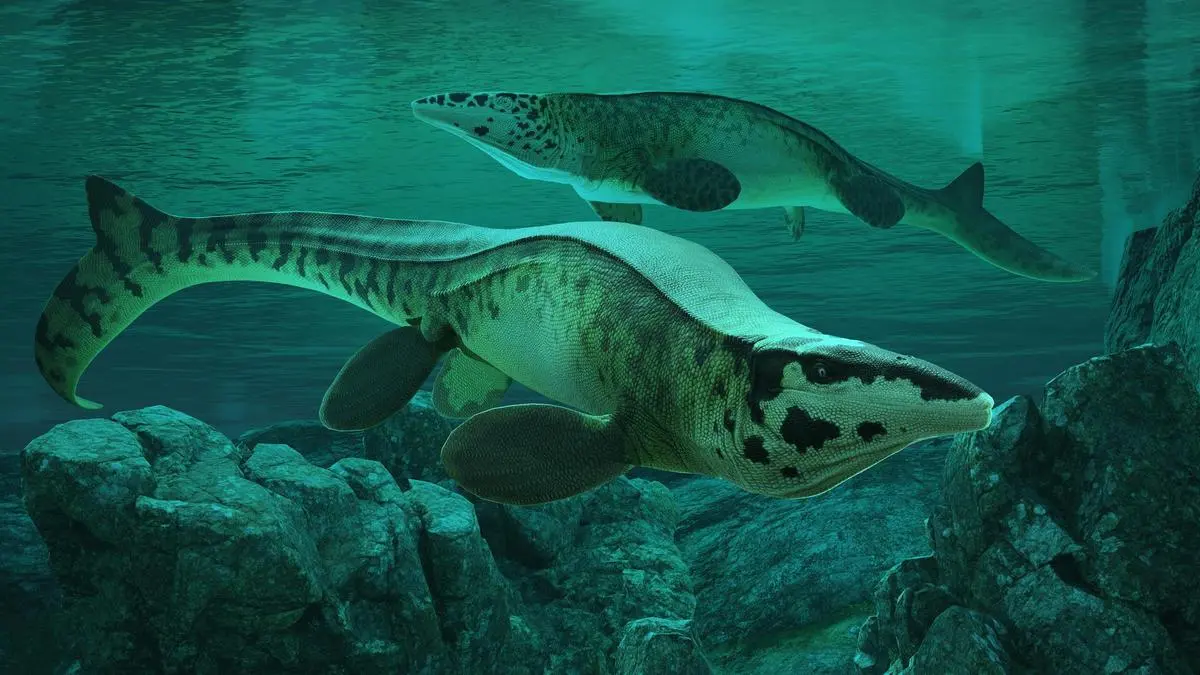
A reconstruction of the Cretaceous Period marine reptile Tylosaurus rex in the Cretaceous-era Western Interior Seaway of North America. The image was released on May 21, 2026. | Photo Credit: Alderon Games/Path of Titans
Tyrannosaurus rex was a huge land predator during the twilight of the age of dinosaurs. But it was not the only T. rex that terrorized the Cretaceous Period. There also was a marine reptile named Tylosaurus rex - the T. rex of the sea - that rivaled its land counterpart in size and ferocity.
Scientists said they have identified Tylosaurus rex as a distinct species after a wide-ranging examination of previously discovered fossils. They made the judgment based on its enormous size, fine serrations along the edges of its teeth to cut flesh more efficiently, heavy-duty musculature of the jaws and neck for subduing large prey, and certain other anatomical nuances.
Roughly 66 million years ago, Tyrannosaurus rex roamed the land in Western North America. Approximately 80 million years ago, Tylosaurus rex prowled an inland sea that at the time split North America in two. The seagoing T. rex had a streamlined body, elongated snout with large teeth, four large paddle-like flippers and a powerful tail.
The genus Tylosaurus has been known since fossils were first unearthed during the 19th century. A handful of species are recognized, including Tylosaurus proriger. A genus is a grouping of closely related species sharing similar characteristics. For example, lions and tigers are from the same genus but represent different species.
The largest Tyrannosaurus rex specimen, nicknamed Sue and held at the Field Museum in Chicago, is about 40-1/2 feet long (12.3 meters).
The largest Tylosaurus rex specimen, nicknamed Bunker and held at the University of Kansas Biodiversity Institute and Natural History Museum, is about 43 feet (13.2 meters) long. Bunker previously had been identified as Tylosaurus proriger, but possessed the suite of traits that assigned it to Tylosaurus rex, the researchers said.
“The skull alone is as long as I am tall - 5-foot-7 inches (1.7 meters),” said paleontologist Amelia Zietlow of the History Museum at the Castle in Appleton, Wisconsin, lead author of the study published in the Bulletin of the American Museum of Natural History.
Tylosaurus is a member of a group of marine reptiles with a global distribution called mosasaurs that evolved from land-living lizards to become apex marine predators during the final roughly 30 million years of the age of dinosaurs. Today’s monitor lizards including the Komodo dragon - the largest present-day lizard at up to 10 feet (3 meters) long - are perhaps among the closest living relatives of Tylosaurus rex.
“I’m impressed by modern Komodo dragons,” Zietlow said. “I can barely imagine what it would have been like to be near something many times bigger and even more hateful - said with love.”
Study co-author Ron Tykoski, vice president of science and curator of vertebrate paleontology at the Perot Museum of Nature and Science in Dallas, said Tylosaurus rex would have been twice the length of today’s largest great white sharks.
“Imagine standing, or more appropriately swimming, next to a 35 to 45 foot (10.7 to 13.7 meters) long marine Komodo dragon,” Tykoski said. “Would you say that would be pretty danged impressive?”
Most of the fossils identified as Tylosaurus rex come from north and central Texas, though Bunker came from Kansas. The holotype specimen - the fossil used to formally name a species - is at the Perot Museum.
The new species name, meaning “king of the tylosaurs,” was a nod to Tyrannosaurus rex - “an incredible animal itself, obviously,” Zietlow said.
These two T. rexes were not contemporaries, though forerunners of the giant dinosaur lived at the same time as the giant mosasaur. Tylosaurus rex was among the largest of the mosasaurs, alongside the likes of Mosasaurus hoffmanni.
While Tyrannosaurus rex could target the largest prey on land, Tylosaurus rex could do so in the sea.
“Strong muscles and serrated teeth suggest that Tylosaurus rex was preying on other large animals, likely other marine reptiles and large fish, and ripping them to pieces. Tylosaurus species in general were not picky eaters - their teeth are not super specialized towards any one kind of prey besides ‘other animals,’” Zietlow said.
Published on May 28, 2026
此内容由惯性聚合(RSS阅读器)自动聚合整理,仅供阅读参考。 原文来自 — 版权归原作者所有。