





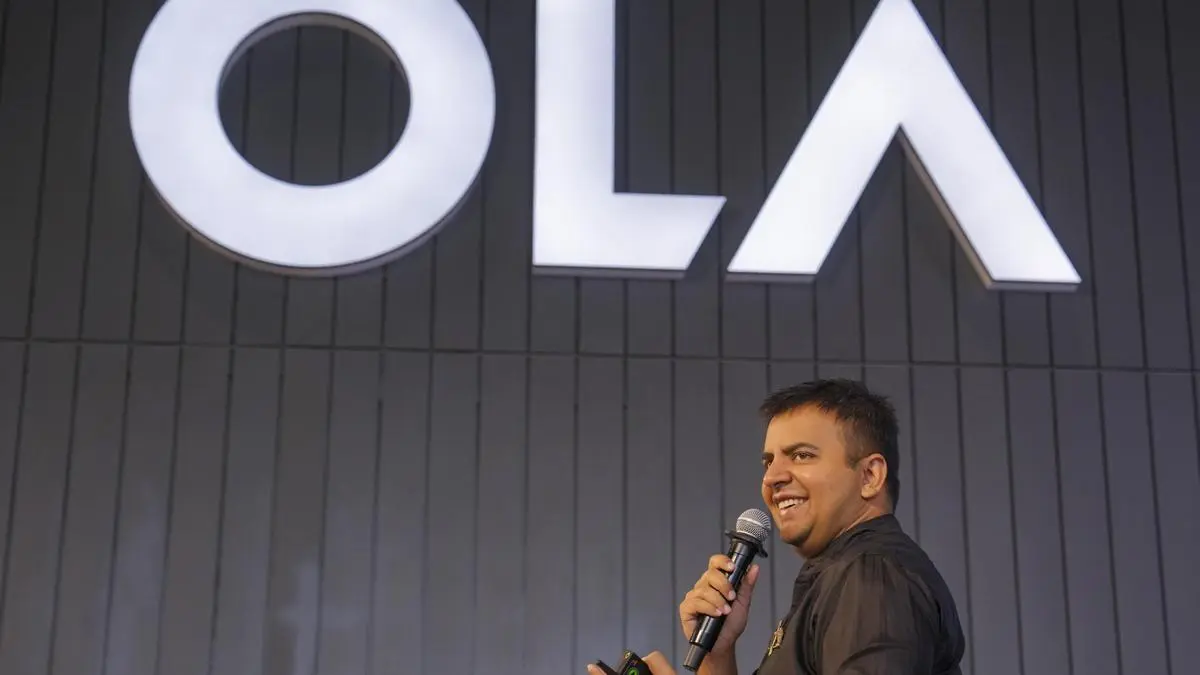
Chairman and Managing Director of Ola Electric Bhavish Aggarwal | Photo Credit: SHAILENDRA BHOJAK
In his May 20 letter to shareholders, Bhavish Aggarwal, Chairman and Managing Director of Ola Electric Mobility Ltd, made an implicit bargain: judge Ola Electric less by the hole burned in its balance sheet and more by the factories, technology and battery platform that shareholder capital has helped create.
“FY26 was a year of reset for Ola Electric,” Aggarwal wrote. “We used the year to strengthen the fundamentals of the business—service, product quality, gross margins, operating costs, cash discipline, sales productivity and cell manufacturing.”
The message is clear. Aggarwal is asking shareholders to look past a bruising year in scooters and focus instead on what he believes is the company’s more enduring asset: a vertically integrated battery and energy platform that could eventually matter more than the vehicles that financed it.
Whether that bet justifies the pain endured by customers and investors remains to be seen. But Aggawal wants investors to remember FY26 as the less as the year Ola Electric lost its lead in electric scooters and more as the year it laid the industrial foundations for a business far larger than scooters.
Aggarwal stops short of offering a direct apology to customers or shareholders. Instead, he acknowledges that service had become “the largest constraint on demand and brand trust,” a concise admission of the operational failures that hurt both customer confidence and the company’s market position.
FY26 was the year customers and investors bore the cost of those execution lapses. Sales fell sharply, market share slipped and thousands of owners grappled with service delays and quality issues that dented confidence in one of India’s most high-profile EV brands.
Aggarwal’s argument is that these setbacks should be viewed not merely as operational mistakes, but as the construction cost of a much larger energy business.
That understated phrase captures the heart of Ola’s problem. Service delays stretched to around nine days in October 2025, and backlogs reached 14 days before improving to nearly one day by March 2026. For thousands of customers, those delays turned what was marketed as a technology-led mobility revolution into a frustrating ownership experience.
The financial toll was equally revealing. Warranty costs fell to ₹59 crore in FY26 from ₹555 crore in FY25. Part of that decline reflects lower sales, but the reduction was far steeper than the 43.5 per cent drop in deliveries to 173,794 units from 307,846 units. Had Ola incurred warranty costs at the same per-vehicle rate as FY25, the FY26 warranty bill would have been roughly ₹313 crore rather than ₹59 crore, indicating a substantial improvement in product quality and repair efficiency. Evidence that the reset is working.
The numbers support much of that claim. Q4 FY26 was the company’s first operating cash-flow positive quarter, with consolidated cash flow from operations of ₹91 crore. Gross margin rose to 38.5 per cent from 13.7 per cent a year earlier, while consolidated operating expenses, including lease rentals, nearly halved to ₹428 crore from ₹844 crore.
Even so, the scale of the setback remains significant. Deliveries fell 43.5 per cent in FY26, and consolidated revenue from operations dropped 50.1 per cent to ₹2,253 crore from ₹4,514 crore. The company’s goal of rebuilding national market share to 15–20 per cent over the next six months suggests how much ground was ceded to TVS Motor, Bajaj Auto and Ather Energy.
The strongest part of Aggarwal’s letter lies in batteries. “Ola was built for this moment,” he wrote, arguing that the company is uniquely positioned across “the two most important pillars of India’s energy future, electric mobility and batteries.”
The company has said its Gigafactory already has 2.5 GWh of operational capacity, with installation for a 6 GWh commercial ramp largely complete and expected to be fully commercialised by the end of the current quarter.
“This is no longer a conceptual project but an operating manufacturing platform running at commercially viable yields” the company said in its investor presentation.
According to the company management the sleeper detail in the presentation is Ola’s claim to have commercialised dry-electrode manufacturing technology, which can reduce capital expenditure by 33 per cent, lower energy consumption by 40–60 per cent and shrink factory footprint by 70 per cent compared with conventional processes.
About 15 per cent of current vehicle orders already use Ola-made cells, and the company expects its entire product portfolio to transition to in-house batteries by September 2026. Beyond vehicles, Ola has launched Shakti, a distributed energy-storage product with more than 50,000 leads and over 200 distributor partners, and is developing Mahashakti, a utility-scale storage system targeted for launch in calendar year 2027.
Citing Avendus Research, Ola estimates India’s battery market could reach 420 GWh annually by 2035, representing a roughly $30 billion opportunity.
Ola plans to expand its battery capacity from 6 GWh to 20 GWh through a capital raise at the cell subsidiary level, a move that suggests the battery business could eventually attract standalone funding—and perhaps a valuation separate from the loss-making vehicle business.
For investors who backed the grand promise Bhavish Aggarwal made before Ola Electric went public, the latest shareholder letter offers a simple proposition: judge the company not by the turbulence in scooters, but by the battery platform taking shape beneath it.
The scooters tested the patience of customers and scorched investor confidence. Aggarwal is now asking shareholders to place one more bet—that the Gigafactory, not the scooters, will ultimately deliver the payoff.
Published on May 21, 2026
此内容由惯性聚合(RSS阅读器)自动聚合整理,仅供阅读参考。 原文来自 — 版权归原作者所有。