









COOL COLLAB. Karban co-founders Tanya Goyal and Karan Bansal
Startup Karban is preparing to launch offline retail and commercial installation services for its integrated air-circulation systems.
Currently selling entirely through its website, the venture’s next phase of growth will focus on retail partnerships, B2B deployments and strengthening after-sales service infrastructure, says Karban co-founder Tanya Goyal.
The company’s flagship product — Airzone — combines a ceiling fan, air purifier and ambient lighting system into a single unit, priced at ₹18,999. The product is available in ceiling-mounted, wall-mounted and standing formats.
“Scaling up our offline and B2B channels is the immediate priority,” Goyal says. “We’ve proven the product works and customers value it. Now we need to make it accessible beyond online-only buyers.”
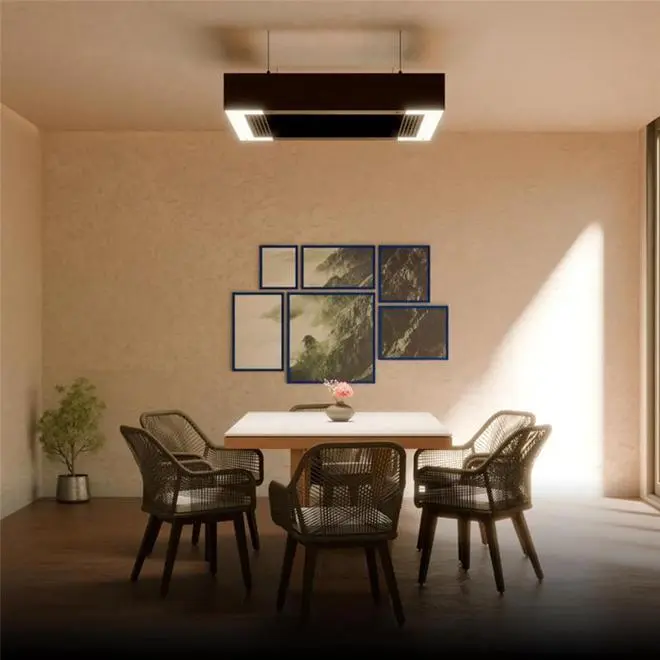
Karban’s flagship product — Airzone — combines a ceiling fan, air purifier and ambient lighting system into a single unit
Karban’s expansion plans come at a time when India’s premium appliances market is witnessing a rising demand for energy-efficient and multi-functional products, even as legacy brands and smart-home startups intensify competition across categories such as fans, purifiers and connected home devices.
Unlike most appliance makers, which focus on incremental upgrades, Karban is pitching itself as a category creator in what it calls the “ultra appliance” segment — multiple functions bundled into one integrated system.
The idea for the product emerged from a larger airflow problem in Indian homes, where ceiling fans, air purifiers and lighting systems operate independent of each other, without addressing overall air circulation.“We didn’t set out to build a smart-home appliance. We set out to solve an airflow problem,” Goyal says. “Fans push air down, purifiers sit in corners cleaning whatever air reaches them, and none of these systems really work together.”
The company says its bladeless architecture and high-performance BLDC motor enable wider air circulation with lower energy consumption, compared with conventional ceiling fans.
Karban is also leaning heavily on product engineering as a differentiator. Co-founder Karan Bansal had previously worked in the field of aerodynamics and airflow research. Karban uses the principles of computational fluid dynamics in its airflow-focused design.
“Most brands are making smarter fans or connected purifiers. We are building from first principles on how air should move through a living space,” Goyal says.
While the company declined to share revenue or sales figures, it says it plans to remain selective in its product launches and team expansion for the next two years.
Published on May 25, 2026
此内容由惯性聚合(RSS阅读器)自动聚合整理,仅供阅读参考。 原文来自 — 版权归原作者所有。