



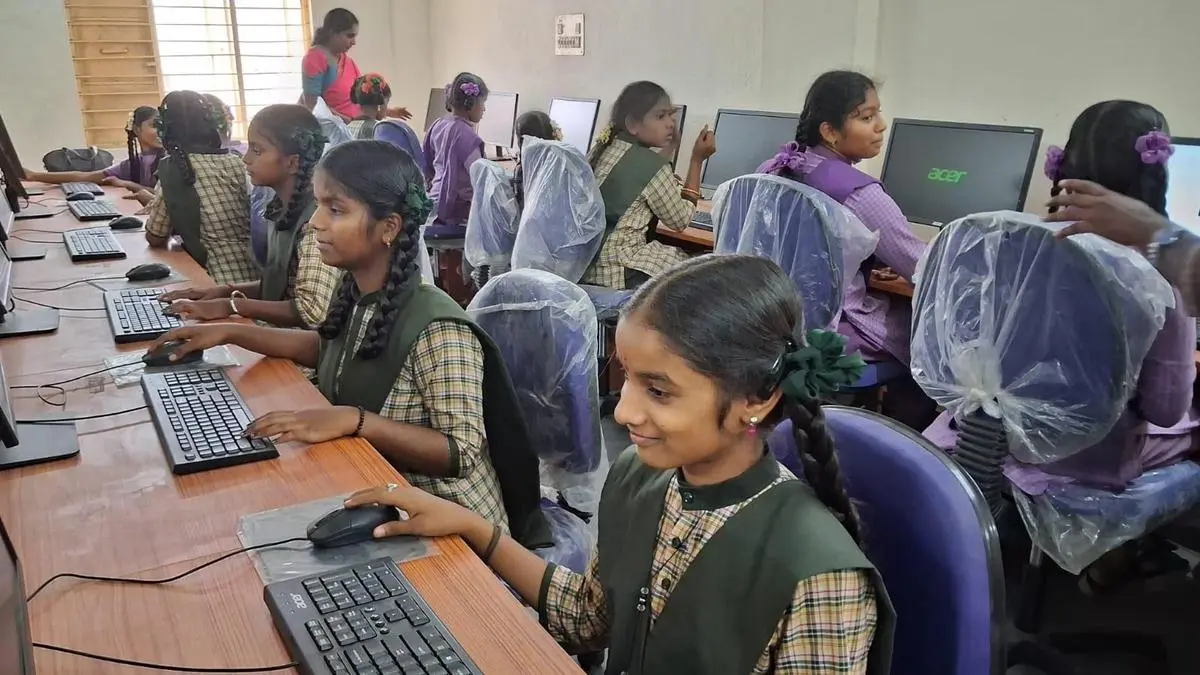
Schooling: Improving learning outcomes is still a challenge | Photo Credit: HANDOUT
India’s school education story, as laid out in a new report by NITI Aayog, begins on an encouraging note. Over the past decade, India has achieved what once seemed elusive: near-universal access to primary schooling, better enrolment among girls and disadvantaged groups, improved basic infrastructure in schools, and signs of recovery in foundational literacy. With 14.7 lakh schools serving nearly 25 crore students, the architecture of access is now largely in place.
Yet, beneath this progress lies a deeper, more troubling truth — India may have succeeded in getting children into schools, but it is struggling to ensure that they stay, learn and emerge ready for a changing economy. While enrolment is robust at the elementary level, participation collapses as children move into secondary and higher secondary education, with gross enrolment at the higher secondary stage just 58.4 per cent. A key reason lies outside the classroom. For millions of low-income families, adolescence marks the point at which education begins to compete directly with survival. Secondary schooling brings transport costs, books, uniforms, exam fees and often private tuition. At the same time, household economic pressures intensify. Many teenagers are pulled into the labour market early.
This challenge is becoming more acute in a new economy increasingly shaped by low-barrier gig work. Delivery platforms, logistics apps and on-demand services offer quick earning opportunities that require little formal qualification. The gig economy, in fact, risks quietly normalising early exit from education for vulnerable families. The tragedy is that this happens even as learning levels remain weak. Too many children are progressing through grades without mastering the basics. The report points to a system still dominated by rote pedagogy and assessment structures that fail to measure real understanding.
India therefore faces a paradox: access has expanded, but learning quality and retention remain fragile; aspiration for private schooling has risen, but quality assurance remains uneven; policy frameworks are modern, but classroom realities lag behind. The answer cannot simply be to keep children in school longer. Schooling itself must become more relevant to the future economy. As artificial intelligence reshapes work, India must rethink education as preparation not for clerical or repetitive jobs, many of which automation will eliminate, but for higher-value roles requiring problem-solving, creativity, digital fluency, design thinking, communication and STEM skills. Secondary schooling must integrate AI literacy, critical thinking and market-linked skills without abandoning foundational learning. India must create an economy that rewards higher skills with better wages. If the future offers only low-paid gig work, families will continue to choose immediate income over long-term education. The challenge lies in building a system that makes staying in school more worthwhile than leaving it early.
Published on May 21, 2026
此内容由惯性聚合(RSS阅读器)自动聚合整理,仅供阅读参考。 原文来自 — 版权归原作者所有。