



Continuing governance and succession-related uncertainty within the Tata group has begun to weigh visibly on investor sentiment, with listed Tata companies losing nearly ₹10 lakh crore in market value since Ratan Tata died in October 2024.
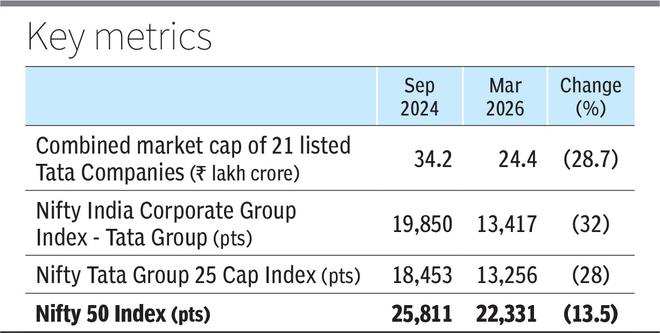
Data sourced from the Prime Database shows the combined market capitalisation of 21 listed Tata companies declined 28.7 per cent to ₹24.4 lakh crore in March 2026, from ₹34.2 lakh crore as of September 30, 2024, nine days before Ratan Tata passed away. Tata group indices also sharply underperformed broader markets and rival business groups during the period.
The Nifty India Corporate Group Index – Tata Group declined over 32 per cent between September 2024 and March 2026, while the Nifty Tata Group 25 Cap index fell 28 per cent. In comparison, the Nifty 50 declined around 13.5 per cent during the same period, while corporate group indices for Mahindra Group and Aditya Birla Group were down only around 5 per cent each, according to NSE Indices data.
FPIs have pared stakes across several Tata companies with the sharpest reduction seen in premium growth-oriented businesses that had witnessed strong valuation rerating during the post-pandemic rally.
Market participants said the divergence suggests investors have become increasingly selective within the Tata universe at a time when governance visibility, succession planning and leadership continuity at the group level have drawn greater attention.
Tussle among trustees
Tata Trusts, which holds a little over 66 per cent in the holding company Tata Sons, is seeing a tussle among the trustees with divergence among them over key issues such as listing of Tata Sons, and nominees on its board, while there is also uncertainty over N Chandrasekaran getting another term as its chairman. Another dimension has been added to the internal strife with complaints of alleged violations of the Maharashtra Public Trusts Act, that has led to a key trustees meeting being postponed twice.
“Ever since Ratan Tata’s death, they have taken quite some time to come out of the mess, but they have taken some solid steps to address the public perception of the group,” said Arun Kejriwal, Founder of Kejriwal Research and Investment Services. “The tendency of investors is that they do not like controversy or uncertainty. Wherever there is controversy, investors take a bit of a backseat,” he said.
“The market is effectively pricing in uncertainty at the holding-company level, even though the operating businesses remain fundamentally strong,” said a fund manager who did not wish to be identified.
Analysts said broader global risk aversion and correction in richly valued stocks have worsened sentiment across markets in recent months. However, the sharper underperformance in Tata group companies and indices had begun well before the latest phase of global volatility. “Markets can live with weak quarters, but they struggle with uncertainty around leadership and structure. That’s when investors start assigning a higher risk premium,” said a senior market participant tracking the group.
Published on May 19, 2026