


A couple months ago, the macros that underpin equities looked completely different — inflation was controlled, interest rates were lowered and discretionary consumption was recovering well post GST cuts. There didn’t seem to be any serious threat to earnings growth. However, since March, the picture has turned gloomy — oil price remains volatile and elevated, monsoon could be below normal and higher fertiliser costs could stoke food inflation. These now cast uncertainty on steady delivery of earnings growth by Indian companies. Meanwhile, geopolitics is the most complex it has been in decades, adding another layer of uncertainty.
Since the war broke out, markets have corrected to reflect this uncertainty but at the same time, fuelling talk that this is a good time to buy, with valuations now below long-term averages. Nifty 50’s P/E dipped close to 20x in March against a 10-year mean of about 25x. Today, it trades at about 22x (niftyindices.com), having recovered from the bottom in early April. But is every 22x Nifty P/E really the same? That question matters more once you factor in the quietly rising cost of equity (CoE), which is often overlooked.
CoE or the expected rate of return from equities is the discount rate used to convert estimated future cash flows to their present value and is a key variable in valuation. Mathematically, for a given set of cash flows, a higher expected rate of return means a lower valuation, and vice-versa. Logically too, this holds. Higher-risk assets demand higher returns, and investors try to achieve this by paying a lower entry price. Thus, in theory, there is an inverse relationship between CoE and net present value.
With that introduction to CoE out of the way, let us circle back to the question. Today, Nifty trades at 21x earnings, just as it did at the beginning of CY04. However, the CoE then was just 9.9 per cent as against today’s 11.7 per cent (from 10.8 per cent as of January 1, 2026). The index’s EPS grew 50 per cent in CY04 over CY03 and it posted returns of 11 per cent. With such high earnings growth highly unlikely in the said macro backdrop, this increase in CoE further signals a possibility of equities underperforming expectations in CY26.
In this story, we analyse 25 years of data to observe whether the theoretical inverse relationship between valuation and CoE has held. But before getting into the analysis, it helps to understand how CoE is computed — and who better to learn from than Professor Aswath Damodaran — the ‘Dean of Valuation’ himself.
The framework
Professor Damodaran’s CoE is broadly based on the CAPM (capital asset pricing model) equation: CoE = Rf + β * (Rm – Rf) where,
Rf – risk-free rate of return, Rm – expected return of the broad stock market and β – beta, a measure of relative risk of a portfolio versus the broad market portfolio (like S&P 500, for instance). The term Rm – Rf is also called equity risk premium (ERP).
Assume Rf, Rm and β at 5 per cent, 10 per cent and 1.2. CoE in this case would work out to 11 per cent (5 + 1.2 * (10-5)).
Damodaran’s approach to each of these variables is different from the traditional way of computing them and is logically sounder and here is how it is done.
Risk-free rate
Textbooks suggest using the yield on a long-term government bond in the same currency as the cash flows being discounted. For rupee cash flows, this would be the yield on the 10-year government security.
Damodaran points out a flaw here. Even sovereigns carry default risk, however remote. Hence, he suggests adjusting the sovereign yield for default risk using its credit default swap (CDS) spread. A CDS works like insurance — you pay a premium to be indemnified if the sovereign defaults. For instance, as of April 1, 2026, the CDS spread on the 10-year Indian government bond was 1.02 per cent, and the bond yield stood at 6.96 per cent. Adjusting for this spread gives a risk-free rate of 5.94 per cent. Damodaran takes this a step further. He suggests using only the incremental CDS spread over that of an Aaa-rated sovereign. The CDS spread on a 10-year Swiss government bond (Aaa-rated) was about 0.17 per cent. The incremental spread for India, therefore, works out to 0.85 per cent (1.02 minus 0.17), yielding a risk-free rate of 6.11 per cent.
However, this approach is possible only if there is an active CDS market for the currency. In case of its absence, he offers an alternative — use the CDS spread of a similarly rated sovereign. India’s sovereign rating by Moody’s is Baa3, and the CDS spread for a Baa3-rated government bond then was about 2.09 per cent. Subtracting this from the Indian 10-year yield gives a risk-free rate of 4.87 per cent (6.96 minus 2.09).
Since we rely on Damodaran’s dataset (available consistently since 2001), we use this second approach in our analysis. Link to dataset > Risk Premiums for Other Markets.
Equity risk premium
ERP (Rm – Rf) measures the additional return investors demand from equities over the risk-free rate. A simple way to estimate Rm is to use historical equity returns, but this assumes the future will replicate the past.
Damodaran instead adopts a forward-looking approach, computing an internal rate of return that discounts future cash flows (dividends and buybacks) of a broad market index to its current level.
Damodaran treats ERP as a sum of two independent components:
(A) Mature market ERP — compensation for inherent risk of equities, irrespective of geography
(B) Country risk premium — compensation for operating in a specific market or geography
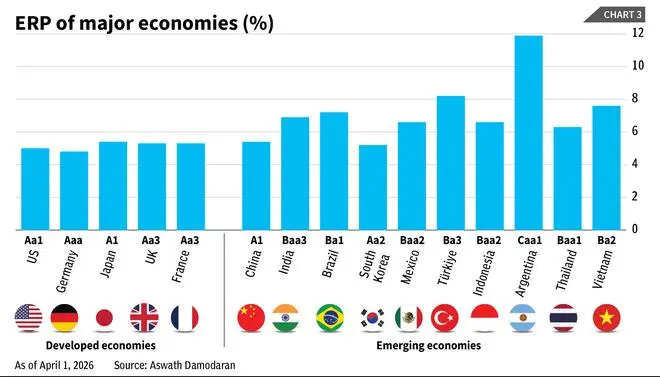
For the mature market, he uses the US and the S&P 500 because the index offers robust historical data and liquidity. However, since May 2025, the US is no longer an Aaa-rated sovereign and has been downgraded to Aa1. Yet Damodaran sticks to the S&P 500 with a minor additional adjustment for this rating downgrade, as there is no equivalent broader market index in other Aaa-rated countries.
Let us walk through how he calculates ERP for an emerging market like India, as of April 1, 2026, for instance.
First, for Rm, with estimates of S&P 500’s cash flows (dividends and buybacks) for the next five years and a terminal value (estimated to grow at the t-bond rate till perpetuity) Damodaran arrives at an IRR (internal rate of return) of 9.1 per cent that discounts these cash flows to the current value of the index. IRR is basically the discount rate that equates the present value of future cash flows to the current price of an asset. This forward-looking IRR serves as the Rm.
Next up, ordinarily, one would use the 10-year US Treasury yield (4.3 per cent) as the Rf. However, since the US is no longer Aaa-rated, its Treasury yield includes a rating premium over that offered by a Aaa-rated sovereign. The CDS spread for an Aa1-rated sovereign (US) was about 0.26 per cent. Adjusting for this, the true risk-free rate becomes 4.06 per cent, yielding a US ERP of 5.04 per cent (9.1 minus 4.06). However, this is still not the mature market ERP (‘A’ from above). This 5.04 per cent includes a small US-specific country risk premium (‘B’ for US) of 0.26 per cent (CDS spread). Removing this gives the pure mature market ERP, which works out to 4.78 per cent (A).
Next comes India’s country risk premium (India’s ‘B’).Damodaran largely suggests using the same CDS spread used to compute the risk-free rate earlier — in this case 2.09 per cent. While this addresses the sovereign risk of the currency, other emerging-market risks are left to be modelled only through cash flows, avoiding double counting of risks.
Adding A and B, India’s ERP works out to 6.87 per cent (4.78 plus 2.09).
Summing up, with Rf at 4.87 per cent, ERP at 6.87 per cent, the CoE works out to 11.74 per cent as of January 1, 2026. Of course, ERP has to be multiplied with β, when working with a portfolio that is smaller than the broader market portfolio. However, since we have worked with the broader Nifty 500, we have skipped β here.
Theory holds?
It should now be clear that there exists an inverse relationship between CoE and valuation. To see if this theory holds, we have constructed charts 1 and 2. Chart 1 maps the change in Nifty 500’s P/E (as of calendar year-ends) and the change in CoE for all calendar years since 2001. Chart 2 shows the absolute values of the index’s P/E and CoE (as of year-ends).
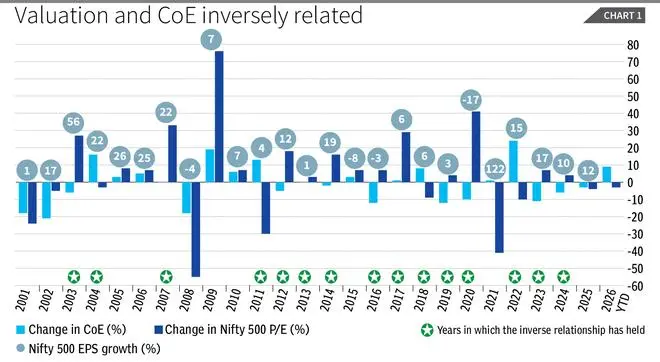
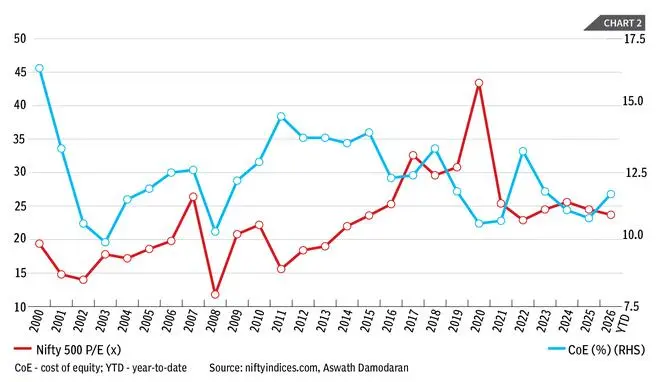
It can be seen from Chart 1 that the inverse relationship has largely held—in years where CoE has fallen or stayed flat, P/E has expanded and vice-versa. Still, there are exceptions because valuation is influenced not only by CoE but also by earnings growth, sentiment and liquidity. While earnings growth can be quantified, sentiment and liquidity are harder to measure. For instance, 2021 was an outlier: CoE was unchanged, yet the P/E contracted over 40 per cent — from 43x (December 2020) to 25x (December 2021), as EPS surged 122 per cent from a low base in 2020.
On the other hand, in 2008, after the global financial crisis, investors flocked to the safety of government bonds, bringing down Rf and eventually CoE. Ideally, valuation should have expanded. However, P/E contracted 55 per cent owing to a bearish sentiment.
Let’s now focus on 2026. CoE has increased 9 per cent so far, from 10.8 per cent (January 1) to 11.7 per cent (April 1 - date of Damodaran’s latest release). Valuation, on the other hand, has contracted just 3 per cent, leading one to doubt if the market is under-pricing risks. If it is doing so, a late realisation could take the valuation multiple downward.
With the conflict in West Asia yet to come to a meaningful conclusion, the cost of oil remains elevated and highly volatile, adversely impacting India’s current account deficit, currency and inflation. It is reasonable to expect night and day difference between the average cost of Indian crude basket in FY27 (April 2026 average was $114, for context) versus FY26 ($71 a barrel). This could erode margins of sectors such as FMCG, paints, logistics, chemicals, tyres, castings & forgings, and others that are dependent on petroleum-based inputs. Elsewhere, base-metal prices are rising, AI disruption is real and rural consumption remains heavily weather-dependent, with El Niño and a potential rainfall-deficit posing downside risks. Financial stocks could see higher credit costs driven by possible defaults in MSME and commercial vehicle loans, denting earnings.
All these imply more uncertainty to earnings growth forecasts than in recent years. When you combine higher CoE and earnings uncertainty, you must take note that a Nifty 50 P/E of 22x now is not the same as in another past year when it was trading at the same level. Factor this in your investment decisions. In this context, if earnings growth falters and thus valuations become expensive, a correction could follow sooner or later.
Published on May 9, 2026