


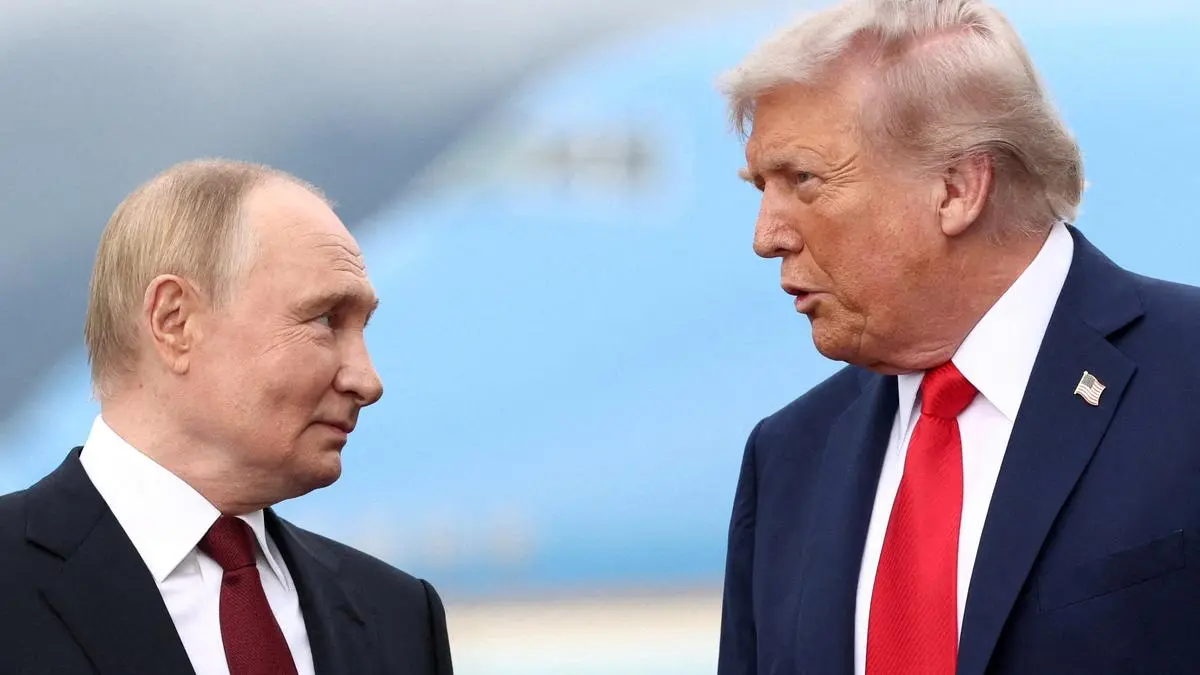
U.S. President Donald Trump and Russian President Vladimir Putin | Photo Credit: KEVIN LAMARQUE
On the surface, Chinese leader Xi Jinping's back-to-back summits with US President Donald Trump and Russia's Vladimir Putin looked pretty similar, with formal handshakes in Beijing's Tiananmen Square, enthusiastic greetings from flower-waving children, and marching columns of soldiers branching gleaming bayonets.
But the visits also revealed how different China's relationship is with the two countries.
During Trump's visit, China sought to stabilize ties with the United States, while Putin's trip served to deepen its strategic partnership with Russia.
Xi emphasised ceremonial hospitality during Trump's visit, including a rare tour of Zhongnanhai, the former imperial gardens that now serve as the headquarters for China's government. Beijing understood Trump valued highly visible displays of respect, said George Chen, partner for Greater China practice for The Asia Group.
“Xi knows this is what Trump values: being treated like a VIP, respected in front of the cameras.” With Putin, Chen said, Xi switched to substance. “Reaffirming the friendship treaty, signing new energy deals, and re-emphasising their no limits' partnership,” he added.
The differences between Trump and Putin's visits began with their length: the US president stayed in China for three days, while Putin's visit lasted two.
Both leaders were welcomed at Tiananmen Square with ceremonial guards, a military band and children waving Chinese and national flags.
Both also held closed-door meetings with Xi at the Great Hall of the People, next to the square.
But while Trump's visit did not include a public agreement-signing ceremony, Putin and Xi witnessed the signing of bilateral agreements and memorandums of understanding.
Trump also received a private tour of the Temple of Heaven and walked through the imperial gardens of Zhongnanhai.
Putin, instead, spent much of his time with Xi inside the Great Hall of the People, where the two presidents toured a photo exhibition on China-Russia relations and later had tea.
Last week's trip was Trump's second visit to China as president. For Putin, it was his 25th visit to the country.
The main contrast between the two summits was in their messaging.
With Trump, Xi focused on the need to maintain a relatively stable relationship after months of tensions and a trade war between the world's two largest economies. He urged the US president to see China as a partner rather than a rival, and both leaders agreed to work toward what they described as “a constructive China-US relationship of strategic stability”.
With Putin, Xi sought to reinforce and deepen a longstanding partnership that is both strategic and economically important for the two countries.
While the US and China are still trying to stabilise their trade ties, Moscow and Beijing reaffirmed their relationship as essential partners. Putin said the “driving force” of the relationship was the energy sector, particularly oil and gas.
The two sides signed more than 40 cooperation agreements covering areas including trade, technology and media exchanges. The two leaders also signed a joint declaration describing Russia and China as “important centres of power in a multipolar world”.
Trump and Xi, by contrast, did not sign a joint declaration or oversee the signing of any agreements during the visit. It was only after the US president left Beijing that the two countries announced the details of several accords, with Washington saying China had agreed to buy US agricultural products at an annualised rate of USD 17 billion and purchase 200 Boeing jets.
“China and Russia reached more agreements, and with China and the US, what are the agreements? Even that is not very clear,” said Claus Soong, an analyst at the Mercator Institute for China Studies in Berlin.
But Lyle Morris, senior fellow on Chinese national security and foreign policy at Asia Society Policy Institute's Centre for China Analysis, said the biggest surprise from the Xi-Putin meetings was that it appears no formal deal was signed for the Power of Siberia 2 gas pipeline plan, which could send gas from Russia to China through Mongolia.
“This is a huge setback for Russia and Putin,” he said.
Moscow is closely aligned with Beijing on the issue of Taiwan, the island democracy China claims as its own. Meanwhile, the US maintains an intentionally ambiguous stance on the island and serves as its main informal backer and arms provider.
Xi made it clear to Trump that Taiwan is the most important issue in the bilateral relationship and warned that mishandling US ties with the self-governing island could lead to confrontation between the two countries.
Trump did not publicly address Taiwan during the visit. But on his way back to the United States, he described arms sales to Taiwan as a “very good negotiating chip” with China, comments that stirred anxieties on the island, which Beijing claims as its own territory.
With Putin, there was no sign of disagreement over the issue.
In the joint declaration signed by Xi and Putin, Russia reiterated its opposition to Taiwanese independence “in any form” and voiced support for what it described as China's efforts to defend its sovereignty and achieve “national unification”.
According to the Chinese Foreign Ministry, both sides also raised concerns over what they called "accelerated remilitarisation" of Japan, against the backdrop of strained China-Japan ties over Taiwan. (AP) SCY SCY
Published on May 21, 2026
此内容由惯性聚合(RSS阅读器)自动聚合整理,仅供阅读参考。 原文来自 — 版权归原作者所有。