


惯性聚合 高效追踪和阅读你感兴趣的博客、新闻、科技资讯
阅读原文 在惯性聚合中打开

推荐订阅源

I
InfoQ
C
CERT Recently Published Vulnerability Notes
The Last Watchdog
The Last Watchdog
P
Proofpoint News Feed
D
Darknet – Hacking Tools, Hacker News & Cyber Security
让小产品的独立变现更简单 - ezindie.com
GbyAI
GbyAI
T
Tenable Blog
博客园 - 三生石上(FineUI控件)
P
Privacy & Cybersecurity Law Blog
Simon Willison's Weblog
Jina AI
Jina AI
Threat Intelligence Blog | Flashpoint
T
Tor Project blog
博客园_首页
F
Fortinet All Blogs
博客园 - Franky
Latest news
Latest news
Last Week in AI
Last Week in AI
T
Threat Research - Cisco Blogs
Scott Helme
Scott Helme
L
LINUX DO - 热门话题
U
Unit 42
Cyber Security Advisories - MS-ISAC
Hugging Face - Blog
Hugging Face - Blog
D
Docker
Project Zero
Project Zero
OSCHINA 社区最新新闻
OSCHINA 社区最新新闻
MongoDB | Blog
MongoDB | Blog
F
Full Disclosure
D
DataBreaches.Net
Google DeepMind News
Cisco Talos Blog
Cisco Talos Blog
Y
Y Combinator Blog
WordPress大学
WordPress大学
C
Cyber Attacks, Cyber Crime and Cyber Security
H
Help Net Security
奇客Solidot–传递最新科技情报
奇客Solidot–传递最新科技情报
月光博客
月光博客
cs.CL updates on arXiv.org
Blog — PlanetScale
Blog — PlanetScale
钛媒体:引领未来商业与生活新知
钛媒体:引领未来商业与生活新知
S
Schneier on Security
C
Cybersecurity and Infrastructure Security Agency CISA
P
Proofpoint News Feed
PCI Perspectives
PCI Perspectives
Cloudbric
Cloudbric
V
Visual Studio Blog
Recorded Future
Recorded Future
人人都是产品经理
人人都是产品经理

Business News Today: Latest Business News, Finance News

Markets’ dilemma: Trust the bark or wag of oil prices The sector call illusion Bandu’s Blockbusters For April 12, 2026 Mastering Derivatives: Does Lag Impact Effectiveness Of OI? Who Am I? April 12, 2026 Index Outlook: Rising From Dire Straits US Market Outlook: Gaining Strength Bullion Cues: Gold And Silver Futures Face Barrier F&O Tracker: Tentative Shift In Trend F&O Strategy: Buy L&T Put Maruti Suzuki to launch 4 EVs by 2031 India Inc flags surge in cost of packaging raw material, seeks relief measures India-flagged LPG tanker Jag Vikram crosses Strait of Hormuz after US-Iran ceasefire Muted pricing power, rising costs to curb benefits of demand in cement sector: HDFC Securities Iran's new supreme leader Mojtaba Khamenei has severe and disfiguring wounds, sources say No road tax, registration fees for electric vehicles priced up to ₹30 lakh till March 2030: Delhi’s draft EV policy Central Railway to run four special local trains for Ambedkar Jayanti West Asia tensions push up costs for India; further impact hinges on stability: Report ED initiates fresh raids against former Bengal minister Chatterjee in teacher recruitment scam Election Commission reverses Mittal’s DVAC posting, appoints him DGP, TN Armed Police Israel and Lebanon are expected to hold talks. Here’s what to know US, Iran set for peace talks but doubts emerge over Lebanon, sanctions Cotton Association revises output estimates for 2025-26 up at 324 lakh bales of 170 kg each Orbicular gets USFDA’s tentative nod for generic Semaglutide Injection in partnership with Apotex Malls, high-streets in NCR clock 45% rise in leasing of retail spaces in Jan-Mar: C&W FIIs pull ₹28,375 crore in five sessions; domestic buyers cushion fall as indices post best week in months Nifty and Bank Nifty Prediction for the week 13 Apr’26 to 17 Apr’26 by BL GURU Proposed Trump arch in Washington DC includes winged figure, eagles, lions and gold inscriptions 'Ladakh' replaces 'Jammu and Kashmir' in Aadhaar records for UT residents Misri ends US trip with focus on civil nuclear cooperation and LPG exports Artemis II astronauts return to Earth after historic lunar flyby and Pacific splashdown US-Iran peace talks in Pakistan: What will be discussed? 5paisa Capital's ₹469 crore rights issue oversubscribed 1.24 times Shriram Finance’s credit rating climbs after MUFG investment SEBI chief reaffirms open-door policy for global capital Reliance seeks government approval to buy Iranian crude oil US Vice President Vance arrives in Pakistan for crucial peace talks with Iran EU condemns ‘illegal’ Israeli expansion: 30 new West Bank settlements spark global outcry US intelligence indicates China preparing weapons shipment to Iran Agtech marketing in the age of regional content and creator communities Rajnath Singh, Nitin Gadkari to join 3-day agri event at Shivraj’s home turf, inaugurated today How agripreneurship will drive improved rural livelihoods in India World’s largest tur producer, yet an importer: A self-sufficiency puzzle unfolding on ground Ethanol in diesel generators: India’s next practical step towards energy security How sustainable sourcing can unlock value in India’s agri-value chains SEBI launches three new IT platforms to transform regulatory landscape India allows Iranian oil tankers to berth at Sikka port under special exemption US expected to extend waiver for Russian oil imports amid global energy price concerns India, Japan discuss Strait of Hormuz security Editorial. Fair deal Editorial. Wait and watch Letters to the Editor dated April 10, 2026 IPL 2026: Ad volume witness marginal dip in first 13 matches MAHE and Helogen Corporation partner for space-based biomedical research Share of Indian employees ‘engaged’ at work on a decline, says report West Asia Crisis: Induction cooking may consume 13-27 GW power In Bengal, will the Left’s vote shift to the Right? Govt defers power plant maintenance for three months; ready for summer demand Tractor sales cross 10 lakh mark in FY26 on strong rural demand, GST cut Sharp fall in prices hit gold ETF inflows in March Kerala’s mandate at crossroads as social welfare meets job demand and upward mobility Invoices financed on RXIL’s platform jumps 51% to ₹1,21,105 cr in FY26 India to continue buying Russian crude oil BJP unveils Bengal manifesto, pledges to implement Uniform Civil Code, measures against infiltration Sun Pharma shares down 4 per cent on reports of overtures for US-based Organon India’s textile and garments exports to the US declined 28.7% in February 2026 NDA promises mega textile hub near Tiruppur; Goyal bats for Edapaddi K Palaniswami leadership Civic issues at the heart of T Nagar’s knife-edge poll battle Why India’s ₹5 pack won’t disappear, but getting smaller Political climate gets Madurai temperatures soaring Rajive Kumaraswami to be MD and CEO of Chola MS General Insurance West Asia conflict: LPG usage at 21-month low in March Greenlight open market buybacks, but stay cautious TCS shares down 3.2% despite Q4 profit growth and deal wins SEBI uncovers ₹2,950-crore Ponzi-like network, fines Trdez ₹1 crore SIP inflows hit record high in March despite market turbulence RBI unveils medium-term strategy framework ‘Utkarsh 2029’ Unfortunate fallout of cyber crime investigations Fintechs bet big on digital FDs, eye larger share of retail savings RBI proposes ₹1 Lakh crore asset threshold for NBFC Upper Layer classification India comfortable on crude and LPG supply on diversified sourcing, says IOC chairman E-way bill generation surged all time high of over 14 crore in March Vingroup plans 60,000 EV fleet as part of $6.5 billion Maharashtra push Cotton prices firm up tracking global prices Corn prices poised to fall on Iran-US ceasefire pact TVS Srichakra assumes US sponsorship rights to boost global brand visibility Vedanta Aluminium signs pact with two downstream companies Broker’s call: JM Financial (Buy) Shapoorji Pallonji group reiterates call for public listing of Tata Sons TCS Q4 results: Staying in purgatory for a while Letters to the Editor dated April 9, 2026 Systematix Private Wealth aims ₹40,000-crore AUM in five years Indian govt hikes NBS fertilizer rates for kharif season by up to 21% to ₹41,533.81 crore LIC board meets today to consider maiden bonus issue Rupee seen sliding to 100 per Dollar as Oil prices surge Here’s everything you need to know about upcoming Assembly Elections 2026 Judging and backing early winners Nifty & Bank Nifty இந்த வாரம் (30 Mar’26 to 03 Apr’26) என்ன ஆகும்? எங்கு செல்லும்? The Honda Shine 100 DX review: Light work Inside The Latest MF Rating Update
New credit loss norm could hurt
2026-04-30 · via Business News Today: Latest Business News, Finance News
Raising interest rates worsens borrower quality, so banks manage risk by restricting access to credit rather than increasing prices — this is credit rationing

Raising interest rates worsens borrower quality, so banks manage risk by restricting access to credit rather than increasing prices — this is credit rationing | Photo Credit: Deepak Verma

For decades Indian banks managed bad loans under the Incurred Loss (IL) approach. Banks provisioned only after borrowers actually defaulted. The Reserve Bank of India is changing the Asset Classification, Provisioning, and Income Recognition norms. From April 1, 2027, banks must shift to the Expected Credit Loss (ECL) framework, from backward-looking IL model.

The RBI is asking lenders to anticipate crashes before they happen. Loans will be classified into three stages based on extent of credit deterioration. Stage 1 category (performing assets, no significant increase in credit risk) requires provisions for expected losses over the next 12 months. Stage 2 (performing assets with significant increase in credit risk but not credit impaired) and Stage 3 (non-performing or credit impaired) categories require lifetime loss coverage.

ECL uses three variables: Exposure at Default (EAD), Loss Given Default (LGD), and Probability of Default (PD). Together, they estimate not just current stress, but future vulnerability. This new rule retains the existing norms for classifying non-performing assets (i.e., 90-days overdue), complemented by the banks’ assessment of any forward looking credit risk requiring additional provision. For example, Stage 1 identification or the shift from Stage 1 to Stage 2 can occur irrespective of the current 90-day overdue norm. Therefore, credit risk could be triggered by 30+ days past due (rebuttable), rating downgrades, borrower stress, or portfolio-level signals.

Prudent ECL creates a policy dilemma: does systemic resilience come at the cost of credit rationing? As of March 2025, Indian banks held net advances of ₹15,905,063 crore, of which, around 75 per cent are secured by collateral or guarantees, leaving 25 per cent unsecured (see Table). On paper, this appears comfortable. In reality, collateral values often collapse during systemic stress due to fire-sale effects, where assets cannot be liquidated near book value. This weakens recovery rates and raises Loss Given Default (LGD).
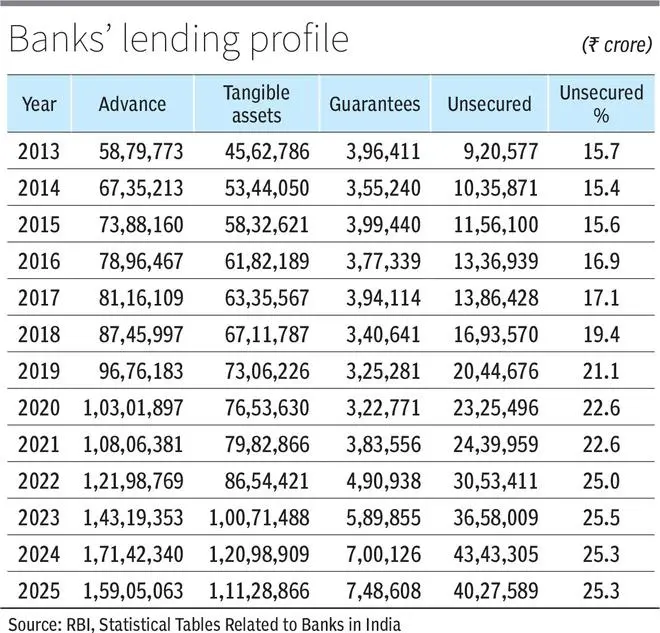
Once banks lose confidence in collateral recovery, they tighten lending, not because borrowers are weaker, but because security becomes unreliable. Unsecured advances rose from 15.7 per cent in 2013 to 25.3 per cent in 2025, lowering recovery rates and thereby increasing ECL provisioning pressure. Now the question remains: will this potential increase in provisioning trigger credit rationing?

When banks demand collateral to reduce unsecured exposure, borrower behaviour creates a natural self-selection. Safe borrowers, confident of repayment, are willing to pledge assets, while riskier borrowers avoid collateral because they expect a higher chance of default. Under ECL, this sorting becomes sharper. Since banks must account for LGD from day one, unsecured loans carry a much higher immediate provisioning burden. As a result, banks may simply avoid offering unsecured credit altogether.

In credit markets, when demand exceeds supply, interest increase fails to clear the market, due to the Stiglitz-Weiss Theory. Under this, if a bank tries to “price in the risk” of an unsecured loan by charging a 20 per cent interest rate, the “safe” borrowers who have low-margin, low-risk projects leave the market because the cost eats their entire profits. “Risky” borrowers remain because they only plan to pay if their high-stakes project succeeds. The bank knows that it is left with a Akerlof’s “lemon” pool of borrowers. To avoid this, the bank keeps interest rates lower than the market-clearing level and simply refuses to lend to everyone who wants money i.e., rationing. Banks stop lending to anyone who does not have “excessive” collateral. Raising interest rates worsens borrower quality, so banks manage risk by restricting access to credit rather than increasing prices — this is credit rationing.

Risky borrowers also affect the Probability of Default component of ECL. As Stiglitz and Weiss argued, beyond a point, higher interest rates attract mainly high-risk borrowers, making price a weak risk-control tool. Under ECL, loans to such borrowers trigger higher projected PD, especially during economic slowdowns. The resulting provisioning burden may exceed what banks can recover through higher interest income. This may push banks to tighten credit standards rather than simply raising interest rates as price increase hurts quality.

Probability of default

The real shift in ECL is moving from “what happened” to “what might happen.” Banks must incorporate macroeconomic variables into PD models. If PD estimates are highly sensitive to interest rates or sector stress, even a small shock can push loans from Stage 1, requiring only short-term provisioning, to Stage 2, where lifetime expected losses must be recognised. To avoid this jump, banks may stop lending to sectors showing early signs of weakness.

While ECL may push banks towards safer, collateral-backed lending, it also raises a deeper question: should access to credit depend on true repayment capacity or simply on asset ownership? ECL creates a forward-looking system that prices risk more transparently and reduces the chance of sudden systemic shocks. However, ECL risks exclusion of capable but asset-light borrowers, while favouring weaker borrowers with strong collateral.

A promising entrepreneur without property may be denied credit, while a mediocre borrower with real estate gets funded. The risk of credit rationing is real, but ECL is not a threat to growth by itself. Its success will depend on how well banks use data and how effectively RBI’s five-year transition period helps balance prudence with credit access.

Bhusan is Professor of Practice at TAPMI Bengaluru, Basu is Professor at IIM Bangalore, and Jeet is PhD Scholar at IIM Ranchi

Published on May 1, 2026