明安图数,又称卡塔兰数,英文名\(Catalan\) \(number\),是组合数学中一个常出现于各种计数问题中的数列。以中国蒙古族数学家明安图 \((1692-1763)\)和比利时的数学家欧仁·查理·卡塔兰 \((1814–1894)\)的名字来命名,其前几项为(从第零项开始) : \(1, 1, 2, 5, 14, 42, 132, 429, 1430, 4862,16796, 58786 …\)
https://zhuanlan.zhihu.com/p/31317307
https://zhuanlan.zhihu.com/p/31526354
https://zhuanlan.zhihu.com/p/31585260
https://zhuanlan.zhihu.com/p/31050581
简单来说,卡特兰数就是一个有规律的数列,在坐标图中可以表示为:从原点\((0,0)\)出发,每次向\(x\)轴或者\(y\)轴正方向移动\(1\)个单位,直到到达\((n,n)\)点,且在移动过程中不越过第一象限平分线的移动方案总数。
我们暂且先不考虑移动过程中不越过第一象限平分线这个约束条件,那么从\((0,0)\)点到\((n,n)\)点的过程中,我们总共需要向右移动\(n\)步,向上移动\(n\)步,一共\(2n\)步。我们可以理解为在\(2n\)步里面选出\(n\)步来向上移动,那么剩下的\(n\)步就是向右移动的步数,那么方案总数就是\(\LARGE \displaystyle C_{2n}^{n}\)
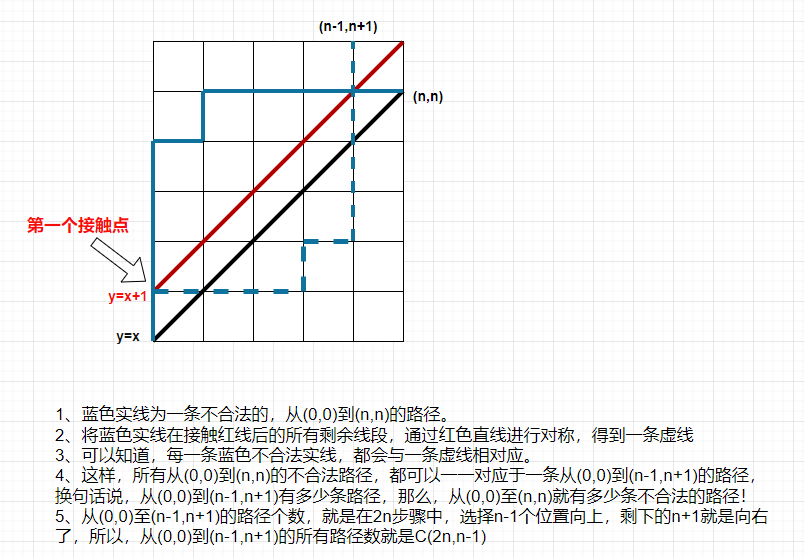
现在,我们来看看如何解决不越过第一象限平分线这个问题。仔细想想,不越过第一象限平分线也就等价于不触碰到\(y = x + 1\)这条直线。而我们如果把触碰到了直线\(y = x + 1\)的路线的第一个与\(y = x + 1\)的触碰点之后的路线关于直线\(y = x + 1\)对称,并画出对称后的路线
黄海解读
我们会发现触碰到了直线\(y = x + 1\)的路径的终点都变成了点\((n-1,n+1)\)。也就是说,从\((0,0)\)点到\((n,n)\)点的路线当中触碰了直线\(y = x + 1\)的路线条数与从\((0,0)\)点到\((n-1,n+1)\)点的路线条数的数量是相等的。于是从\((0,0)\)点到\((n,n)\)点的非法路径条数为\(\LARGE \displaystyle C_{2n}^{n-1}\) 。
综上所述,从\((0,0)\)点到\((n,n)\)点满足条件的路径数为
$$\huge f(n)=C_{2n}{n}-C_{2n}$$
通过化简,公式可以简化为:
\[\large Catalan_n= C_{2n}^{n}-C_{2n}^{n-1}=\frac{(2n)!}{n! \times n!}-\frac{(2n)!}{(n+1)!\times (n-1)!} \\ =\frac{(2n)!\times (n+1)}{n!\times (n+1)!}-\frac{(2n)!\times n}{n! \times (n+1)!} \\ =\frac{(2n)!\times (n+1)-(2n)!\times n}{n!\times (n+1)!} \\ =\frac{(2n)!}{n!\times (n+1)!}=\frac{1}{n+1}\times \frac{(2n)!}{n!\times n!} =\frac{C_{2n}^n}{n+1} \]
$$\huge \displaystyle f(n)=\frac{C_{2n}^n}{n+1} $$
除了这个通项公式之外,卡特兰数还有一个由该通项公式推导而来的递推公式:
\(\large \displaystyle Catalan_{n+1}= \frac{1}{n+2}C_{2n+2}^{n+1} \\ =\frac{1}{n+2}\times \frac{(2n+2)!}{(n+1)!\times (n+1)!} \\ =\frac{1}{n+2}\times \frac{(2n)!\times (2n+1) \times (2n+2)}{n! \times n!\times (n+1)^2} \\ =\frac{1}{n+2}\times \frac{(2n+1)\times(2n+2)}{n+1} \times \frac{1}{n+1} \times \frac{(2n)!}{n!\times n!} \\ =\frac{2(2n+1)}{n+2}\times \frac{1}{n+1}\times C_{2n}^n \\ =\frac{4n+2}{n+2}Catalan_n \)
初始值:f[0] = f[1] = 1
$$\huge f(n)=\frac{4n-2}{n+1}f(n-1) $$
$$ \huge f(n)=\frac{(2n)!}{(n+1)! \times n!} $$
$$\huge \displaystyle f(n)=\sum_{i=0}^{n-1}f(i)f(n-i-1) $$
证明:在\(n\)对括号的排列中,假设最后一个括号和第\(i\)个左括号匹配。则在第\(i\)个左括号之前,一定已经匹配上了(\(i-1\))对左括号。如下图,因此,此种情况的数量为\(f(i-1)*f(n-i)\)。(\(1<=i<=n\))最后一个右括号可以\(1\sim n\)个左括号匹配共\(n\)种情况。
因此,对\(i\)从\(1\)到\(n\)的情况求和得到\(\large \displaystyle f(n)=\sum_{i=0}^{n-1}f(i)f(n-i-1)\),即可得到递推公式。
设栈\(S\)的初始状态为空,元素\(a,b,c,d,e\)依次入栈,以下出栈序列有多少种可能性?注意:这个序列顺序是定的.
重点:归纳法思考,由大及小。
我们这样去想,假设最终的出栈序列可能性用\(f(n)\)表示,其中\(n\)就是元素的个数。
假设第\(k\)个数是最后出栈的数,那么:
现在,\(k\)将原来的问题,划分为两个子问题\(f(n-k)\)和\(f(k-1)\),根据乘法原理,结果就是\(f(n-k)*f(k-1)\)。
\(k\)的取值范围是\(1 \leq k \leq n\),再根据加法原理:
\[\large f(n)=\sum_{k=1}^{n}f(n-k)\times f(k-1) \]
展开写就是:$$\large f(n)=f(0) \times f(n-1) + f(1) \times f(n-2) + ... +f(n-1)\times f(0)$$
代码实现:
f[0] = 1;
for (int i = 1; i <= 12; i++) {
    int fi = 0;
    for (int j = 0; j <= i - 1; j++) fi += f[j] * f[i - j - 1];
    cout << fi << " ";
}
#include <bits/stdc++.h>

using namespace std;
typedef long long LL;
const int N = 20;
int f[N];
int main() {
    int n;
    cin >> n;
    f[0] = 1;
    for (int i = 1; i <= n; i++)
        for (int j = 1; j <= i; j++)
            f[i] += f[j - 1] * f[i - j];
    cout << f[n] << endl;
    return 0;
}
变种(排队问题):出栈入栈问题有许多的变种,比如\(n\)个人拿\(5\)元、\(n\)个人拿\(10\)元买物品,物品\(5\)元,老板没零钱。问有几种排队方式。熟悉栈的同学很容易就能把这个问题转换为栈。值得注意的是,由于每个拿\(5\)元的人排队的次序不是固定的,所以最后求得的答案要\(n!\)。拿\(10\)元的人同理,所以还要\(n!\)。所以这种变种的最后答案为\(h(n)*n!\)。
P1754 球迷购票问题
#include <bits/stdc++.h>

using namespace std;
typedef long long LL;
const int N = 30;
LL f[N];
int main() {
    int n;
    cin >> n;
    f[0] = 1;
    for (int i = 1; i <= n; i++)
        for (int j = 1; j <= i; j++)
            f[i] += f[j - 1] * f[i - j];
    cout << f[n] << endl;
    return 0;
}
有\(n\)个结点,问总共能构成几种不同的二叉树。
我们可以假设,如果采用中序遍历的话,根结点第\(k\)个被访问到,则根结点的左子树有\(k-1\)个点、根结点的右指数有\(n-k\)个点。\(k\)的取值范围为\(1\)到\(n\)。讲到这里就很明显看得出是卡特兰数了。
AcWing 1645. 不同的二叉搜索树
没有超过\(long\) \(long\)的存储范围的话,可以使用递推;
#include <bits/stdc++.h>

using namespace std;
typedef long long LL;
const int N = 1010, MOD = 1e9 + 7;

int n;
int f[N];

int main() {
    cin >> n;

    f[0] = 1;
    for (int i = 1; i <= n; i++)
        for (int j = 1; j <= i; j++)
            f[i] = (f[i] + (LL)f[j - 1] * f[i - j]) % MOD;

    cout << f[n] << endl;
    return 0;
}
AcWing 1317. 树屋阶梯
模拟,按照公式(1)进行模拟,需要使用高精度
黄海的题解
#include <bits/stdc++.h>
using namespace std;

const int N = 10010; // 5000*2+10
int primes[N], cnt;
bool st[N];
int a[N], b[N];

void get_primes(int n) {
    for (int i = 2; i <= n; i++) {
        if (!st[i]) primes[cnt++] = i;
        for (int j = 0; primes[j] * i <= n; j++) {
            st[i * primes[j]] = true;
            if (i % primes[j] == 0) break;
        }
    }
}

int get(int n, int p) { // n!中p的次数
    int s = 0;
    while (n) n /= p, s += n;
    return s;
}

void mul(int a[], int b, int &len) {
    int t = 0;
    for (int i = 1; i <= len; i++) {
        t += a[i] * b;
        a[i] = t % 10;
        t /= 10;
    }
    while (t) {
        a[++len] = t % 10;
        t /= 10;
    }
    //去前导0
    while (len > 1 && !a[len]) len--;
}

int C(int a, int b, int c[]) {
    int len = 1;
    c[1] = 1;
    for (int i = 0; i < cnt; i++) {
        int p = primes[i];
        int s = get(a, p) - get(b, p) - get(a - b, p);
        while (s--) mul(c, p, len);
    }
    return len;
}

void sub(int a[], int b[], int &len) {
    int t = 0;
    for (int i = 1; i <= len; i++) {
        t = a[i] - b[i] - t;
        a[i] = (t + 10) % 10;
        t < 0 ? t = 1 : t = 0;
    }
    while (len > 1 && !a[len]) len--;
}

int main() {
    //加快读入
    ios::sync_with_stdio(false);
    cin.tie(0);
    cout.tie(0);

    get_primes(N - 10);

    int n;
    cin >> n;
    int a1 = C(n + n, n, a);
    int b1 = C(n + n, n - 1, b); // bl下面没有用到,原因是两数相减,我们知道a>b,按着a的长度来就行了

    sub(a, b, a1);

    for (int i = a1; i >= 1; i--) printf("%d", a[i]);
    return 0;
}
给出一个\(n\),要求一个长度为\(2n\)的\(01\)序列,使得序列的任意前缀中\(1\)的个数不少于\(0\)的个数,有多少个不同的\(01\)序列?
以下为长度为\(6\)的序列:
111000 101100 101010 110010 110100
类比一下括号问题,此题就是一个祼的卡特兰数问题。
\(n\)个\(+1\)和\(n\)个\(-1\)构成的\(2n\)项 \(a_1,a_2,···,a_{2n}\) ,其部分和满足非负性质,即\(a_1+a_2+···+a_k>=0,(k=1,2,···,2n)\) ,有多少个不同的此序列?
此典例解析与\(01\)序列解析一模一样,即此数列的个数等于第\(n\)个\(Catalan\)数,此处就不再赘述。
在一个\(n\)边形中,通过不相交于\(n\)边形内部的对角线,把\(n\)边形拆分为若干个三角形,问有多少种拆分方案?
如五边形有如下\(5\)种拆分方案:
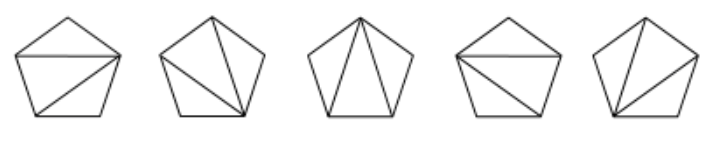
如六边形有如下14种拆分方案:

结论:对凸\(n\)边形进行不同的三角形分割(只连接顶点对形成\(n\)个三角形)数为\(h[n-2]\)
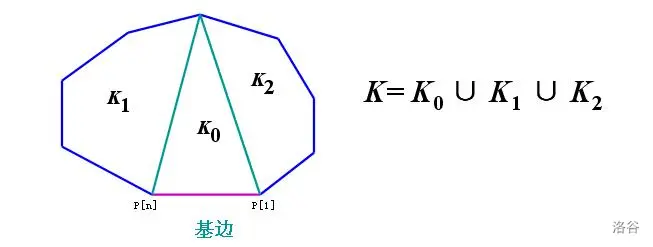
这也是非常经典的一道题。我们可以这样来看,选择一个 基边 ,显然这是多边形划分完之后某个三角形的一条边。图中我们假设基边是\(p_1,p_n\),我们就可以用 \(p_1,p_n\) 和另外一个点假设为\(p_i\)做一个三角形,并将多边形分成三部分(要是\(i\)与\(1,n\)挨着的话,就是两部分),除了中间的三角形之外,一边是\(i\)边形,另一边是\(n−i+1\)边形。\(i\)的取值范围是\(2\)到\(n−1\)。所以本题的解
\[\large c(n)=c(2)*c(n−1)+c(3)*c(n−2)+...c(n−1)*c(2) \]
令\(f(i)=c(i+2)\)则
\[\large f(i)=f(0)f(i−1)+f(1)f(i−2)...+f(i−1)f(0) \]
很明显,这就是一个卡特兰数了。
#include <bits/stdc++.h>

using namespace std;
const int N = 10;

// 学习视频
// https://www.bilibili.com/video/BV1nE411A7ST
int g[N];

// 递归
int f(int n) {
    if (n == 0 || n == 1) return 1;
    int sum = 0;
    // f(0)*f(n-1)+f(1)*f(n-2)+....+f(n-1)*f(0)
    for (int i = 0; i < n; i++)
        sum += f(i) * f(n - 1 - i);
    return sum;
}
int main() {
    // 1、递推法
    g[0] = g[1] = 1;
    for (int i = 2; i < N; i++)
        for (int j = 0; j < i; j++)
            g[i] += g[j] * g[i - j - 1]; // 考虑思路:画括号法

    for (int i = 0; i < N; i++)
        cout << g[i] << endl;

    // 2 、递归法
    for (int i = 0; i < N; i++)
        cout << f(i) << endl;
    return 0;
}
此内容由惯性聚合(RSS阅读器)自动聚合整理,仅供阅读参考。 原文来自 — 版权归原作者所有。