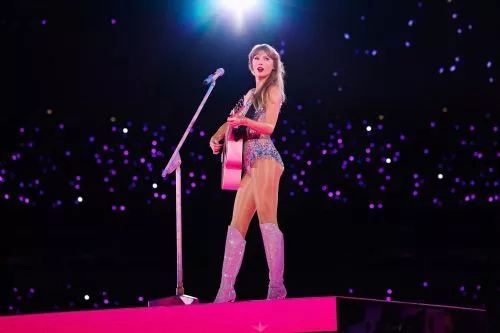
On April 24, Taylor Swift filed three trademark applications for her voice and appearance to protect her from “threats posed by AI,” wrote Josh Gerben, Swift’s attorney. Through these applications, she became the second celebrity to use trademark laws to prevent AI misuse, after “Interstellar” actor Matthew McConaughey, who had his voice and image trademarked in January 2026 for the same reasons: unauthorized use of his identity and personality.
What is Taylor Swift trademarking?

Here are the audio clips she submitted for trademark registration: [Audio-1] and [Audio-2]
What is the current status? TAS (Taylor Alison Swift) Rights Management filed the trademark applications on April 24; they have been recorded but not yet assigned to an examiner, according to Justia Trademarks.
Would trademarking two phrases protect the whole voice? Yes, says her attorney. “So locking up phrases like ‘Hey, it’s Taylor Swift’ and ‘Hey, it’s Taylor’ isn’t just about those phrases. It’s about the voice itself. If anyone creates anything using that voice via AI, Taylor and her legal team could argue it violates her trademark rights,” reads the blog post. It also referred to already trademarked sounds like Netflix’s tu-dum or NBC’s Chimes.
Trademarking is an additional layer of protection for publicity rights: “The filings arrive as AI-generated content continues to create problems in the entertainment industry. Musicians and actors have increasingly found their voices and images used in unauthorized videos, songs, and digital content that is created by AI and circulated online,” reads the blog post. It also said that this mechanism is an “additional layer of protection.”
Advantages of trademark laws over copyright and publicity rights: Swift’s attorney explained the advantages of trademark law:
The ambiguities of trademark laws in the AI age: “But it remains to be seen if the filings will work as intended. A Federal Court will need a case to stress-test the legal theories behind the filings. That said, the legal theories behind the filings are strong. And I look forward to the blockbuster case when Swift sues the AI platforms,” he said.
What did Matthew McConaughey trademark? According to the Wall Street Journal, some of them are:
“We want to create a clear perimeter around ownership with consent and attribution the norm in an AI world,” he reportedly said to the Wall Street Journal when the news broke out in January 2026. You can access his trademark registrations on the US Patent and Trademark Office website. Some of them identified by website ChatGPTisEatingtheWorld are: [7995851 |7931810 |7893248 |7995959 |5373751].
Whose voice is protected in India? Although trademark laws are not widely used in India to prevent AI misuse of voice, image or likeness, several celebrities have gone to the courts to protect their likeness, including their voices, using the doctrine of personality rights, which is not codified as statutory law in India. Some of the instances, particularly related to voice, are:
AR Rahman on paying royalties for using AI voices of late singers: “It was an experiment. I would say it’s like 70% successful, but I wanted to do it legitimately. I wanted to take the permission of the folks, you know, the wife and the family, of both the families, Shahul Amid and Bama Bakia. And it also becomes a means of sustenance for them. In future, people will use that stuff. They ask permission, ‘Is it okay with you?’ And then we pay them. I felt my conscience is clear,” said AR Rahman while speaking to the BBC. [Transcipt | Video]
Also Read:
For You
此内容由惯性聚合(RSS阅读器)自动聚合整理,仅供阅读参考。 原文来自 — 版权归原作者所有。