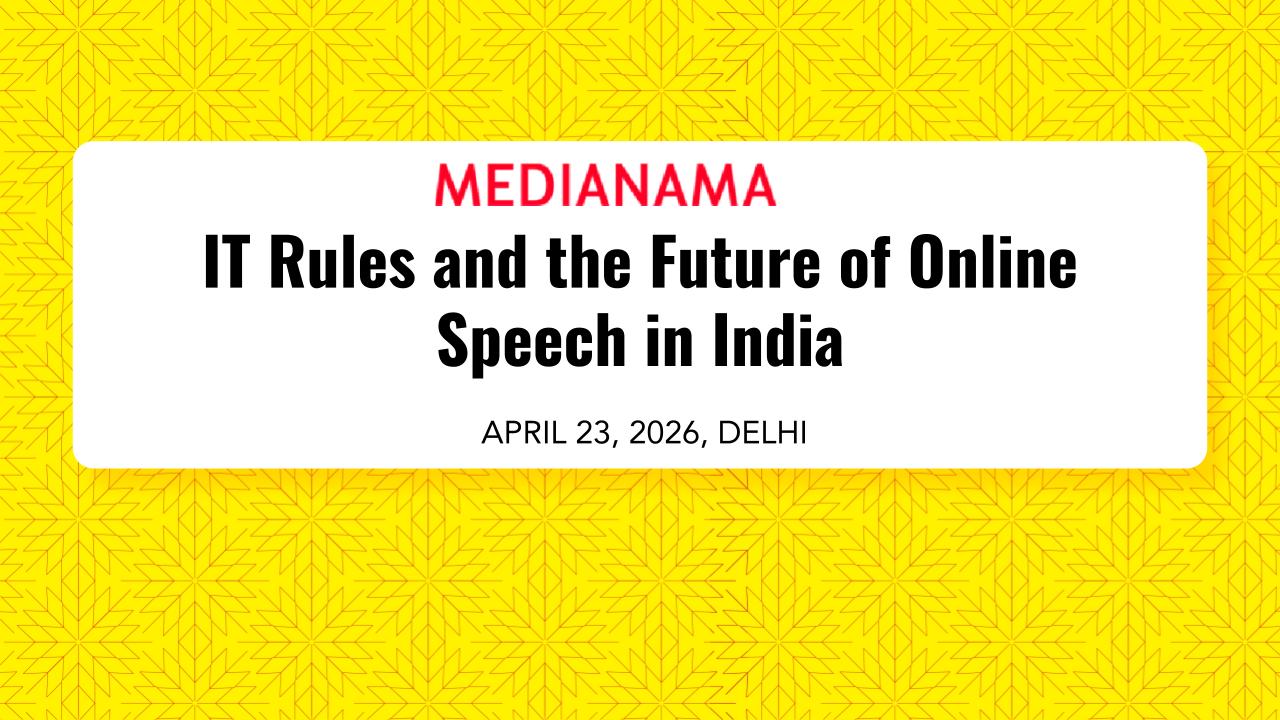
MediaNama invites you to attend our hybrid discussion on ‘IT Rules and the Future of Online Speech in India’ on 23 April 2026 on the recent draft amendments to IT Rules.
- Date: Thursday, 23 April 2026
- Time: 12:30 PM to 5 PM
- Format: Hybrid Event – In-Person and Virtual (Via Zoom)
- Venue: Gulmohar Hall, India Habitat Centre, Delhi
Register here (for in-person attendance) | Zoom link (for virtual participation)
Note: The Zoom link is intended for outstation participants only. If you are based in Delhi, please register for in-person attendance.
Objectives of the discussion:
- Examine what the latest draft amendments to the IT Rules actually entail, and why the government’s characterisation of them as “clarificatory and procedural in nature” does not reflect their true scope and impact.
- Discuss how the draft IT Rules can transform safe harbour protections into a perpetually renewable obligation tied to an evolving set of executive orders, clarifications, and advisories, and how this compliance burden incentivises platforms to over-remove content and self-censor.
- Analyze the impact of the expansion of Ministry of Information and Broadcasting’s (MIB) oversight to user-generated news and current affairs content, and what it means for every individual who posts, shares, or comments on such content online.
- Assess the constitutional concerns already raised by the Bombay and Madras High Courts regarding the Inter-Departmental Committee (IDC).
- Enable a multi-stakeholder dialogue among platforms, legal and policy professionals, civil society, regulators, news organisations, and researchers to outline a more effective and rights-protective approach to intermediary governance in India.
- Document key insights to help policymakers and lawmakers design the forthcoming Digital India Act.
On 30 March 2026, the Ministry of Electronics and Information Technology (MeitY) published draft amendments to the Information Technology (Intermediary Guidelines and Digital Media Ethics Code) Rules, 2021, (IT Rules) with an extended public consultation window closing on 29 April 2026. The government has characterised these changes as “clarificatory and procedural in nature,” aimed at improving legal certainty and the enforceability of ministry directions. However, the amendments go far beyond being merely procedural.
- The proposed Rule 3(4) in draft IT rules can transform a relatively bounded liability protection into a perpetually renewable obligation tied to an evolving and unpredictable set of executive orders, clarifications, FAQs etc., leading to structural over-compliance and pre-emptive content removal.
- The Rule 8(1) extends Code of Ethics framework to all user-generated news and current affairs content, bringing every individual who posts, shares, or comments on news-related content within the same oversight regime, which was previously reserved for registered publishers.
- The draft IT Rules formalises the power of MeitY and the MIB to refer “matters” directly to the Inter-Departmental Committee (IDC) without any prior complaint, dismantling the procedural threshold that previously anchored IDC jurisdiction.
- The draft rules also clarify that data retention obligations are cumulative across laws, with no ceiling on duration or scope.
Importantly, in February 2026, when MeitY notified the amendments to IT Rules governing Synthetically Generated Information (SGI), which compressed the takedown window for unlawful content from 36 hours to 3 hours following a government or court order, and to 2 hours for non-consensual intimate imagery flagged by victims.
Taken collectively, these amendments expand the executive’s power to direct what intermediaries must do, while compressing the time they have to do it.
Addressing these concerns, MediaNama is hosting a focused discussion on the 2026 IT Rules amendments, examining what the amendments actually do, what the documented concerns about their design and constitutional status are, and what a more effective and rights-protective approach to intermediary governance in India could look like.
Register here (for in-person attendance) | Zoom link (for virtual participation)
Note: The Zoom link is intended for outstation participants only. If you are based in Delhi, please register for in-person attendance.
Here are 5 reasons why, if you’re in technology/policy, you must consider attending MediaNama discussions:
- Share your point of view and get instant feedback: At MediaNama discussions, you get to share your point of view, instead of being talked to by a panel: over 60% of a MediaNama discussion is interactive and focused on debating issues with the participants in a room full of an audience curated for relevance.
- Meet others working on the same subject: We have dedicated networking time at MediaNama discussions, where you can meet and engage with others working on the same subject, and get a sense of what’s happening behind the scenes.
- Hear a point you hadn’t considered: We curate our participants for a diversity of perspectives, with people working on the same issue, but coming from a different background: hear not just from policy wonks, but also technologists, founders, people working with lawmakers, among others. There’s always another way of looking at something.
- Outcome-focused: At the end of each session, one of the key questions we consider is a wish list: what should change, why, and how?
- Breadth and depth of understanding: At MediaNama, we are focused on providing our readers and attendees with both depth and breadth to understand technology policy. We work hard to determine the probing questions that lend themselves to a deeper understanding of issues, discuss principles, and bring out perspectives that you might not have considered. You can ask questions too. Sometimes the questions are more important than the answer.
Note:
- Registration does not guarantee attendance. In case you fit our mandate for the intended audience, we’ll send you a confirmation before the event.
- Your contact information will never be shared with anyone outside of MediaNama.
Note: MediaNama hosting this discussion with support from Meta, Amazon and Google. Our community partners for this event are Internet Freedom Foundation (IFF), Centre For Communication Governance (CCG) and Digipub.
Also Read:
- Draft IT Rules explained: What MeitY’s draft amendments mean for platform liability, content creators, content takedowns and data retention
- Censorship tracker of March 2026: what the Indian government didn’t want you to see
- Your take: How the public is reacting to MeitY’s latest draft amendments to IT rules?
For You
- Read Reasoned by Nikhil Pahwa: How AI is changing our world
- Sign up for MediaNama's Daily Newsletter to receive regular updates
- Sponsor a MediaNama Event