







Serving tech enthusiasts for over 25 years.
TechSpot means tech analysis and advice you can trust.
In context: Efforts to make carbon capture more practical have long run into the same problem: energy. Pulling CO2 out of emissions streams is technically feasible, but doing it cheaply enough to scale has been far harder. Most systems in use today rely on liquid chemical processes like amine scrubbing. These setups work, but they come with a major drawback. Releasing the captured CO2 requires heating large volumes of liquid to temperatures above 100 °C, which drives up both energy use and cost.
A research team at Chiba University in Japan is taking a different approach, focusing on solid carbon materials that can do the same job with far less heat. Their work centers on a new class of materials called viciazites, designed to control how nitrogen atoms are arranged within a carbon structure.
That level of control turns out to matter. Carbon materials have been studied for CO2 capture before, especially because they're relatively inexpensive and offer large surface areas for adsorption. Adding nitrogen improves their ability to bind CO2, but there has been a persistent issue: traditional methods scatter those nitrogen groups randomly, making it difficult to pin down what actually works best.
The Chiba team, led by Associate Professor Yasuhiro Yamada and Associate Professor Tomonori Ohba, set out to remove that uncertainty. Instead of random placement, they engineered materials where nitrogen atoms sit next to each other in specific configurations. The goal was to directly connect structure with performance.
They produced three variations. One featured adjacent primary amine (-NH2) groups and was created through a multi-step process involving coronene, bromine treatment, and ammonia exposure, achieving 76% selectivity. The other two used different starting materials to produce adjacent pyrrolic nitrogen at 82% selectivity and adjacent pyridinic nitrogen at 60%.
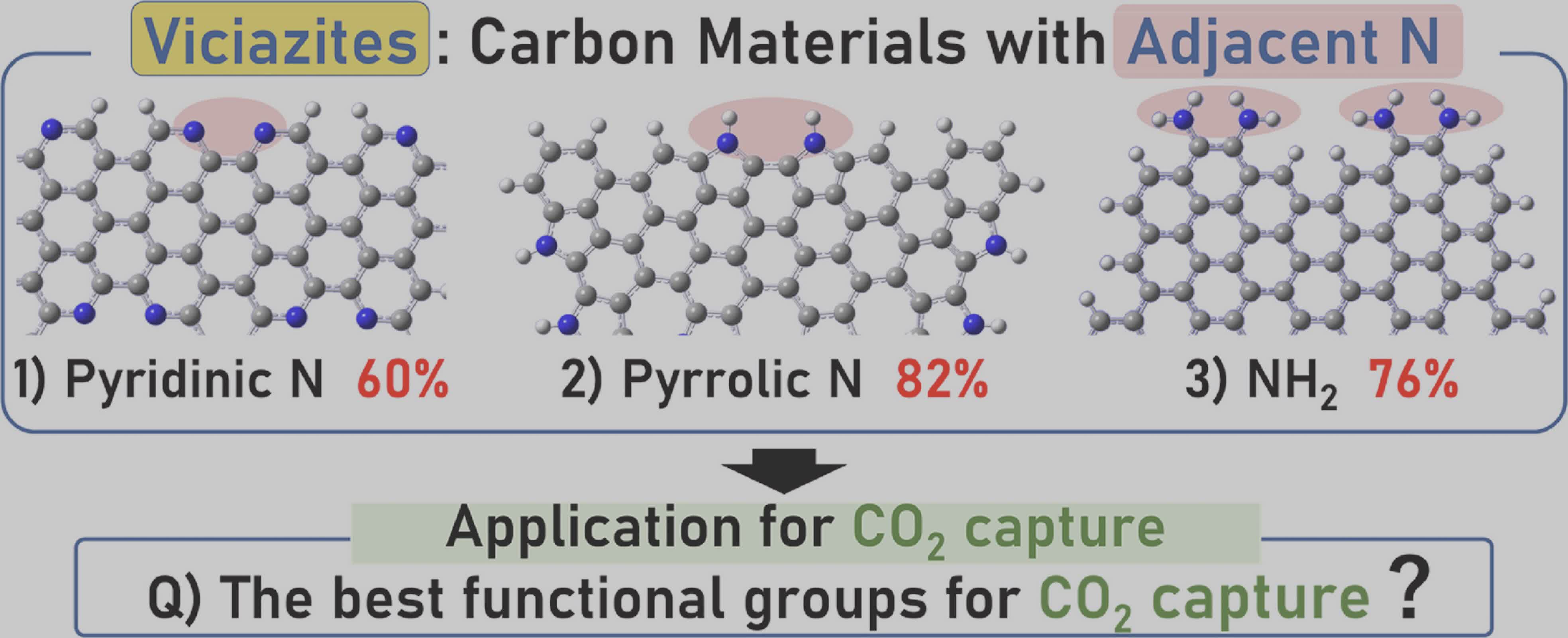
After attaching these materials to activated carbon fibers, the team verified the structures using nuclear magnetic resonance spectroscopy, X-ray photoelectron spectroscopy, and computational modeling. The analysis confirmed that the nitrogen atoms were positioned as intended rather than randomly distributed.
When tested, the differences between the materials became clear. Both the – NH2 and pyrrolic configurations improved CO2 uptake compared to untreated carbon fibers. However, the pyridinic version showed little change.
The bigger distinction showed up during regeneration. For carbon capture systems, how easily CO2 can be released is just as important as how well it's captured. Materials with adjacent -NH2 groups stood out here. "Performance evaluation revealed that in carbon materials where NH2 groups are introduced adjacently, most of the adsorbed CO2 desorbs at temperatures below 60 °C," Dr. Yamada said. "By combining this property with industrial waste heat, it may be possible to achieve efficient CO2 capture processes with substantially reduced operating costs."
That temperature is well below what conventional systems require, which opens the door to using low-grade waste heat already available in many industrial environments.
The pyrrolic version, while requiring more heat to release CO2, may hold up better over time due to stronger chemical stability. That suggests different configurations could be suited to different operating conditions rather than a single one-size-fits-all material.
Beyond the immediate application, the work demonstrates a more precise way to design carbon-based adsorbents. "Our motivation is to contribute to the future society and to utilize our recently developed carbon materials with controlled structures," Dr. Yamada said. "This work provides validated pathways to synthesize designer nitrogen-doped carbon materials, offering the molecular-level control essential for developing next-generation, cost-effective, and advanced CO2 capture technologies."
The researchers also point to potential uses outside carbon capture, including metal ion removal and catalysis, where fine-tuned surface chemistry can play a similar role.
此内容由惯性聚合(RSS阅读器)自动聚合整理,仅供阅读参考。 原文来自 — 版权归原作者所有。