
惯性聚合 高效追踪和阅读你感兴趣的博客、新闻、科技资讯
阅读原文 在惯性聚合中打开

推荐订阅源

freeCodeCamp Programming Tutorials: Python, JavaScript, Git & More
G
Google Developers Blog
Hugging Face - Blog
Hugging Face - Blog
博客园 - 【当耐特】
S
SegmentFault 最新的问题
宝玉的分享
宝玉的分享
博客园 - Franky
博客园_首页
钛媒体:引领未来商业与生活新知
钛媒体:引领未来商业与生活新知
WordPress大学
WordPress大学
有赞技术团队
有赞技术团队
月光博客
月光博客
博客园 - 聂微东
OSCHINA 社区最新新闻
OSCHINA 社区最新新闻
小众软件
小众软件
Microsoft Security Blog
Last Week in AI
Last Week in AI
Vercel News
Vercel News
Cyber Security Advisories - MS-ISAC
爱范儿
爱范儿
J
Java Code Geeks
博客园 - 叶小钗
Engineering at Meta
Engineering at Meta
阮一峰的网络日志
阮一峰的网络日志

TechSpot

Flagship Rematch: Ryzen 7 5800X3D vs. Core i9-12900K Slack chats and internal data from failed startups are finding a second life in AI training A $5 Bluetooth tracker hidden in a postcard exposed a warship's movements Leakers claim PlayStation 6 could offer at least 3x the performance of the PS5 The Mac Mini is no longer a niche product, it's local AI infrastructure IPv6 traffic reaches parity with IPv4 for the first time, Google data shows Xbox expansion cards are now cheaper than SSDs, and PC users are repurposing them Blue Origin prepares to reuse New Glenn booster in bid to challenge SpaceX Nvidia could bring back the 12GB RTX 3060 as supply issues disrupt GPU roadmap What was the first OS you ever used? SNK revives NeoGeo AES with modern upgrades and HDMI support Valve's Proton 11 beta boosts Linux gaming with better performance and classic game support Researchers warn Microsoft Defender vulnerability is already being exploited A four-day Steam freebie turned into $250,000 for an indie game AMD may relaunch Ryzen 7 5800X3D for AM4's 10th anniversary This humanoid robot can almost run as fast as a human sprinter Two New Jersey men jailed for helping North Korean IT workers infiltrate 100+ companies A $7,000 DIY radar project is taking on hardware that usually costs over $100,000 Metro 2039 is going darker than ever, launching this winter on PC and consoles Gemini arrives on macOS with a dedicated desktop app AI infrastructure boom pushes AMD, Intel and Arm to new valuation heights New self-healing material can repair itself over 1,000 times, extend the lifespan of cars and aircraft Japan's bullet train to debut high-tech private cabins, for an added fee Memory card and flash drive pricing surges 120%, with some models spiking 260% Open-source tool decrypts all private data collected by Windows Recall on Copilot PCs The 2026 PC and Console Gaming Report shows most revenue now comes from games outside the Top 20 PureMac is a new open-source macOS cleanup and app removal tool Your Airbnb host might actually be AI Steam might soon display 30-day price history for game deals Intel brings 18A process to budget laptops with new Core Series 3 CPUs
PCIe has doubled bandwidth every generation for two decad...
Daniel Sims · 2026-05-07 · via TechSpot

Serving tech enthusiasts for over 25 years.
TechSpot means tech analysis and advice you can trust.

Looking ahead: Development of the next generation of PCIe connector technology has reached a new milestone. The PCI Special Interest Group (PCI-SIG) has released an updated outline of its plans to continue the upgrade cadence it has maintained for two decades. Although PCIe 8.0 is not scheduled for completion before 2028, it could offer eight times the bandwidth of today's fastest motherboard components.

Manufacturers can now review the 0.5 draft specification for PCIe 8.0. The spec aims to increase bandwidth significantly while reducing power consumption.

PCIe is the technology that connects expansion cards installed on PC motherboards. The constant need for higher bandwidth became apparent when 3D accelerator cards (the predecessors to modern GPUs) became popular. NVMe SSDs also leverage PCIe to achieve higher transfer speeds than older SSDs and hard drives that used SATA cables. Each new PCIe generation typically doubles the available bandwidth for NVMe SSDs.
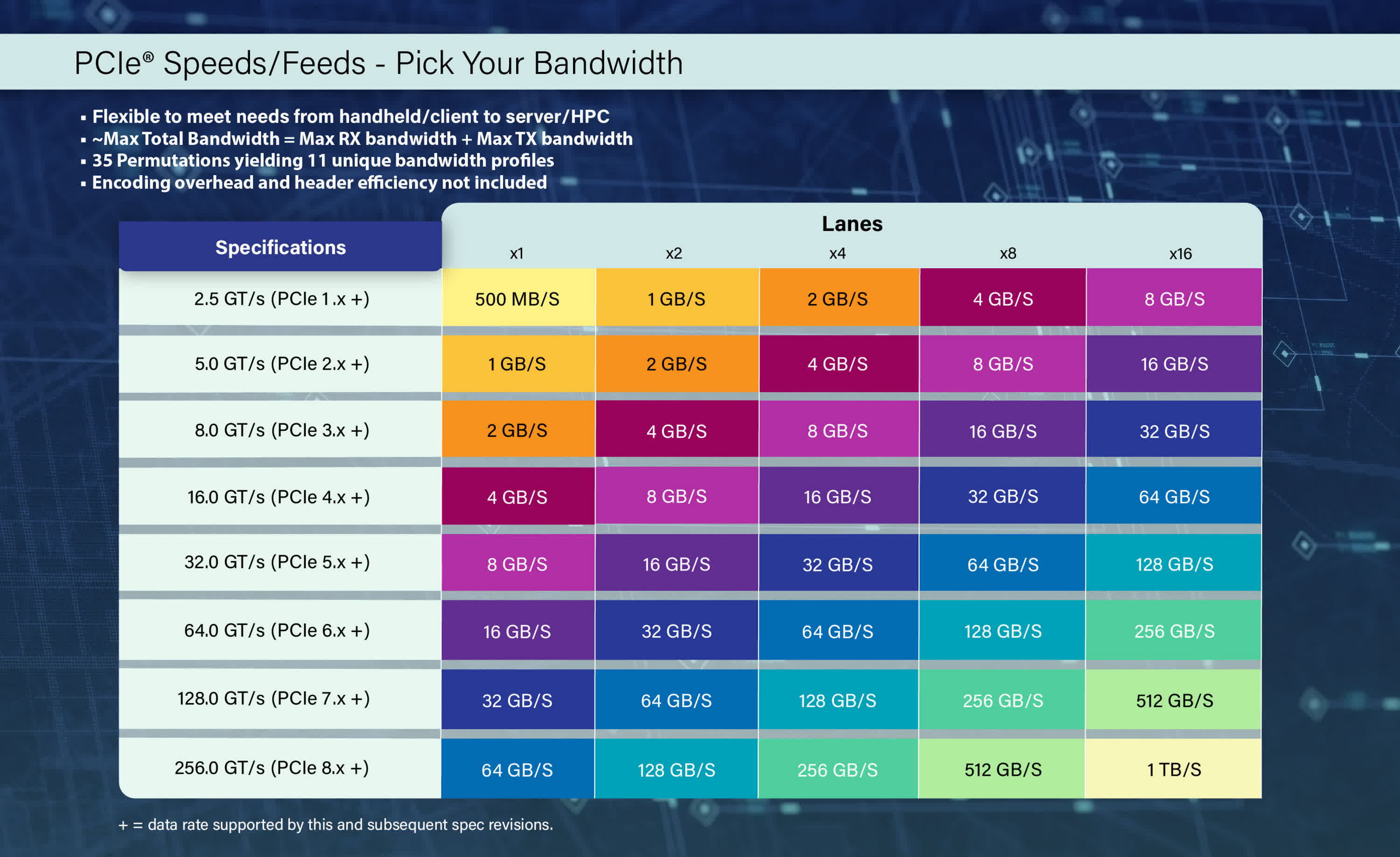
The new specification is the first draft release that outlines all of PCIe 8.0's technical goals. The primary aim is to deliver a raw bitrate of 256 GT/s, enabling 1 TB/s of bidirectional bandwidth while in x16 configuration.

Achieving this goal would keep PCIe on track to double its bandwidth with each generation since PCIe 1.0. The latest PCIe 8.0 draft specification is ahead of schedule, so PCI-SIG remains confident that the final specification will arrive before the end of 2028. It will likely appear first in enterprise applications such as AI, data centers, machine learning, edge computing, aerospace, and automotives.

Must Read: The Inner Workings of PCI Express

For most consumer devices in 2026, PCIe 3.0 (capable of 32 GB/s) and 4.0 (64 GB/s) remain sufficient, with PCIe 5.0 (128 GB/s) representing the cutting edge. While some PCIe 5.0 SSDs can achieve read speeds of around 14 GB/s, Micron recently unveiled an enterprise PCIe 6.0 drive that reaches 28 GB/s. Meanwhile, PCIe 7.0's final specification emerged last year.

Investigating new connector technology is another primary goal for PCIe 8.0. The last few generations have pushed up against the limits of traditional copper cabling, prompting manufacturers to explore fiber-based alternatives. Additional aims include maintaining latency standards, enhancing protocols to increase bandwidth even further, minimizing power consumption, and ensuring backward compatibility with earlier PCIe generations.