
惯性聚合 高效追踪和阅读你感兴趣的博客、新闻、科技资讯
阅读原文 在惯性聚合中打开

推荐订阅源

Last Week in AI
Last Week in AI
有赞技术团队
有赞技术团队
钛媒体:引领未来商业与生活新知
钛媒体:引领未来商业与生活新知
人人都是产品经理
人人都是产品经理
博客园 - 司徒正美
博客园 - 聂微东
OSCHINA 社区最新新闻
OSCHINA 社区最新新闻
博客园 - 叶小钗
罗磊的独立博客
IT之家
IT之家
博客园 - 三生石上(FineUI控件)
V
Visual Studio Blog
T
Tailwind CSS Blog
大猫的无限游戏
大猫的无限游戏
Hugging Face - Blog
Hugging Face - Blog
H
Hackread – Cybersecurity News, Data Breaches, AI and More
N
Netflix TechBlog - Medium
MyScale Blog
MyScale Blog
J
Java Code Geeks
L
LangChain Blog
S
SegmentFault 最新的问题
奇客Solidot–传递最新科技情报
奇客Solidot–传递最新科技情报
Apple Machine Learning Research
G
Google Developers Blog

Latest from Live Science

Naked mole rats wage bloody wars of succession to choose a new queen — but one colony did something scientists… Can the US be trusted with the moon? A law scholar raises concerns after Artemis II Lyrid meteor shower 2026: See spring's first rain of 'shooting stars' peak in moonless skies $3 million prize goes to duo whose research led to first sickle cell CRISPR therapy 700-year-old mummy from Bolivia contains earliest confirmed evidence of strep throat bacteria in the Americas New pain-relief opioid could be much less addictive than morphine, rodent study finds Experimental drug doubles one-year survival in pancreatic cancer Science news this week: Physicists witness faster-than-light darkness pinpricks, humans are still evolving, and some… Archaeologists discover perfectly circular ancient Egyptian temple that may have been used for sacred water rituals Some polar bears are adapting to their melting habitat. Will it be enough to save the iconic species? 2 supermassive black holes may collide 100 years from now ‪—‬ and Earth would feel it Anglo-Saxon burial holds an older sister cradling her little brother after they both died 1,400 years ago, possibly of… Colorado River may have pooled and spilled over to form the Grand Canyon, solving a long-standing mystery ‪—‬… 'We all screamed when it happened': Bright-green fireball meteor caught exploding over famous Viking raid site… Northern lights may be visible from several US states Friday and Saturday as giant hole opens up in sun Hackers used AI to steal hundreds of millions of Mexican government and private citizen records in one of the largest… The first black hole ever discovered is spewing 'dancing jets' at half the speed of light Stephen Hawking's black hole information paradox could be solved — if the universe has 7 dimensions 'Something's missing': Most thorough-ever study of the cosmos proves we still can't explain how the… 'Human evolution didn't slow down; we were just missing the signal': Large DNA study reveals natural selection led to more redheads and less male-pattern baldness Artemis II quiz: Is your knowledge of NASA New study confirms lobsters feel pain, driving scientists to call for a ban on boiling them alive This humanoid robot does all your housework for you ‪—‬ and its makers say it Ancient process that created rare earth elements discovered — and it could help us locate desperately needed deposits Strange mammal ancestor laid huge, leathery eggs —‬ and it was key to surviving the world 73 moon landings? NASA Diagnostic dilemma: A woman heard voices telling her she had a brain tumor ‪—‬ and scans confirmed she did Triassic croc relative from Ghost Ranch, New Mexico finally identified after nearly 80 years in museum basement There were Physicists witness pinpricks of darkness moving faster than the speed of light ‪—‬ without breaking the laws of relativity
Full moon helps paint vibrant, muddy 'brushstrokes' in In...
Harry Baker · 2026-04-28 · via Latest from Live Science
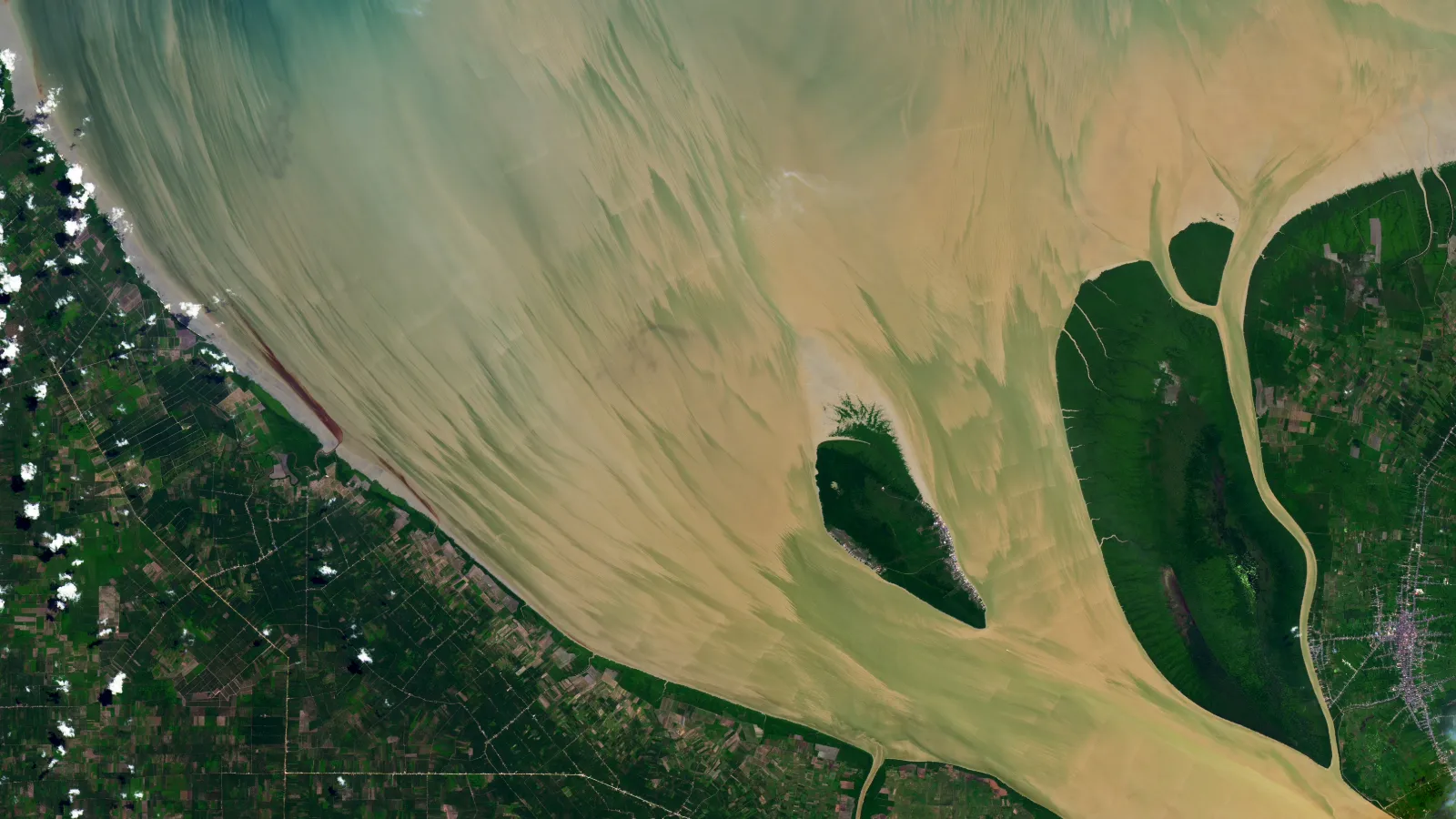
A satellite photo of the mouth of a muddy estuary showing brushstroke-like patterns in the water
Th Landsat 8 satellite spotted a series of "brushstroke-like patterns" in the mouth of the Rokan River, which were painted by an extremely high tide. (Image credit: NASA/Landsat)

QUICK FACTS

Where is it? Rokan River, Sumatra, Indonesia [2.2294556537, 100.62990147]

What's in the photo? Brushstroke-like patterns of sediment painted by a high tide

Which satellite took the photo? Landsat 8

When was it taken? June 23, 2024

This beautiful satellite snap captured a series of "brushstroke-like patterns" that emerged in the mouth of an Indonesian river. The striking striations were triggered by a particularly high tide following a full "Strawberry Moon."

The river runs from the Barisan Mountains in Sumatra's west to the island's north coast, where it drains into the Strait of Malacca. Here, the river morphs into a brackish estuary that flows on each side of Halang Island (photographed).

The Rokan River often has a yellow hue due to high levels of sand and silt in its waters. The sediment gets dragged up from the river's floor, partially due to the constant rising and falling of the tide, according to NASA's Earth Observatory.

In this image, the tide is on its way out, which causes the sediment to be slowly dragged out to sea. When viewed from above, these "brushstroke-like patterns" transform the river into what looks like an abstract painting, Earth Observatory representatives wrote.
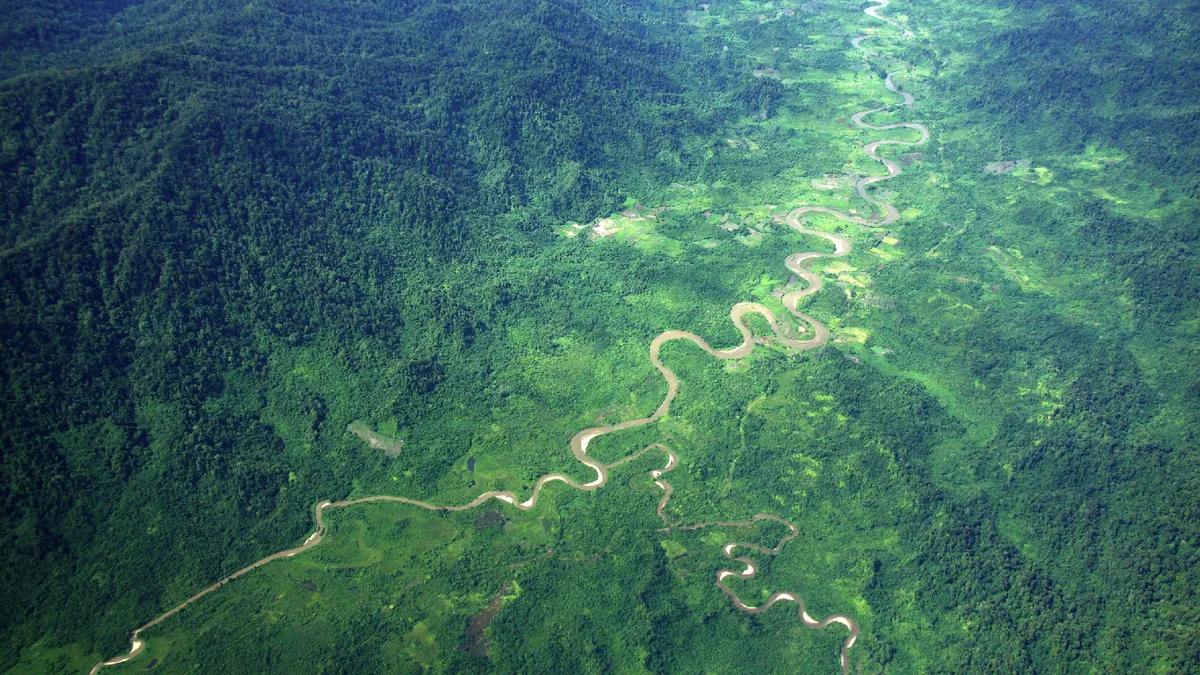
Aerial photo of a river winding through the jungle on Sumatra

The Rokan River stretches for around 220 miles (350 km) through Sumatra's rainforest and experiences a regular "tidal bore." (Image credit: JOKER/Jörg Löffke/ullstein bild via Getty Images)

When the photo was taken, the high tide was at its peak ‪—‬ up to 16 feet (5 meters) higher than low tide. The water was especially high because it was the day after the full "Strawberry Moon" rose in the sky, according to the Earth Observatory. (June's full moon is nicknamed the Strawberry Moon because it coincides with the strawberry harvesting season in the Northern Hemisphere, not because of its color.)

The tidal range is greatest when there is a full moon because the sun and the moon are aligned in a straight line, so they gravitationally push and pull Earth's oceans in sync. This is known as a "spring tide," but it happens throughout the year.

Get the world’s most fascinating discoveries delivered straight to your inbox.

In addition to having a significant tidal range, the Rokan River is home to a regular tidal bore — a powerful surge of water that rushes upstream like a giant wave during high tides. This rare phenomenon occurs only in estuaries with a narrow mouth and a high tidal range.

A 2022 study revealed that the surge is responsible for transporting large amounts of sediment back up the river. If a bore occurred before the satellite photo was taken (which may or may not have happened), it could have stirred up some of the sediment streaks visible in the image.

All of this tidal action can have a significant impact on the estuary itself. A 2016 study compared satellite images of the estuary between 2000 and 2014, and found that the shoreline along the north of Halang Island (which clearly extends beyond the small landmass in the image) is growing at an average rate of 220 feet (67 m) per year.
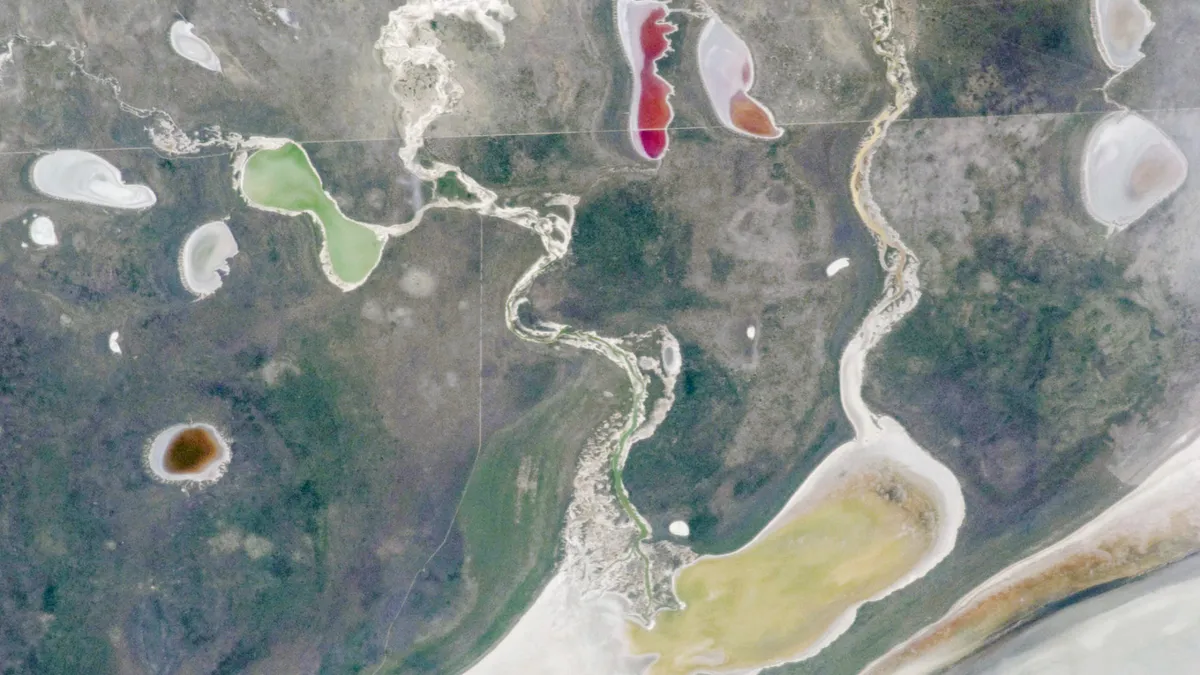

A satellite photo showing a pair of rivers and a series of colorful lakes surrounding a giant white expanse Rainbow-colored phantom lakes

A 2011 astronaut photo shows off a series of colorful mini-lakes that appeared around the edge of a giant Namibian salt flat, known as the Etosha Pan, following a major flooding event.
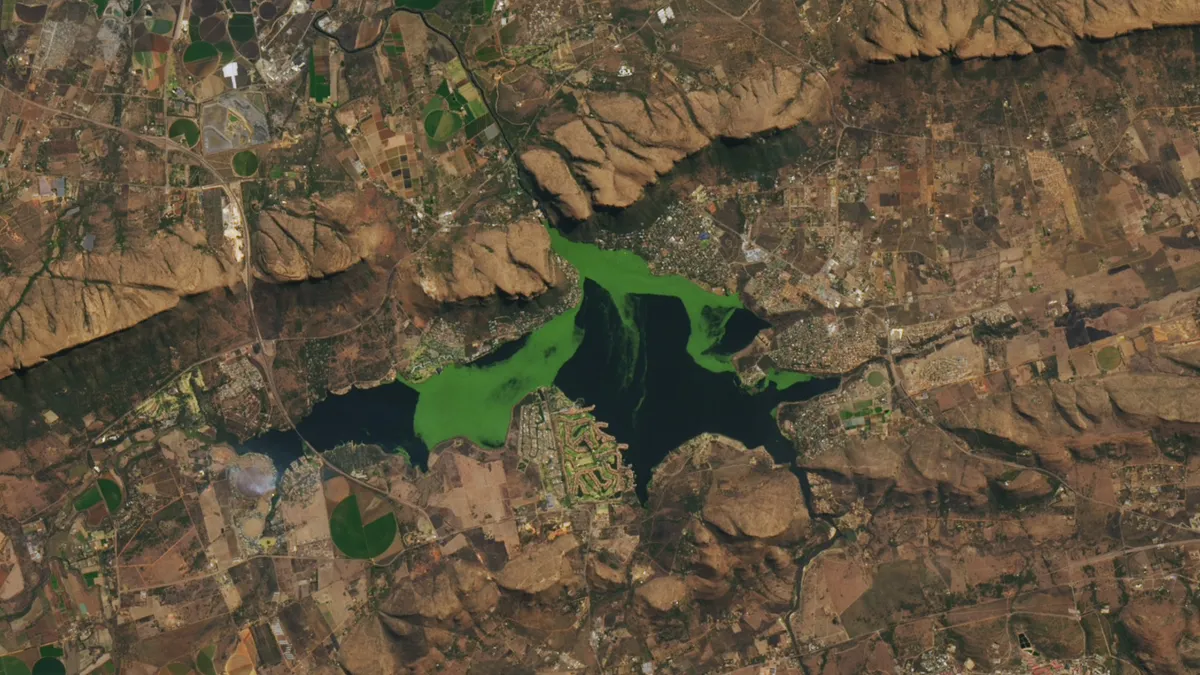
Satellite photo of a large reservoir with bright green masses spreading across its surface Deadly, green sprawling mass

A 2022 satellite photo shows a thick mat of blooming algae and invasive aquatic plants spreading across the surface of the reservoir at South Africa's Hartebeespoort Dam.
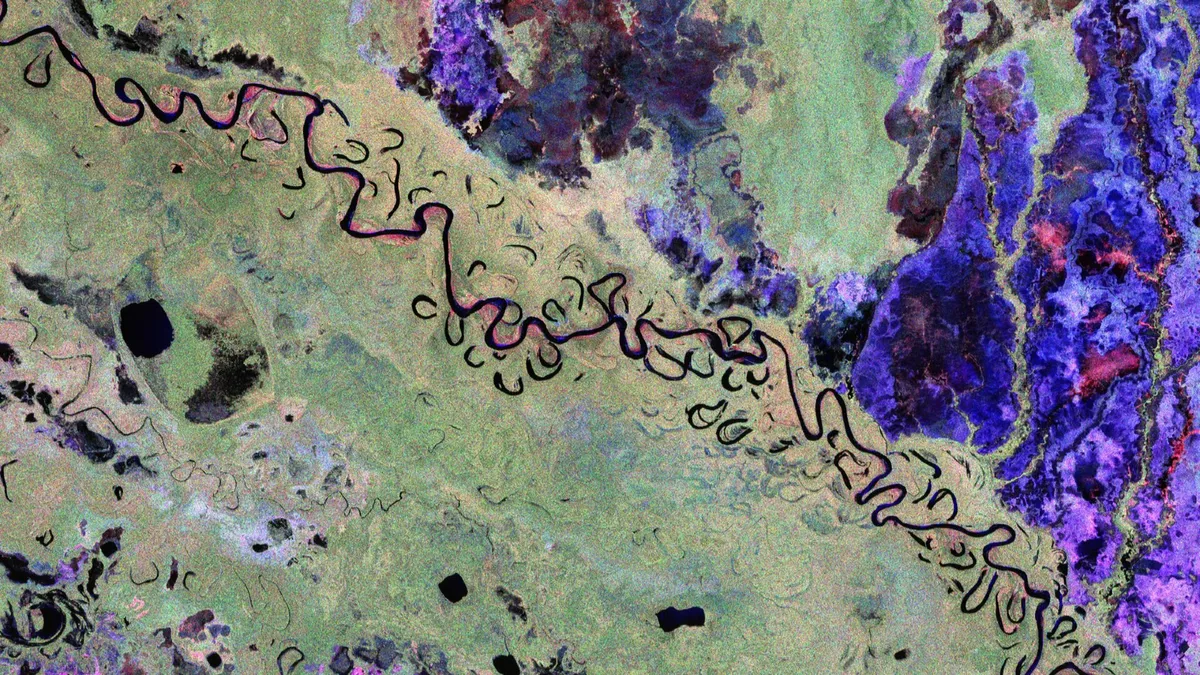
False-color satellite images of Earth taken by ESA's Biomass satellite 1st trippy 'biomass' snap

A 2025 first false-color image from ESA's newly operational Biomass satellite shows off a unique perspective of the rainforests, grasslands and wetlands surrounding a winding river in Bolivia.


Harry is a U.K.-based senior staff writer at Live Science. He studied marine biology at the University of Exeter before training to become a journalist. He covers a wide range of topics including space exploration, planetary science, space weather, climate change, animal behavior and paleontology. His recent work on the solar maximum won "best space submission" at the 2024 Aerospace Media Awards and was shortlisted in the "top scoop" category at the NCTJ Awards for Excellence in 2023. He also writes Live Science's weekly Earth from space series.