


惯性聚合 高效追踪和阅读你感兴趣的博客、新闻、科技资讯
阅读原文 在惯性聚合中打开

推荐订阅源

博客园 - 司徒正美
月光博客
月光博客
奇客Solidot–传递最新科技情报
奇客Solidot–传递最新科技情报
美团技术团队
WordPress大学
WordPress大学
罗磊的独立博客
Last Week in AI
Last Week in AI
人人都是产品经理
人人都是产品经理
爱范儿
爱范儿
MongoDB | Blog
MongoDB | Blog
J
Java Code Geeks
H
Hackread – Cybersecurity News, Data Breaches, AI and More
H
Help Net Security
S
SegmentFault 最新的问题
C
Check Point Blog
酷 壳 – CoolShell
酷 壳 – CoolShell
腾讯CDC
Engineering at Meta
Engineering at Meta
The GitHub Blog
The GitHub Blog
F
Fortinet All Blogs
D
DataBreaches.Net
雷峰网
雷峰网
GbyAI
GbyAI
宝玉的分享
宝玉的分享

Latest from Live Science

Naked mole rats wage bloody wars of succession to choose a new queen — but one colony did something scientists… Can the US be trusted with the moon? A law scholar raises concerns after Artemis II Lyrid meteor shower 2026: See spring's first rain of 'shooting stars' peak in moonless skies $3 million prize goes to duo whose research led to first sickle cell CRISPR therapy 700-year-old mummy from Bolivia contains earliest confirmed evidence of strep throat bacteria in the Americas New pain-relief opioid could be much less addictive than morphine, rodent study finds Experimental drug doubles one-year survival in pancreatic cancer Science news this week: Physicists witness faster-than-light darkness pinpricks, humans are still evolving, and some… Archaeologists discover perfectly circular ancient Egyptian temple that may have been used for sacred water rituals Some polar bears are adapting to their melting habitat. Will it be enough to save the iconic species? 2 supermassive black holes may collide 100 years from now ‪—‬ and Earth would feel it Anglo-Saxon burial holds an older sister cradling her little brother after they both died 1,400 years ago, possibly of… Colorado River may have pooled and spilled over to form the Grand Canyon, solving a long-standing mystery ‪—‬… 'We all screamed when it happened': Bright-green fireball meteor caught exploding over famous Viking raid site… Northern lights may be visible from several US states Friday and Saturday as giant hole opens up in sun Hackers used AI to steal hundreds of millions of Mexican government and private citizen records in one of the largest… The first black hole ever discovered is spewing 'dancing jets' at half the speed of light Stephen Hawking's black hole information paradox could be solved — if the universe has 7 dimensions 'Something's missing': Most thorough-ever study of the cosmos proves we still can't explain how the… 'Human evolution didn't slow down; we were just missing the signal': Large DNA study reveals natural selection led to more redheads and less male-pattern baldness Artemis II quiz: Is your knowledge of NASA New study confirms lobsters feel pain, driving scientists to call for a ban on boiling them alive This humanoid robot does all your housework for you ‪—‬ and its makers say it Ancient process that created rare earth elements discovered — and it could help us locate desperately needed deposits Strange mammal ancestor laid huge, leathery eggs —‬ and it was key to surviving the world 73 moon landings? NASA Diagnostic dilemma: A woman heard voices telling her she had a brain tumor ‪—‬ and scans confirmed she did Triassic croc relative from Ghost Ranch, New Mexico finally identified after nearly 80 years in museum basement There were Physicists witness pinpricks of darkness moving faster than the speed of light ‪—‬ without breaking the laws of relativity
NASA's Curiosity rover finds a surprising number of giant...
Harry Baker · 2026-04-22 · via Latest from Live Science
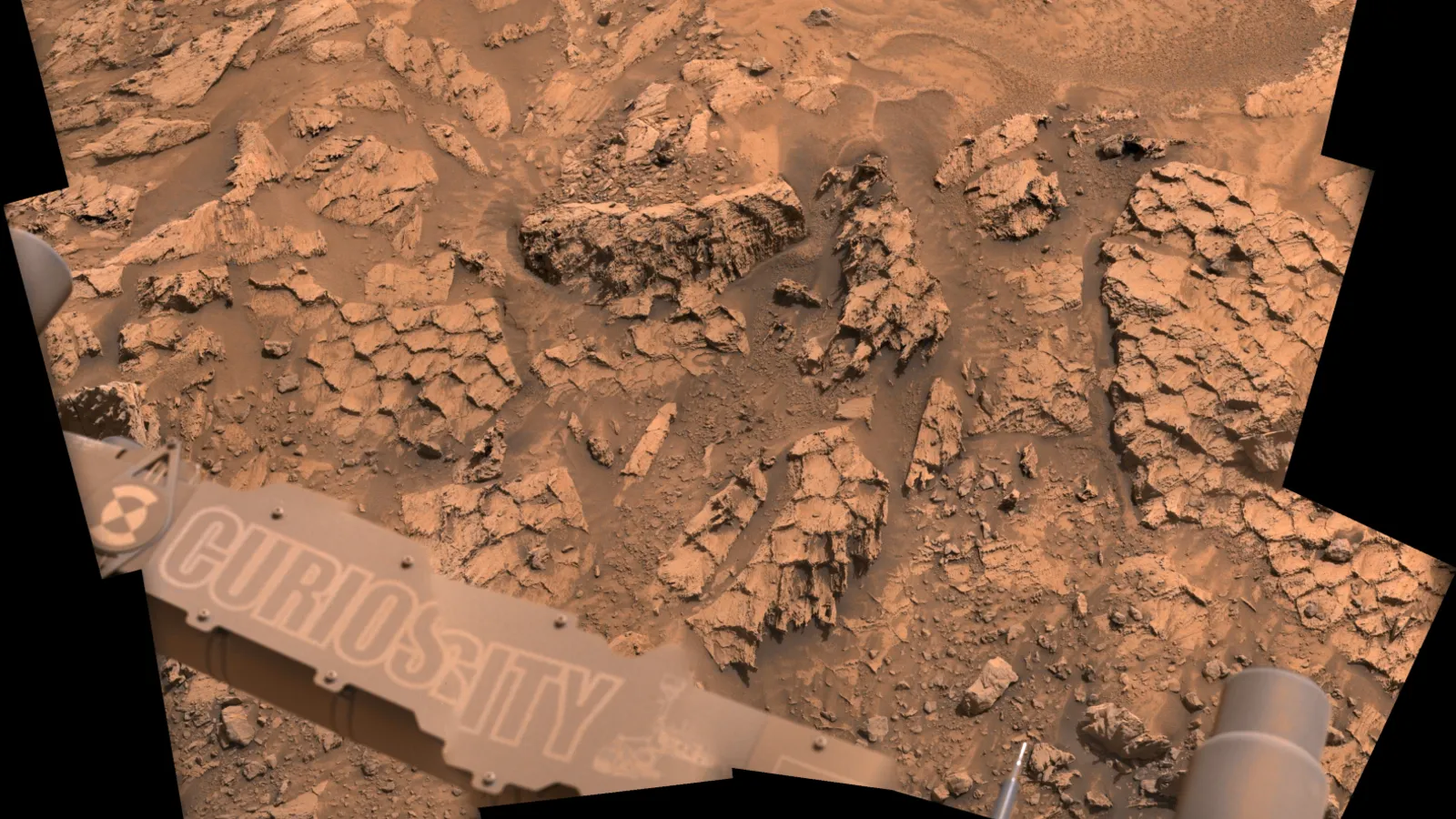
A close-up photo of rocky polygons on Mars that look like giant reptile scales
Dozens of polygon-covered rocks, which look suspiciously like clumps of fossilized "scales" from a monstrously large reptile, surround the surface of Mars near Antofagasta in the Gale crater. (Image credit: NASA/JPL-Caltech/MSSS/Kevin M. Gill)

A section of Mars is covered in a surprising number of features that look like clumps of giant, fossilized reptile scales, new photos reveal. But don't be alarmed ‪—‬ the strange structures did not originate from monstrous aliens. Instead, they may have ties to ancient water.

NASA's Curiosity rover snapped the photos of the peculiar rocks as it was driving toward Antofagasta — a relatively young, 33-foot-wide (10 meters) impact crater located on the slopes of Mount Sharp (also called Aeolis Mons), which stands in the larger Gale crater, near Mars' equator.

A pair of black-and-white photos of the "scales" was released by NASA April 14, while a close-up color image of the rocks was shared online the next day by Kevin M. Gill, a software and spaceflight engineer at NASA's Jet Propulsion Laboratory (JPL) who specializes in image processing. (The pics were captured April 7 and April 13, respectively — also called Sol 4859 and Sol 4865 in Martian time.)

The unusual shape and tight clustering of these rocks have drawn comparisons to the scales of reptiles such as crocodilians, while some commenters joked that the formations look dragon-like.

It is currently unclear how many of the scale-like rocks were photographed or how large they are, but they stretched across the ground "for meters and meters," according to an April 10 NASA blog post.
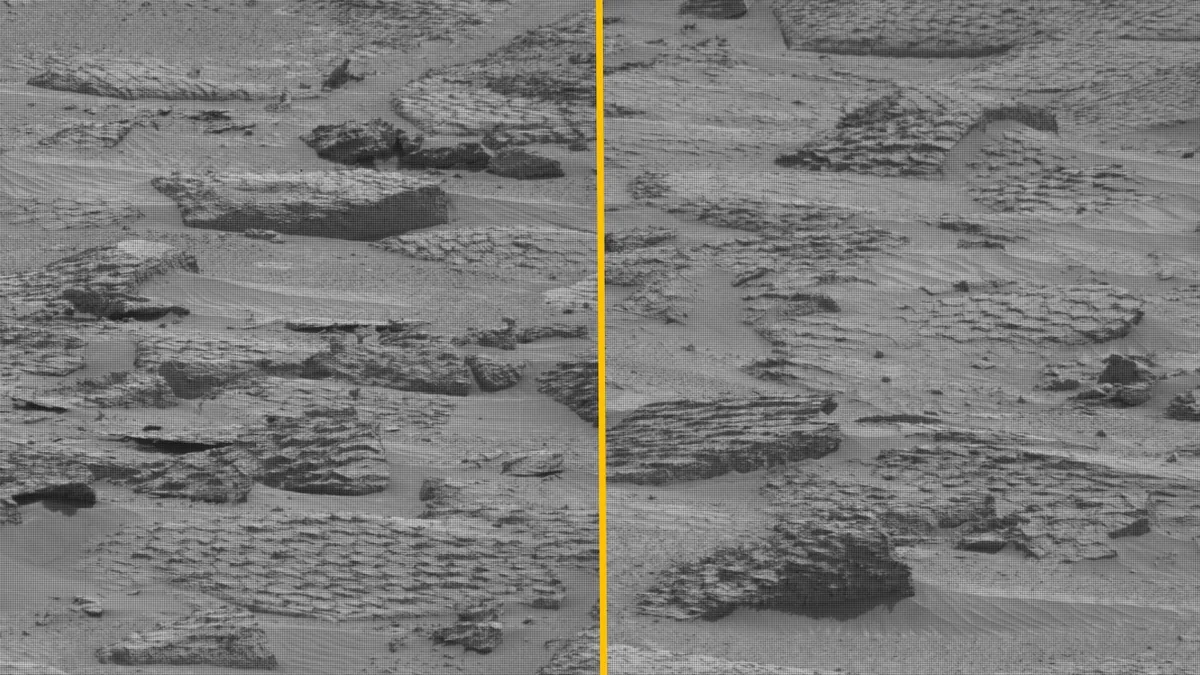
Side-by-side black and white photos of polygon covered rocks on Mars that look like giant reptile scales

Curiosity snapped several photos of the scaly rocks stretching "for meters and meters" as it drove toward Antofagasta. (Image credit: NASA/JPL-Caltech/MSSS)

Although the researchers were not shocked to see these multifaced rocks, or "polygons," they were surprised by the sheer quantity of them in the area.

"Many of the rocks we've driven over have these incredible textures — thousands of honeycomb-shaped polygons crisscross their surface," Abigail Fraeman, a planetary scientist at JPL, wrote in the blog post. "We've seen polygon-patterned rocks like these before, but they didn't seem quite this dramatically abundant."

Get the world’s most fascinating discoveries delivered straight to your inbox.

Polygons with a similar honeycomb-like shape have been seen before on Mars on both smaller and larger scales. In these past instances, the shapes were often tied to the drying of wet mud or ice crystals moving beneath the Martian surface. However, it is too early for scientists to tell exactly how the latest shapes formed.

Curiosity has collected "lots of images and chemical data that will help us distinguish between different hypotheses for how the honeycomb textures formed," Fraeman said.

Animal impostors

Before reaching Antofagasta, Curiosity spent the better part of a year studying a series of rocky ridges on Mount Sharp dubbed "boxwork." These features are also known as Martian "spiderwebs" because of how they zigzag across the ground, and the wandering robot recently spotted tiny, egg-like spheroids stuck to their sides. (The "webs" should not be confused with the infamous "Spiders on Mars," which are dark, arachnid-like features that litter the planet's surface.)
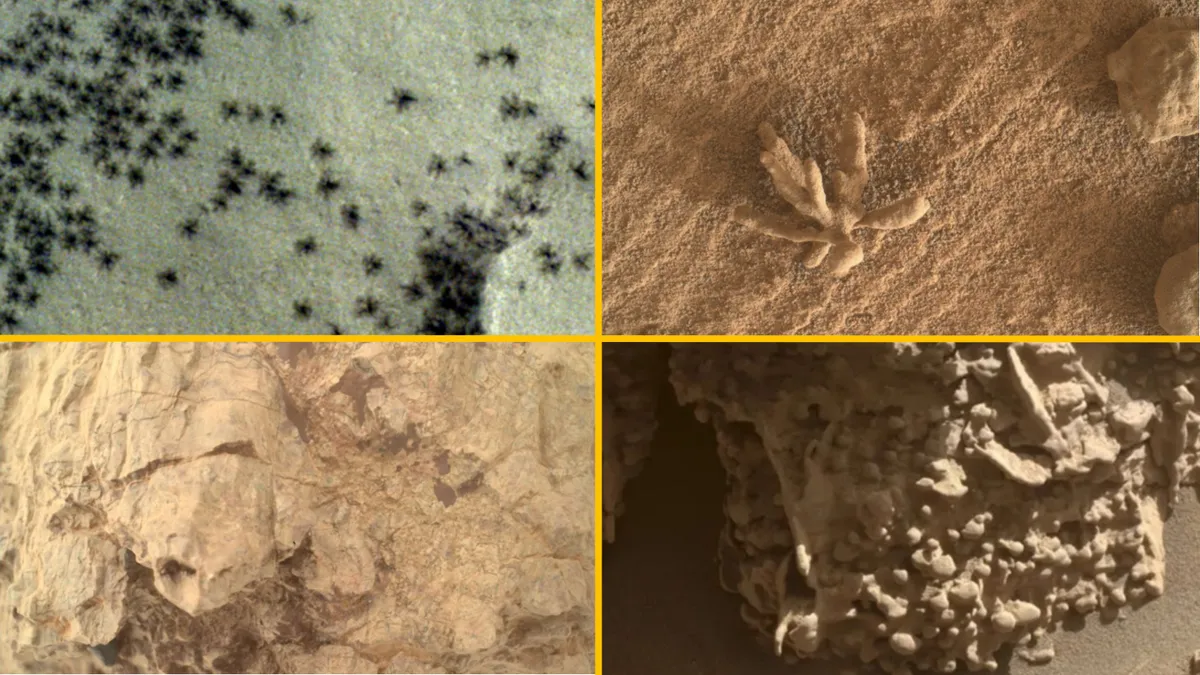
A collage of four rocky features on Mars that look like other animals

Curiosity and the other spacecraft on or around Mars have spied dozens of animal impostors on the Red Planet's surface, including "Spiders on Mars" (top left), a coral-like rock (top right), a Martian turtle (bottom left) and egg-like spheroids (bottom right). (Image credit: Top left: ESA/DLR/FU Berlin; top right: NASA/JPL-Caltech/MSSS; bottom left: NASA/JPL-Caltech; bottom right: NASA/JPL-Caltech/MSSS.)

Since landing on the Red Planet in 2012, the rover has also snapped a series of other objects that look suspiciously animal-like, including a surprisingly realistic coral-like rock formation.

RELATED STORIES

NASA's other Mars rover, Perseverance, has also seen its fair share of faux creatures since touching down in 2021, including a statuesque "turtle" poking its head out of a shell. And the fleet of spacecraft orbiting Mars has spied other unusual entities, including a "butterfly" crater and a Martian "dog" buried beneath the planet's north pole.

Most of these animal associations are the result of a phenomenon known as pareidolia, which is when the human brain sees or hears something significant in a random image or pattern.


Mars quiz: Is your knowledge of the Red Planet out of this world?

Harry is a U.K.-based senior staff writer at Live Science. He studied marine biology at the University of Exeter before training to become a journalist. He covers a wide range of topics including space exploration, planetary science, space weather, climate change, animal behavior and paleontology. His recent work on the solar maximum won "best space submission" at the 2024 Aerospace Media Awards and was shortlisted in the "top scoop" category at the NCTJ Awards for Excellence in 2023. He also writes Live Science's weekly Earth from space series.

You must confirm your public display name before commenting

Please logout and then login again, you will then be prompted to enter your display name.