
惯性聚合 高效追踪和阅读你感兴趣的博客、新闻、科技资讯
阅读原文 在惯性聚合中打开

推荐订阅源

博客园 - 司徒正美
The GitHub Blog
The GitHub Blog
钛媒体:引领未来商业与生活新知
钛媒体:引领未来商业与生活新知
Apple Machine Learning Research
L
LangChain Blog
GbyAI
GbyAI
博客园_首页
V
Visual Studio Blog
Martin Fowler
Martin Fowler
WordPress大学
WordPress大学
H
Hackread – Cybersecurity News, Data Breaches, AI and More
博客园 - 叶小钗
腾讯CDC
博客园 - Franky
IT之家
IT之家
Google DeepMind News
Microsoft Azure Blog
D
Docker
大猫的无限游戏
大猫的无限游戏
Recent Announcements
小众软件
小众软件
博客园 - 三生石上(FineUI控件)
B
Blog
酷 壳 – CoolShell
酷 壳 – CoolShell

Latest from Live Science

Naked mole rats wage bloody wars of succession to choose a new queen — but one colony did something scientists… Can the US be trusted with the moon? A law scholar raises concerns after Artemis II Lyrid meteor shower 2026: See spring's first rain of 'shooting stars' peak in moonless skies $3 million prize goes to duo whose research led to first sickle cell CRISPR therapy 700-year-old mummy from Bolivia contains earliest confirmed evidence of strep throat bacteria in the Americas New pain-relief opioid could be much less addictive than morphine, rodent study finds Experimental drug doubles one-year survival in pancreatic cancer Science news this week: Physicists witness faster-than-light darkness pinpricks, humans are still evolving, and some… Archaeologists discover perfectly circular ancient Egyptian temple that may have been used for sacred water rituals Some polar bears are adapting to their melting habitat. Will it be enough to save the iconic species? 2 supermassive black holes may collide 100 years from now ‪—‬ and Earth would feel it Anglo-Saxon burial holds an older sister cradling her little brother after they both died 1,400 years ago, possibly of… Colorado River may have pooled and spilled over to form the Grand Canyon, solving a long-standing mystery ‪—‬… 'We all screamed when it happened': Bright-green fireball meteor caught exploding over famous Viking raid site… Northern lights may be visible from several US states Friday and Saturday as giant hole opens up in sun Hackers used AI to steal hundreds of millions of Mexican government and private citizen records in one of the largest… The first black hole ever discovered is spewing 'dancing jets' at half the speed of light Stephen Hawking's black hole information paradox could be solved — if the universe has 7 dimensions 'Something's missing': Most thorough-ever study of the cosmos proves we still can't explain how the… 'Human evolution didn't slow down; we were just missing the signal': Large DNA study reveals natural selection led to more redheads and less male-pattern baldness Artemis II quiz: Is your knowledge of NASA New study confirms lobsters feel pain, driving scientists to call for a ban on boiling them alive This humanoid robot does all your housework for you ‪—‬ and its makers say it Ancient process that created rare earth elements discovered — and it could help us locate desperately needed deposits Strange mammal ancestor laid huge, leathery eggs —‬ and it was key to surviving the world 73 moon landings? NASA Diagnostic dilemma: A woman heard voices telling her she had a brain tumor ‪—‬ and scans confirmed she did Triassic croc relative from Ghost Ranch, New Mexico finally identified after nearly 80 years in museum basement There were Physicists witness pinpricks of darkness moving faster than the speed of light ‪—‬ without breaking the laws of relativity
'Almost tragicomical': Coins minted to protect the Englis...
kkillgrove@l · 2026-05-07 · via Latest from Live Science

Two rare silver coins discovered by metal detectorists in Denmark reveal that the Vikings made jewelry out of Christian coins that were originally designed to prevent Viking raids, according to experts at the National Museum of Denmark.

The coins were minted around 1009, during the reign of English king Æthelred II, nicknamed "Æthelred the Unready," and featured religious motifs that he hoped would protect his people from the Viking scourge. But he didn't count on the Vikings' appreciation of the coins' aesthetics.
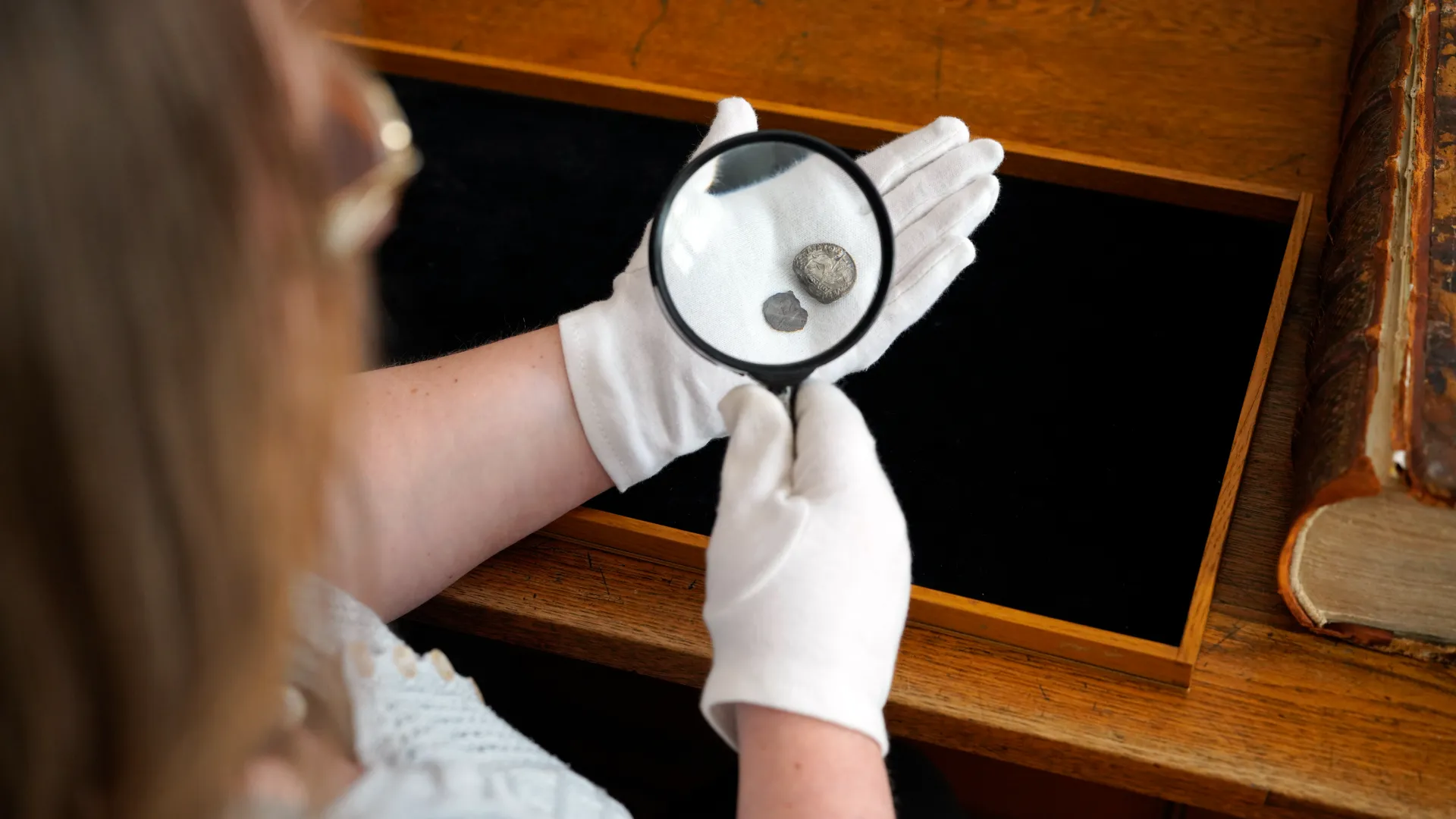
a woman wearing white cotton gloves looks at two old coins under a magnifying glass

Gitte Ingvardson looks at the two coins using a magnifying glass.

(Image credit: John Fhær Engedal Nissen/National Museum of Denmark)

Experts have dubbed this style of anti-Viking coin "Agnus Dei," or "Lamb of God," because the front of the coin features a lamb pierced by a cross, which is a symbol of Christ's sacrifice. Alpha and omega — the first and last letters of the Greek alphabet — also appear on the coin's front side, symbolizing that God is the beginning and end. On the back of the coin, a dove symbolizing the Holy Spirit takes flight.

Contemporary English coins also feature a cross on the back but lack the imagery of the lamb, and the fronts of those coins typically include a profile of the king.

Only 30 such "Lamb of God" coins have been found to date, and most were discovered in Scandinavia; they were likely plundered by Vikings who were not actually warded off by the religious symbols. Most of the Scandinavian examples feature metal loops that had been soldered on, presumably so the Vikings could wear the coins on necklaces or as amulets.

"The Vikings soon realized that it was far more practical to use coins than to hack the silver into pieces for trading purposes," Ingvardson said. The rare coins are important artifacts linking English kings, Danish kings, Christianity and the Vikings.

Get the world’s most fascinating discoveries delivered straight to your inbox.

The Viking Age ended in 1066, and people in what is now Denmark began converting to Christianity around then as Norse paganism declined. For example, archaeologists previously found more than 70 burials dating to the 1100s in a medieval Danish cemetery, and it's likely that these Norse people were Christians, although some may have retained some Norse pagan beliefs.


See how much you know about ancient Norsemen with our Viking quiz!