



惯性聚合 高效追踪和阅读你感兴趣的博客、新闻、科技资讯
阅读原文 在惯性聚合中打开

推荐订阅源

Y
Y Combinator Blog
V
V2EX
Jina AI
Jina AI
爱范儿
爱范儿
M
MIT News - Artificial intelligence
量子位
L
LangChain Blog
Google DeepMind News
酷 壳 – CoolShell
酷 壳 – CoolShell
罗磊的独立博客
腾讯CDC
MongoDB | Blog
MongoDB | Blog
P
Proofpoint News Feed
宝玉的分享
宝玉的分享
OSCHINA 社区最新新闻
OSCHINA 社区最新新闻
Last Week in AI
Last Week in AI
H
Hackread – Cybersecurity News, Data Breaches, AI and More
F
Fortinet All Blogs
The GitHub Blog
The GitHub Blog
Engineering at Meta
Engineering at Meta
博客园 - 聂微东
让小产品的独立变现更简单 - ezindie.com
Vercel News
Vercel News
T
The Blog of Author Tim Ferriss

Latest from Live Science

Naked mole rats wage bloody wars of succession to choose a new queen — but one colony did something scientists… Can the US be trusted with the moon? A law scholar raises concerns after Artemis II Lyrid meteor shower 2026: See spring's first rain of 'shooting stars' peak in moonless skies $3 million prize goes to duo whose research led to first sickle cell CRISPR therapy 700-year-old mummy from Bolivia contains earliest confirmed evidence of strep throat bacteria in the Americas New pain-relief opioid could be much less addictive than morphine, rodent study finds Experimental drug doubles one-year survival in pancreatic cancer Science news this week: Physicists witness faster-than-light darkness pinpricks, humans are still evolving, and some… Archaeologists discover perfectly circular ancient Egyptian temple that may have been used for sacred water rituals Some polar bears are adapting to their melting habitat. Will it be enough to save the iconic species? 2 supermassive black holes may collide 100 years from now ‪—‬ and Earth would feel it Anglo-Saxon burial holds an older sister cradling her little brother after they both died 1,400 years ago, possibly of… Colorado River may have pooled and spilled over to form the Grand Canyon, solving a long-standing mystery ‪—‬… 'We all screamed when it happened': Bright-green fireball meteor caught exploding over famous Viking raid site… Northern lights may be visible from several US states Friday and Saturday as giant hole opens up in sun Hackers used AI to steal hundreds of millions of Mexican government and private citizen records in one of the largest… The first black hole ever discovered is spewing 'dancing jets' at half the speed of light Stephen Hawking's black hole information paradox could be solved — if the universe has 7 dimensions 'Something's missing': Most thorough-ever study of the cosmos proves we still can't explain how the… 'Human evolution didn't slow down; we were just missing the signal': Large DNA study reveals natural selection led to more redheads and less male-pattern baldness Artemis II quiz: Is your knowledge of NASA New study confirms lobsters feel pain, driving scientists to call for a ban on boiling them alive This humanoid robot does all your housework for you ‪—‬ and its makers say it Ancient process that created rare earth elements discovered — and it could help us locate desperately needed deposits Strange mammal ancestor laid huge, leathery eggs —‬ and it was key to surviving the world 73 moon landings? NASA Diagnostic dilemma: A woman heard voices telling her she had a brain tumor ‪—‬ and scans confirmed she did Triassic croc relative from Ghost Ranch, New Mexico finally identified after nearly 80 years in museum basement There were Physicists witness pinpricks of darkness moving faster than the speed of light ‪—‬ without breaking the laws of relativity
Gold sword scabbard discovered under toppled tree in Norw...
kkillgrove@l · 2026-05-08 · via Latest from Live Science

A man went out on a morning walk in southwest Norway and stumbled upon a surprise: an elite warrior's sword scabbard that was purposefully buried 1,500 years ago. The rare gold object, which was richly decorated with serpentine animals, was probably an offering to the gods at a time of famine and societal turmoil, researchers say.

"I saw a mound in the ground under a tree and poked at it with a stick," the hiker said in a translated statement from the University of Stavanger in Norway. "Suddenly, I saw something that glittered. I didn't quite understand what I had found."

"The odds of finding something like this are minimal," Håkon Reiersen, an archaeologist at the University of Stavanger Archaeological Museum, said in the statement. The scabbard fitting is worn, suggesting its owner used it a lot before disposing of it.

"Whoever wore the sword it was on was probably the leader in this area in the first half of the 6th century and had a warrior retinue of loyal men attached to him," Reiersen said.

During the sixth century, southern Norway experienced a significant population decline due to volcanic eruptions, a lengthy cold snap and bubonic plague pandemics. One of the power centers at the time was located at Hove, where a large farm complex and numerous gold artifacts have been discovered, suggesting the people who lived there were elite.

"By sacrificing such magnificent objects to the gods, the leaders at Hove confirmed their status and power," Reiersen said.

Get the world’s most fascinating discoveries delivered straight to your inbox.

The newly discovered gold scabbard ornament, which was found northeast of Hove, is very rare and displays hallmarks of a skilled artisan, Siv Kristoffersen, a professor emerita at the University of Stavanger Archaeological Museum, said in a separate translated statement.
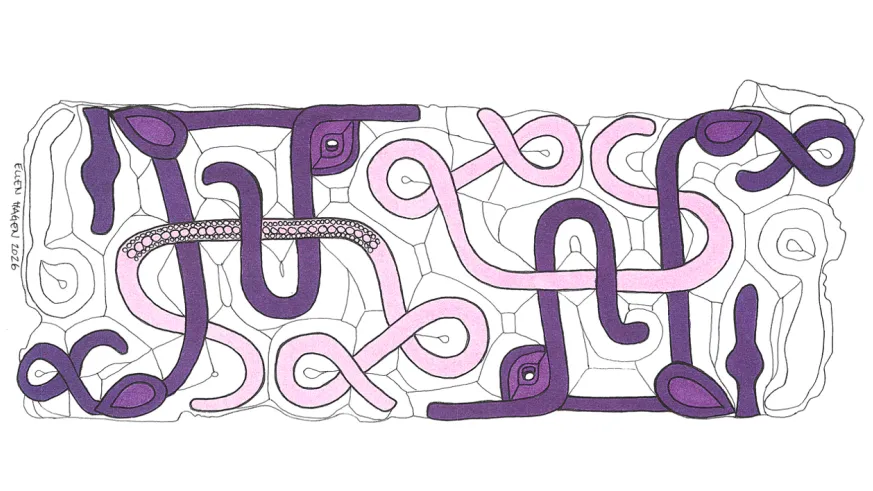
a line drawing of a meandering pattern with two serpentine animals colored in purple and a ribbon in pink

A drawing of the decoration on the gold sword scabbard revealing two animals (in purple) and a ribbon (in pink).

(Image credit: Ellen Hagen/University of Stavanger Archaeological Museum)

Although the scabbard decoration appears at first glance to be a series of curving lines, Kristoffersen noted that the middle of the design includes two animal figures in profile facing each other, but "it is possible that this should be interpreted as a human head with an animal body — a mixed motif that occurs often in this design style." These ribbon-shaped creatures were commonly used in the first half of the sixth century in Norway.

"The filigree ornamentation places the object among the finest works from the period," Kristoffersen said, referring to the triple, beaded gold threads. "This must have been a magnificent sword."

The scabbard ornament is part of a rare and mysterious group of objects sometimes found in Scandinavia that include spiral rings; gold, disc-shaped pendants; and these harmonica-shaped weapon ornaments. Experts think the groups of artifacts were deposited on purpose as "sacrificial" or "killed" objects that were offered to the gods to ask for protection from natural disasters.

Given the gold scabbard ornament's proximity to Hove, its location may have been a ritual center that Hove's leaders could access. "The new find is therefore another piece of the puzzle that shows that there was a center of power around Hove from 200 to 550 A.D.," Reiersen wrote in another translated statement.

The object will go on display at the University of Stavanger Archaeological Museum, the museum's director, Kristin Armstrong-Oma, said, as soon as experts have finished studying it. "This allows us to further research the find itself and the ornamentation and find new answers about the power elite that ruled here at this time," she said.


Can you identify these historical objects of war? Test your smarts with our weapons of the world quiz!