












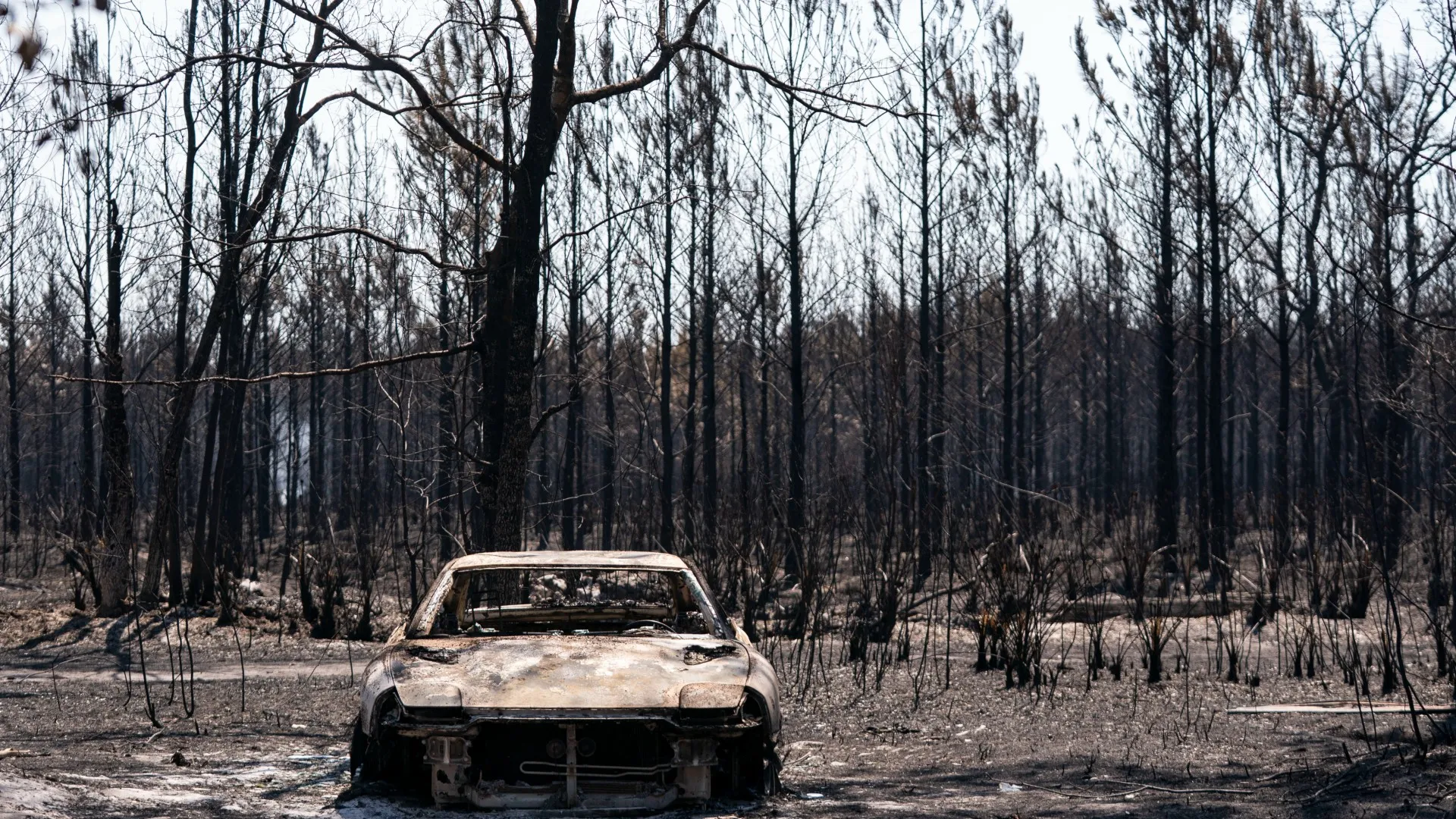
It's now clear. Scientists predict that humanity will miss its target of keeping atmospheric warming to 1.5 degrees Celsius above pre-industrial times, with the globe sailing into an even warmer future. And the impacts of this warming are escalating, from extreme weather disasters and hits to biodiversity to melting glaciers and sea level rise.
So: How high will our temperature go? How long will it stay at its peak before cooling back down? And what will this mean for our planet?
This became the guiding star of global action to fight climate change, with wide acknowledgement that the higher the warming, the higher the harms to ecosystems, human health, food supplies and other aspects of planetary well-being.
Yet now, more than a decade later, nations' cumulative actions and commitments on emissions are falling far, far short of what's needed to meet the Paris Agreement goals. Complicating matters, the United States pulled out of the agreement in 2020 and again in 2026 — the only one of the original 195 parties to do so.
One of the sticking points in international negotiations has been reaching consensus on fossil fuels. Controversially, the 2015 Paris Agreement didn't even mention fossil fuels — a political concession designed to keep fossil-fuel-rich nations on board. But it has long been clear that cutting emissions and stopping warming means moving away from carbon-based fuels: Today, burning fossil fuels for energy is the source of about three-quarters of global greenhouse gas emissions.
It wasn't until the 2023 meeting of the UNFCCC that parties officially called for a transition away from fossil fuels. Disappointingly, though, despite a push from some nations, the most recent 2025 meeting ended without a hoped-for roadmap for a fossil fuel phaseout. In response, a coalition of countries has made plans for a First Conference on Transitioning Away from Fossil Fuels. Representatives of more than 50 nations will meet in Colombia at the end of April, as part of an attempt to forge a "fossil fuel treaty" to fast-forward the world's adoption of renewable energy and chart a path away from coal, oil and gas.

Whatever happens with our emissions pathway next will play a huge role in determining the peak amount of warming the planet experiences — whether that’s 1.7 degrees C above pre-industrial times, 2 degrees, 2.6 degrees or more — and if and how fast people can pull that warming back down again.
Andy Reisinger, a climate change researcher and independent consultant who serves on He Pou A Rangi, the New Zealand Climate Change Commission, has studied these issues. A longtime contributor to the Intergovernmental Panel on Climate Change (IPCC), he has helped map out the various ways the world might exceed but then return to 1.5 degrees C of warming. Reisinger recently coauthored a 2025 Annual Review of Environment and Resources paper that explores the concept of climate overshoot.
This conversation has been edited for length and clarity.
How much warming has our planet seen so far?
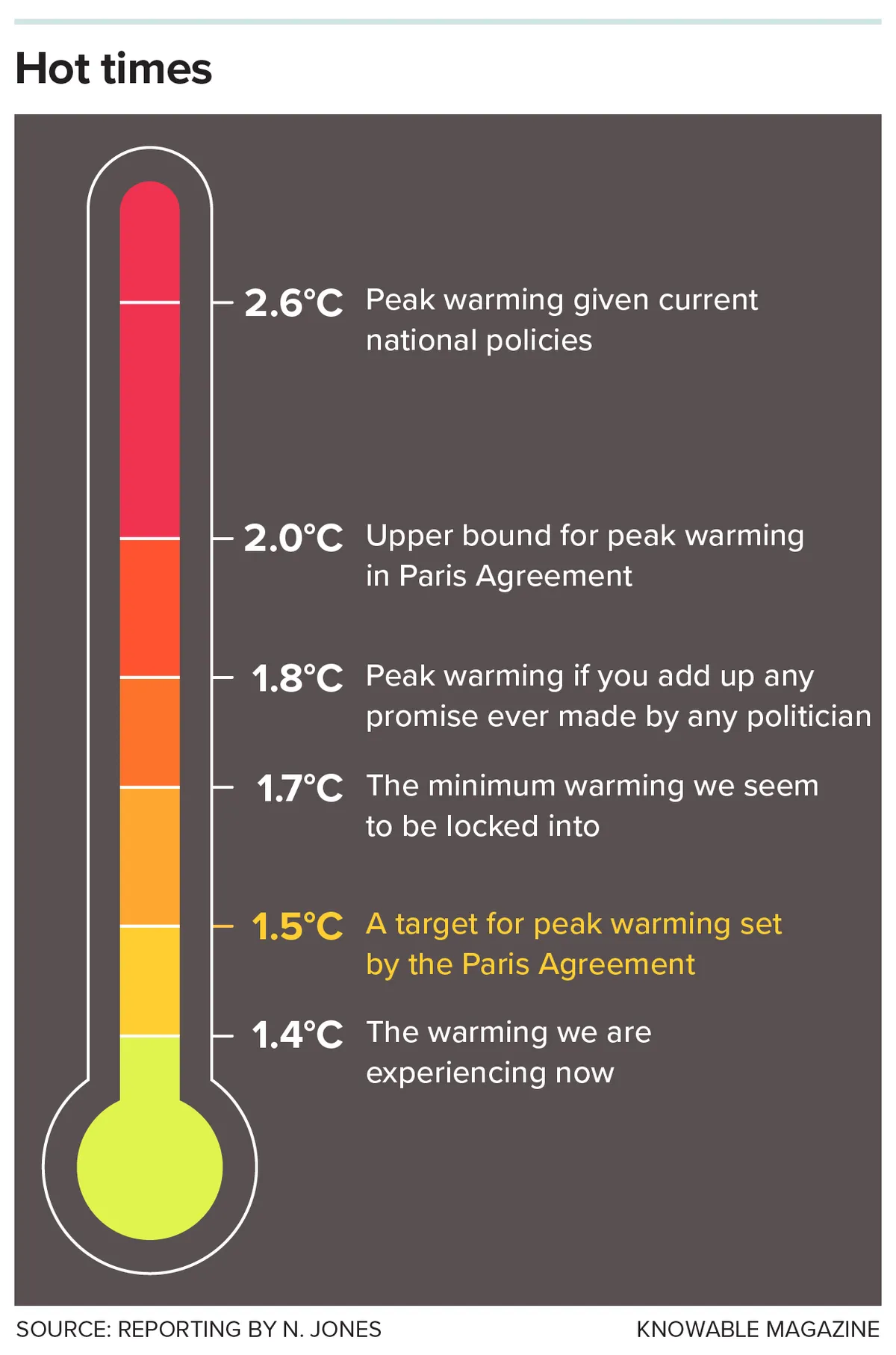
2024 was the first calendar year when global average temperature exceeded 1.5 degrees C above the late 19th century average. But global warming is usually defined as the average temperature over at least two decades, because temperature varies naturally from year to year. Right now, the best estimate is that we're a little bit over 1.4 degrees C of global warming. It's very likely that we're going to surpass 1.5 degrees C of warming within the next 10 years and possibly even within the next five.
What are some of the impacts of that warming so far?
We've seen over the last few years really damaging climatic extremes in the form of heat waves, floods, wildfire, very intense droughts in some regions. The harms include loss of human life, severe economic damages and long-lasting hits to ecosystems. Sea levels have continued to rise; the rate of that rise is now double what it was during the 20th century.
We've seen the first officially recognized climate refugees arriving in Australia from the Pacific Island nation of Tuvalu. We've also seen extremely damaging hurricanes and other intense tropical storms. Of course, there's always the question: Well, is that climate change? There's increasing evidence that some of those extreme events would not have been possible at that intensity without global warming.
What do the best computer simulations show about how warm the planet will get?
The climate system is like a super tanker or a freight train: Even if you slam on the brakes as hard as you can right now, this will not instantly stop the warming. It will slow it down. But it will take decades, even if we go all out, to bring emissions down to a level that will halt the warming entirely.
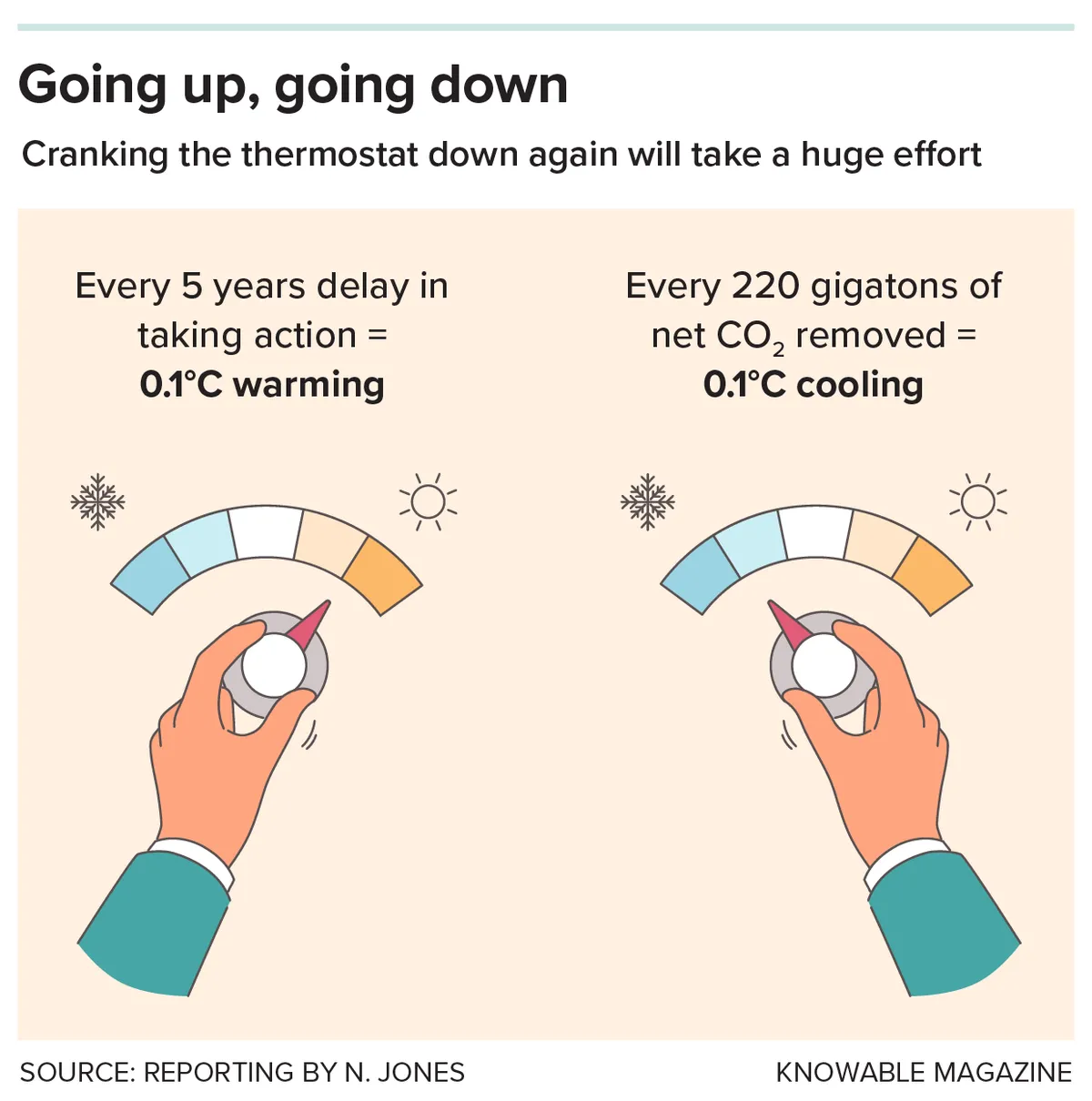
According to models, there's at least another 0.3 degrees C of global warming in store simply because we cannot stop carbon dioxide emissions overnight, which means the best chance we have is to limit warming at 1.7 degrees C. As a rule of thumb, every five years of ongoing emissions at current levels adds another 0.1 degrees C to peak warming. Time is not on our side.
As the world warms further, many weather extremes are expected to get worse or more frequent. Will some systems hit a breaking point?
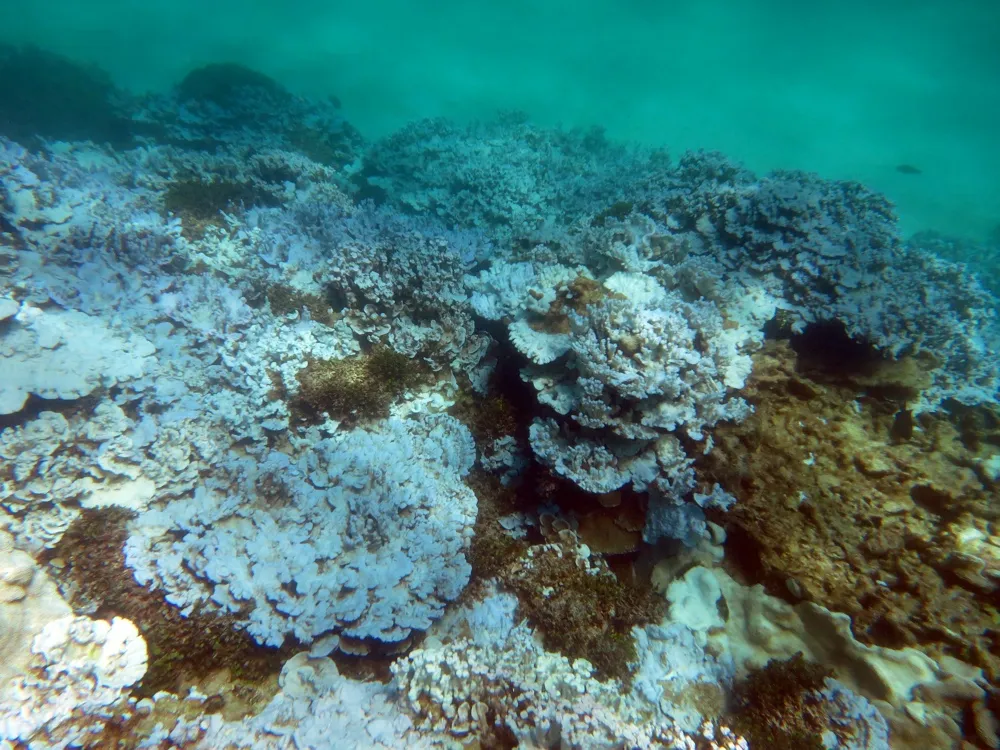
There's good evidence that tropical coral reefs will become largely unviable beyond a critical threshold. We're seeing increasing severe bleaching of major coral reef systems all around the world now. If warming rises to 1.7 degrees C, there is a very good chance that widespread, healthy coral reef systems will no longer be able to function. This doesn’t mean that corals will go extinct; there’s chances for survival in smaller pockets. But the Great Barrier Reef is very unlikely to survive.
A key tipping point that's attracting increasing attention is the Gulf Stream, which carries warm water into the high latitudes in the Atlantic. Some, but not all, models predict potential for an abrupt shutdown, irreversible for many generations, which would have dramatic consequences. It's not just that suddenly the Norwegian fjords freeze over, but there would be widespread changes to rainfall, and challenges to agriculture through rapid cooling and drying.
Countries are waking up to this existential risk. A recent study hints at an increased probability of this happening; but models are still unable at this point to say that the Gulf Stream will dramatically collapse at precisely x or y degrees of warming.
There's a whole range of feedback systems kicking in, including the release of planet-warming methane from tropical wetlands — the more the world warms, the more methane is released, which warms the world even more. Are these feedbacks well-behaved? Do they scale up gradually with global warming? Or do they accelerate?
When talking about corals, you said "if" the world warms by 1.7 degrees C. But isn't that a certainty now?
Yes [laughs]. I mean, that's my mental-health-saving mechanism. It's only "if" in the sense that it hasn't happened yet.
Will we stay below 2 degrees C, the upper target mentioned in the 2015 Paris Agreement?
I wouldn't want to give it a probability. On the positive side, if you look at every emissions target that any politician ever uttered, if you add all of those up, you would limit warming to about 1.8 degrees C. However, that includes pledges that have very little credibility, with no plans or policies to actually deliver on them. If you only look at policies as they currently are, you end up with warming at around 2.6 degrees C as the best estimate.
What will it take to stay below 2 degrees C warming?
We know what to do. It requires, mainly, displacing the use of fossil fuels with electricity and generating that electricity with renewable sources. The good news is that we see a rapid expansion of renewables through solar and wind all around the world. The bad news is those currently meet the increasing demand, but they don't displace existing fossil fuel generation. What needs to happen is a very rapid phasedown, and ultimately phaseout, of the use of fossil fuels to generate electricity, including an accelerated decommissioning of existing fossil fuel infrastructure.
One area that gets less attention is agriculture, which is a major source of methane, and is also linked to increasing carbon dioxide levels through deforestation. Halting deforestation by 2030 is key.
It's a massive endeavor, and yet we can envisage a world with these changes — it's not science fiction.
Should we simply set a new, higher target for an acceptable amount of warming — or should we still fight to return to 1.5 degrees C, even if the temperature peaks higher than that for a short while?
There's an emerging narrative from some people who say, "Well, 1.5 degrees C was always only an aspiration and overly ambitious goal. Now that that's no longer on the table, we can go to more pragmatic policies." That fundamentally misconstrues the issue. The urgency has not decreased. It has increased.
I think it would be deeply problematic to simply say, "Oh, well, 1.5 is gone. Let’s now aim for 1.8." One, what makes you think we'd meet that target? But also, the International Court of Justice last year issued its landmark opinion that 1.5 degrees C is an enduring objective, and that countries are legally obliged to try to limit global warming to it.
We are going to lose millions of people through heat waves, through the consequences of flooding, through malnutrition and drought, if we simply live with a warmer world. We have enough evidence to think that a sustained warmer world is deeply more damaging and risky than a world that reaches some peak warming level temporarily and then brings the temperature back down again.
Once the world temperature peaks at, say, 1.7 degrees or 2.6 degrees C, how hard will it be to return to 1.5 degrees C?
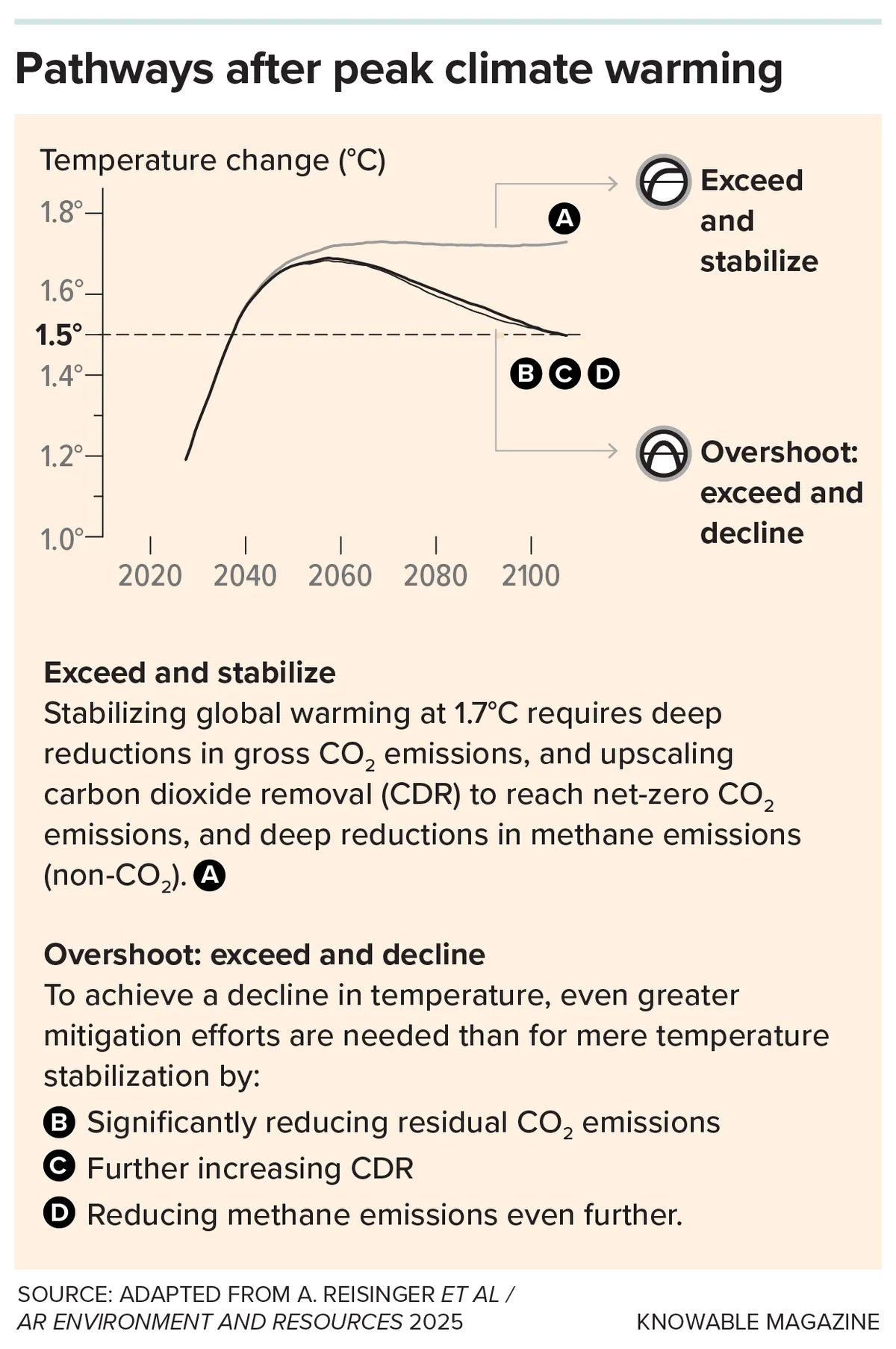
The scale of this challenge is huge, whether you predominantly aim to achieve it by increasing carbon dioxide removal (by planting trees or using industrial processes to suck carbon dioxide out of the air), or through further reductions of carbon dioxide or methane emissions. We need all these things.
The effort needed to bring temperature back down again goes beyond the effort needed to hold global warming at a set target. The best estimate currently is that you need to remove a net of 220 gigatons of carbon dioxide from the atmosphere for every 0.1 degree Celsius of cooling.
Global afforestation — tree planting — around the world delivers about two gigatons of carbon dioxide removal per year. So, if we could halt all deforestation tomorrow, if we stopped all fossil fuel use, and persisted with the current level of afforestation, it would take 100 years to bring temperature down by 0.1 degrees Celsius.
If we don't limit warming to 2 degrees C, there's no way we're going to bring it back to 1.5 degrees C within a reasonable time horizon.
Are there risks involved with trying to reverse warming quickly? Can it be done in a just way, by which people mean a fair and equitable way?
Policies that aim to achieve that and are not well implemented clearly bring major risks in their own right. The use of land to achieve carbon dioxide removal, by planting trees for example, could compete with land for food production. It could displace people whose livelihoods rely on the land. And it could pose severe threats to ecosystems.
I think we know in theory how to manage these risks. The question is, will the real world implement such policies in light of that evidence, or will it run roughshod over calls for a just transition? That’s the space where there’s concern.
You have done a lot of work on reports of the IPCC. Is that organization, which synthesizes current climate science for policymakers, still relevant?
The IPCC remains a vital reference point for what we actually know. What's relevant about the IPCC is shifting: Ten years ago, the question was still, "Is it true that we are changing the climate?" The IPCC found that all of the global average temperature change we've seen over the last 150 years was caused by humans. People didn't contribute to it. They caused it.
Now the interest is more and more shifting to the solution space. The IPCC is still vital, but it's clearly not the only game in town. There are other bodies, like the International Energy Agency, like various NGOs, that say "Here's a whole smorgasbord of solutions." But the IPCC is important because it's the one without an inherent financial motive.
We've seen increasing pushback from countries that are reluctant to acknowledge the IPCC as an authoritative evidence base. And of course, the IPCC is run by humans. It isn't fault-free. But it's the best we have by far.
Have you been encouraged or discouraged by the UNFCCC COP meetings?
COP meetings are clearly political processes: The outcomes are not dictated by facts. Some countries have deep and not illegitimate concerns that, for them, the cure may be worse than the disease.
You don't have to have an altruistic motive to want to get out of fossil fuels.
It's been striking how countries have repeatedly agreed at COP meetings, in the meetings' conclusions, to want to keep the 1.5 degrees C target alive, to not let it go. This is why the topic of overshoot is really important. If you want to keep 1.5 degrees C alive, the only path is now up to a peak warming of greater than 1.5 degrees C and back down again.
I don't see very high chances of the COP meetings actually agreeing to a full fossil fuel phaseout. But let's be clear, the immediate need is for a rapid phasedown of fossil fuels, and even that has been a challenge to get commitments on.
What about the pushback, especially from the United States, on green energy policies and continued support for fossil fuels — including US incursions into oil-controlling nations, like Venezuela and Iran?
The push towards renewables is unstoppable because it's in a country's self-interest. The war in Iran has made that clear. Through reduced fossil-fuel dependency, through reduced price volatility, through increased resilience in case of supply shortages, through reduced health costs from air pollution. All those things add up. You don't have to have an altruistic motive to want to get out of fossil fuels.
You can't run a world superpower on coal. I'm confident of that. The acts of the current US president are not a guide for the long-term future.
The First Conference on Transitioning Away from Fossil Fuels is due to be held at the end of April, co-organized by Colombia and the Netherlands. Is this meeting going to make a big difference, or is it largely symbolic?
It can be a shining beacon even if it's only symbolic. These are diverse countries coming together, including many Pacific Island nations as well as Cambodia, Kenya, Chile, Australia, Denmark and others. Having a forum where you talk through, with a wider group of countries than you might ordinarily call "like-minded," what we need in order to ensure the energy transition is a just transition that protects the most vulnerable — to talk about it aloud, is a really important initiative, even if it comes to nothing. It prepares the ground. That's especially the case in a time of rising authoritarianism.
But I think it's really important to hold onto multilateral institutions like the Paris Agreement and COP meetings, because they are what give voice and power to small countries. Yes, they may be ineffectual. Yes, they can be used and misused through veto and strong special interests. But it would be, in my view, problematic to retreat from multilateralism entirely.
You can certainly complement the multilateral process with narrower initiatives that try and push the ground forward. That can widen the space that multilateral activities can then grow into.
Do you have kids? What do you hope will happen in their world?
We've got one child, a son. For me, the most startling thing is that he, in all likelihood, might be alive in the year 2100. Despite my work in climate change and climate change impacts, I can't help but admit that the year 2100 and the impacts that the world might experience by then is a highly abstract concept.
RELATED STORIES
I cannot deeply visualize and emotively embrace that world. Having a son who may live to see that world is a shock to the system, because it makes it so much more real than any computer model.
My hope is that he will live long enough to see a world that has started on our road to recovery from peak warming. Whether we get back to 1.5 degrees C in his lifetime is highly questionable, but the idea of him seeing the ship being turned around is my strong hope.
As for you and I, these are the coolest summers we will live through. Every other summer in the rest of our lives will be warmer. We will not see the recovery in our lifetime, and that’s something to swallow. But it’s our job to ensure that he can.
This article originally appeared in Knowable Magazine, a nonprofit publication dedicated to making scientific knowledge accessible to all. Sign up for Knowable Magazine’s newsletter.