



惯性聚合 高效追踪和阅读你感兴趣的博客、新闻、科技资讯
阅读原文 在惯性聚合中打开

推荐订阅源

美团技术团队
人人都是产品经理
人人都是产品经理
月光博客
月光博客
V
V2EX
WordPress大学
WordPress大学
酷 壳 – CoolShell
酷 壳 – CoolShell
Last Week in AI
Last Week in AI
博客园 - 三生石上(FineUI控件)
小众软件
小众软件
Hugging Face - Blog
Hugging Face - Blog
V
Visual Studio Blog
宝玉的分享
宝玉的分享
雷峰网
雷峰网
钛媒体:引领未来商业与生活新知
钛媒体:引领未来商业与生活新知
博客园 - Franky
博客园 - 聂微东
博客园 - 司徒正美
博客园 - 【当耐特】
爱范儿
爱范儿
奇客Solidot–传递最新科技情报
奇客Solidot–传递最新科技情报
OSCHINA 社区最新新闻
OSCHINA 社区最新新闻
大猫的无限游戏
大猫的无限游戏
博客园 - 叶小钗
阮一峰的网络日志
阮一峰的网络日志

Latest from Live Science

Naked mole rats wage bloody wars of succession to choose a new queen — but one colony did something scientists… Can the US be trusted with the moon? A law scholar raises concerns after Artemis II Lyrid meteor shower 2026: See spring's first rain of 'shooting stars' peak in moonless skies $3 million prize goes to duo whose research led to first sickle cell CRISPR therapy 700-year-old mummy from Bolivia contains earliest confirmed evidence of strep throat bacteria in the Americas New pain-relief opioid could be much less addictive than morphine, rodent study finds Experimental drug doubles one-year survival in pancreatic cancer Science news this week: Physicists witness faster-than-light darkness pinpricks, humans are still evolving, and some… Archaeologists discover perfectly circular ancient Egyptian temple that may have been used for sacred water rituals Some polar bears are adapting to their melting habitat. Will it be enough to save the iconic species? 2 supermassive black holes may collide 100 years from now ‪—‬ and Earth would feel it Anglo-Saxon burial holds an older sister cradling her little brother after they both died 1,400 years ago, possibly of… Colorado River may have pooled and spilled over to form the Grand Canyon, solving a long-standing mystery ‪—‬… 'We all screamed when it happened': Bright-green fireball meteor caught exploding over famous Viking raid site… Northern lights may be visible from several US states Friday and Saturday as giant hole opens up in sun Hackers used AI to steal hundreds of millions of Mexican government and private citizen records in one of the largest… The first black hole ever discovered is spewing 'dancing jets' at half the speed of light Stephen Hawking's black hole information paradox could be solved — if the universe has 7 dimensions 'Something's missing': Most thorough-ever study of the cosmos proves we still can't explain how the… 'Human evolution didn't slow down; we were just missing the signal': Large DNA study reveals natural selection led to more redheads and less male-pattern baldness Artemis II quiz: Is your knowledge of NASA New study confirms lobsters feel pain, driving scientists to call for a ban on boiling them alive This humanoid robot does all your housework for you ‪—‬ and its makers say it Ancient process that created rare earth elements discovered — and it could help us locate desperately needed deposits Strange mammal ancestor laid huge, leathery eggs —‬ and it was key to surviving the world 73 moon landings? NASA Diagnostic dilemma: A woman heard voices telling her she had a brain tumor ‪—‬ and scans confirmed she did Triassic croc relative from Ghost Ranch, New Mexico finally identified after nearly 80 years in museum basement There were Physicists witness pinpricks of darkness moving faster than the speed of light ‪—‬ without breaking the laws of relativity
Hubble revisits stunning Trifid Nebula after 30 years, an...
Shreejaya Ka · 2026-04-26 · via Latest from Live Science

Swirling clouds of brown dust and gas mix in front of a starry blue spacescape

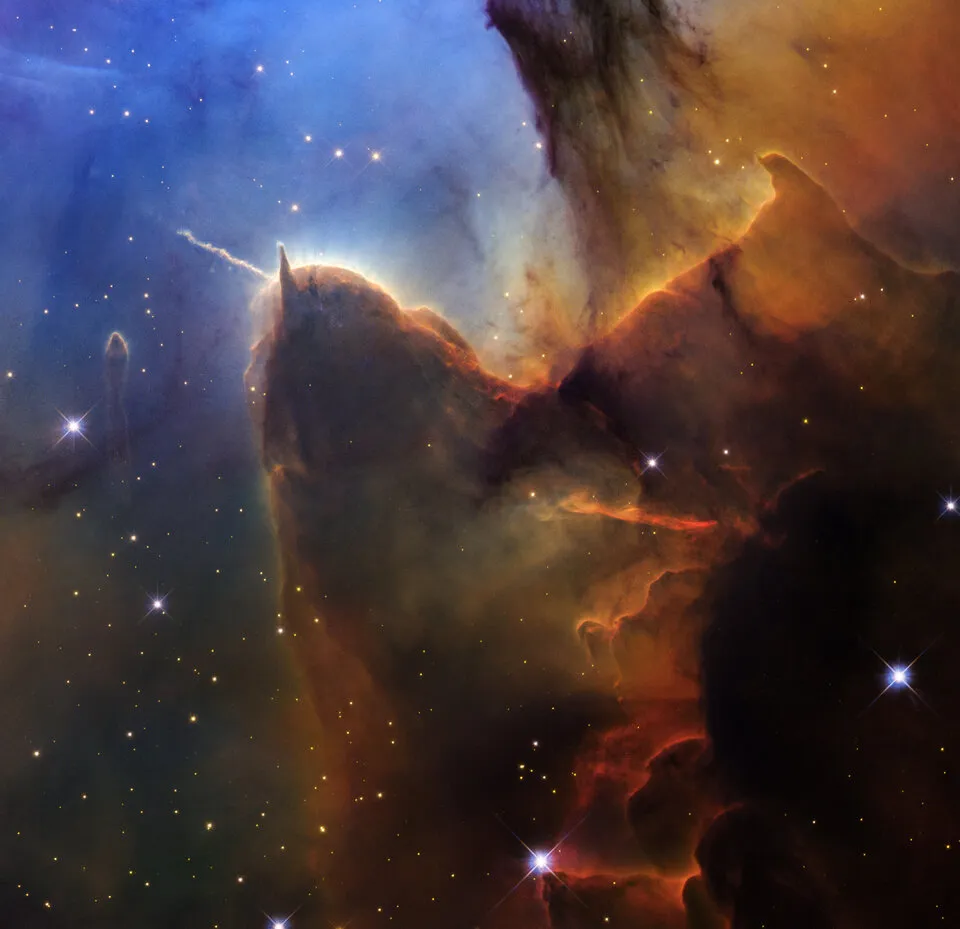
Hubble revisited the aquatic-looking Trifid Nebula 30 years after its original observations. (Image credit: NASA, ESA, STScI. Image processing: J. DePasquale (STScI))

Quick facts

What it is: Trifid Nebula (Messier 20)

Where it is: 5,000 light-years from Earth in the constellation Sagittarius

When it was shared: April 20, 2026
Swirling clouds of brown gas and dust mix against a dark blue starry background.

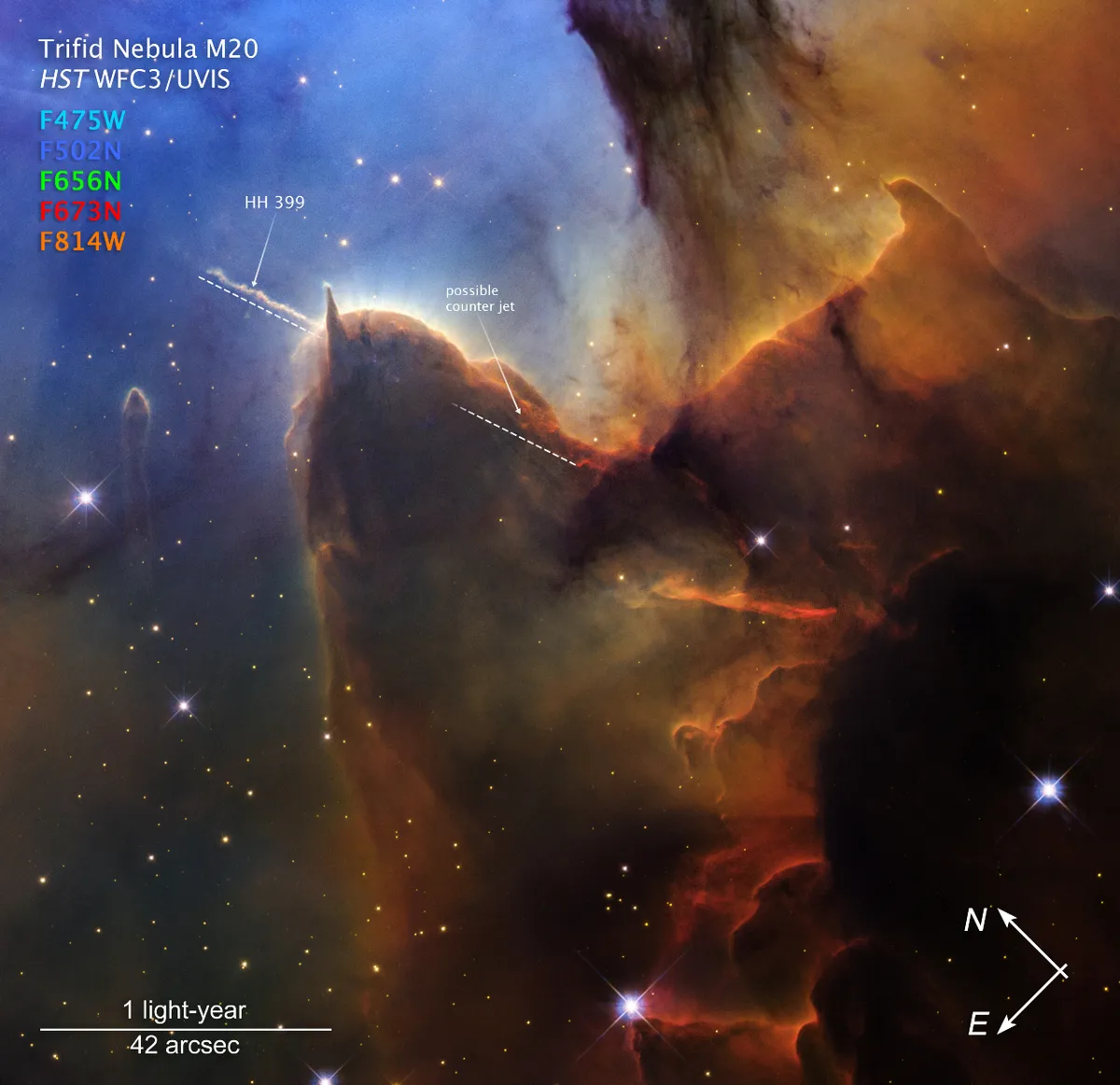
An annotated image of the Trifid Nebula, showing the jet and possible counter-jet being spat out by a young star. (Image credit: NASA, ESA, STScI. Image processing: J. DePasquale (STScI))

In the new image, the mesmerizing orange cloud linings show where powerful ultraviolet radiation from massive stars has stripped electrons from nearby gas, making it glow. Their stellar winds have cleared some surrounding dust, as shown in the bright-blue area where the dust is thinnest. The far-right corner — nearly pitch-black — is where the dust is densest.

The prominent brown-shaped structure in the center left of the image is the "head" of the cosmic sea lemon. Its "body" is a rust-colored cloud of gas. Between two "horns," yellow gas splashes outward like the glow of a volcano's lava, almost as if something were being destroyed there. And that is exactly what's happening; these are regions where the ultraviolet light is eroding gas and dust, according to the European Space Agency.

The main peak, seen left of the sea lemon's head, is accompanied by a jet of energetic gas. This region is part of the Herbig-Haro (HH) object called HH-399, and the jet is ejected by a baby star located within the sea lemon's head. (HH objects are bright regions of nebulosity created by the powerful jets of newborn stars.)

Comparing the new observations with the 1997 image, researchers actually watched the jet expand. This change will allow scientists to estimate the jet's speed, revealing how much energy the young star is injecting into its surroundings. There is also a thick streak of material in bright orange and blazing red that appears to expand to the right — potentially a jet shooting from another newly formed star.

Get the world’s most fascinating discoveries delivered straight to your inbox.

The bright-orange stars scattered across the scene have already won their battle against the nebula. They are fully formed, and their light and stellar winds have cleared the space around them. Over the next few million years, the remaining stars buried in the nebula will do the same. The gas and dust will slowly disappear, and only stars will remain.

With this image, Hubble not only celebrates 36 years of operations but also puts its improved capabilities on full display. The newly operational Vera C. Rubin Observatory, located in Chile's Atacama Desert, also captured the Trifid Nebula, looking like a giant cloud of cotton candy, in its first batch of images.


See more Space Photos of the Week

Shreejaya Karantha is a science writer specializing in astronomy, covering topics such as the sun, planetary science, stellar evolution, black holes, and early universe cosmology. Based in India, she works as a writer and research specialist at The Secrets of the Universe, where she contributes to scripts for research-based and explainer videos. Shreejaya holds a bachelor's degree in science and a master's degree in physics with a specialization in astrophysics.

You must confirm your public display name before commenting

Please logout and then login again, you will then be prompted to enter your display name.