







Despite being surrounded by a multitude of people, urban birds may be picky about who can approach them, new research suggests.
After surveying over 37 city bird species in five European countries, experts found that the avians fled sooner when approached by women than by men. The findings, published in December 2025 in the journal People and Nature, suggest that the birds can differentiate between the sex of the person approaching them.
"As a woman in the field, I was surprised that birds reacted to us differently," study co-author Yanina Benedetti, an ecologist at the Czech University of Life Sciences Prague, said in a statement. "This study highlights how animals in cities 'see' humans, which has implications for urban ecology and equality in science. Many behavioural studies assume that a human observer is neutral, but this wasn't the case for urban birds in our study."
Outside experts agree that these findings are puzzling, but also preliminary.
"Until we have a good reason to hypothesize such differences, I remain a bit skeptical," John Marzluff, a professor emeritus in ecology at the University of Washington, told Live Science in an email. "But I am not at all skeptical that birds pay a lot of attention to us and respond to humans in ways that are important. We just need more research here to better understand why this effect was so consistent."
Baffling bird behavior
To understand whether this puzzling response was a bigger pattern rather than a few skittish encounters, the researchers used a standard measure of urban wildlife wariness: flight initiation distance, or how close a person can get before an animal flees.
The team studied the flight initiation distance in 37 species — including the common wood pigeon (Columba palumbus), carrion crows (Corvus corone), house sparrows (Passer domesticus), hooded crows (Corvus cornix), and blackbirds (Turdus merula) — across cities in the Czech Republic, France, Germany, Poland and Spain.
Some types of birds, like pigeons, seem more comfortable with human behavior and fled later or had a shorter flight initiation distance. Others, like magpies, fled early and had a longer flight initiation distance.
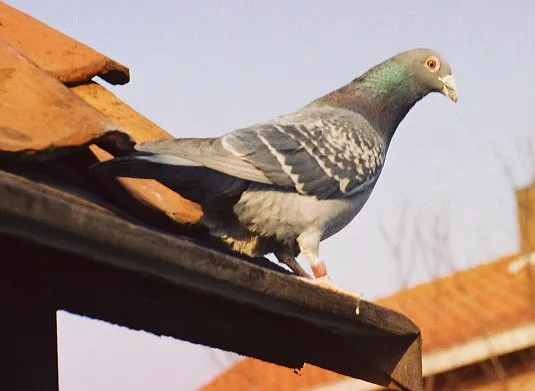
Pigeons seem comfortable living in urban environments.
(Image credit: BenTheWikiMan, Public Domain)
During the study, a man and a woman who were of comparable height and were wearing similar clothing tried to approach a bird in a city's green space by walking in a straight line and keeping their eyes on the avian. The researchers measured the distance after the bird fled. Four men and four women, all expert ornithologists, participated in the research, so the birds interacted with different pairs of people.
From 2,701 observations collected between April and July of 2023, the team found that men could get around 3 feet (1 meter) closer to the birds than women could, on average.
"I fully believe our results, that urban birds react differently based on the sex of the person approaching them, but I can't explain them right now," study co-author Daniel Blumstein, a professor in the Department of Ecology and Evolutionary Biology at UCLA, said in the statement.
Possible theories
The researchers proposed a few ideas for why the city birds flee faster from women. For example, they suggested that pheromones, body shape or gait could be factors.
"If I had to guess, I would agree with the supposition that gait is am important cue the birds are using," Marzluff said. "What I find puzzling is that one would expect such effects to be learned by a bird’s experience with various humans in their environment. If so, then there would be no reason for birds to have only experienced more threatening women. Some surely would have experienced threatening men and therefore the overall response should be no difference in response to sex."
However, the team noted in their paper that they did not have any female participants collect data while they were menstruating — when specific scent compounds in a woman's body odor intensify — an aspect that could be investigated further.
The researchers cautioned that this study is preliminary and that more data is needed to confirm this behavior isn't just a fluke.
"Follow up studies could focus on individual factors such as movement patterns, scent cues, or physical traits, testing them separately rather than grouping them under observer sex," Benedetti said.
"But how do we test this? Perhaps a study resembling Monty Python's Ministry of Silly Walks," Blumstein joked.
Article Sources
Morelli, F., Benedetti, Y., Mikula, P., Blumstein, D. T., Díaz, M., Page, A., Tryjanowski, P., Nowak, M. K., Vincze, E., & Lövei, G. L. (2025). Sex matters: European urban birds flee approaching women sooner than approaching men. People and Nature, 8(2), 316–326. https://doi.org/10.1002/pan3.70226
Are you a bird nerd? Find out with our bird quiz!