


惯性聚合 高效追踪和阅读你感兴趣的博客、新闻、科技资讯
阅读原文 在惯性聚合中打开

推荐订阅源

钛媒体:引领未来商业与生活新知
钛媒体:引领未来商业与生活新知
Apple Machine Learning Research
T
Tailwind CSS Blog
月光博客
月光博客
爱范儿
爱范儿
有赞技术团队
有赞技术团队
OSCHINA 社区最新新闻
OSCHINA 社区最新新闻
aimingoo的专栏
aimingoo的专栏
GbyAI
GbyAI
腾讯CDC
The Cloudflare Blog
人人都是产品经理
人人都是产品经理
MongoDB | Blog
MongoDB | Blog
Microsoft Azure Blog
IT之家
IT之家
Cyber Security Advisories - MS-ISAC
云风的 BLOG
云风的 BLOG
U
Unit 42
博客园 - 三生石上(FineUI控件)
A
About on SuperTechFans
N
Netflix TechBlog - Medium
Google DeepMind News
雷峰网
雷峰网
L
LangChain Blog

Latest from Live Science

Naked mole rats wage bloody wars of succession to choose a new queen — but one colony did something scientists… Can the US be trusted with the moon? A law scholar raises concerns after Artemis II Lyrid meteor shower 2026: See spring's first rain of 'shooting stars' peak in moonless skies $3 million prize goes to duo whose research led to first sickle cell CRISPR therapy 700-year-old mummy from Bolivia contains earliest confirmed evidence of strep throat bacteria in the Americas New pain-relief opioid could be much less addictive than morphine, rodent study finds Experimental drug doubles one-year survival in pancreatic cancer Science news this week: Physicists witness faster-than-light darkness pinpricks, humans are still evolving, and some… Archaeologists discover perfectly circular ancient Egyptian temple that may have been used for sacred water rituals Some polar bears are adapting to their melting habitat. Will it be enough to save the iconic species? 2 supermassive black holes may collide 100 years from now ‪—‬ and Earth would feel it Anglo-Saxon burial holds an older sister cradling her little brother after they both died 1,400 years ago, possibly of… Colorado River may have pooled and spilled over to form the Grand Canyon, solving a long-standing mystery ‪—‬… 'We all screamed when it happened': Bright-green fireball meteor caught exploding over famous Viking raid site… Northern lights may be visible from several US states Friday and Saturday as giant hole opens up in sun Hackers used AI to steal hundreds of millions of Mexican government and private citizen records in one of the largest… The first black hole ever discovered is spewing 'dancing jets' at half the speed of light Stephen Hawking's black hole information paradox could be solved — if the universe has 7 dimensions 'Something's missing': Most thorough-ever study of the cosmos proves we still can't explain how the… 'Human evolution didn't slow down; we were just missing the signal': Large DNA study reveals natural selection led to more redheads and less male-pattern baldness Artemis II quiz: Is your knowledge of NASA New study confirms lobsters feel pain, driving scientists to call for a ban on boiling them alive This humanoid robot does all your housework for you ‪—‬ and its makers say it Ancient process that created rare earth elements discovered — and it could help us locate desperately needed deposits Strange mammal ancestor laid huge, leathery eggs —‬ and it was key to surviving the world 73 moon landings? NASA Diagnostic dilemma: A woman heard voices telling her she had a brain tumor ‪—‬ and scans confirmed she did Triassic croc relative from Ghost Ranch, New Mexico finally identified after nearly 80 years in museum basement There were Physicists witness pinpricks of darkness moving faster than the speed of light ‪—‬ without breaking the laws of relativity
First-of-its-kind map of the mouse nose reveals surprises...
Payal Dhar · 2026-04-29 · via Latest from Live Science
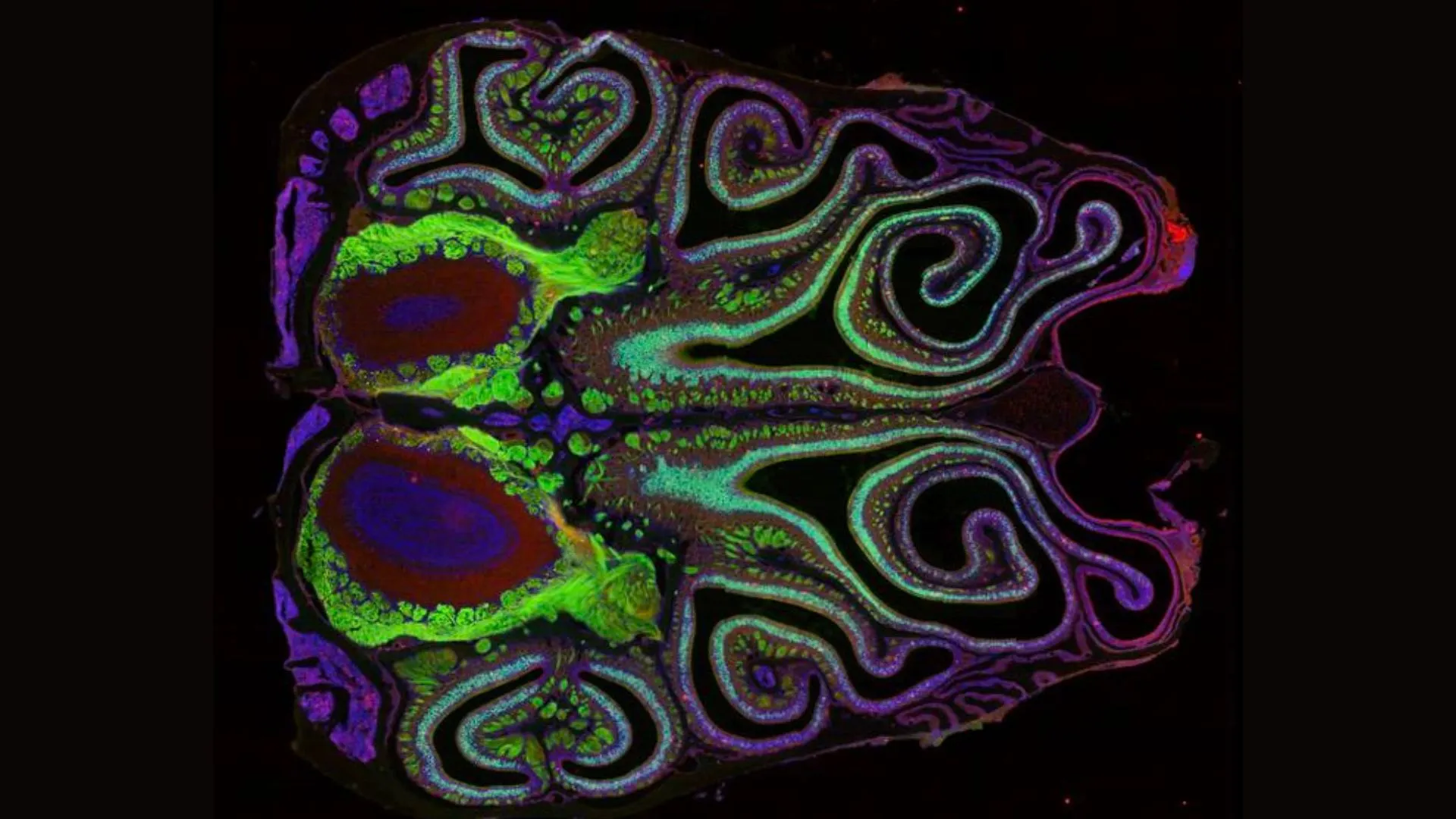
A colorful x-ray image of a mouse nose, showing various pathways with purple, blue and green lines.
This microscope photo of a cross section of a mouse nose shows scent-sensing neurons in green, as well as dying neurons in red. (Image credit: Datta Lab)

Scientists have created a comprehensive map of smell receptors in the mouse nose, revealing a few surprises about this fundamental sense.

Smell receptors, or olfactory receptors, were previously thought to be randomly distributed within the lining of the nasal cavity. But now, the first-of-its-kind map shows that they are highly organized, with different types separated into tight bands.

Smells are detected by olfactory sensory neurons in the nasal cavity. Each neuron expresses one of 1,172 different receptors encoded in mouse DNA, with each receptor detecting a different type of smell.

Other senses ‪—‬ such as touch, vision and hearing ‪—‬ are known to use sensory maps. For example, for hearing, different frequencies are encoded at different positions in the cochlea of the inner ear, and from there, that information is relayed to the brain. Smell was not thought to use such mapping, but in the past six or seven years, newer techniques have enabled scientists to examine around 5.5 million neurons in over 300 individual mice and better understand which genes are active in different nose cells.

One of these techniques is called single-cell sequencing, said senior study author Dr. Sandeep Datta, a neurobiologist at Harvard Medical School. It enabled the researchers to look at each mature olfactory sensory neuron "one at a time, to identify which receptor is being expressed," he explained. Then, a technique called spatial transcriptomics helped the researchers locate those receptors.

Using this data, the team created a "beautiful map" of the over 1,100 smell receptors in the mouse nose. The map showed "a thousand separate stripes of odor receptor expression that overlap with each other but are very organized," Datta said.

Get the world’s most fascinating discoveries delivered straight to your inbox.

Neurons that express the same receptor in the nose target the same spot within the olfactory bulb, the brain's primary processing center for smell, the team found. "The map in the nose is precisely aligned with the map in the brain," Datta said.
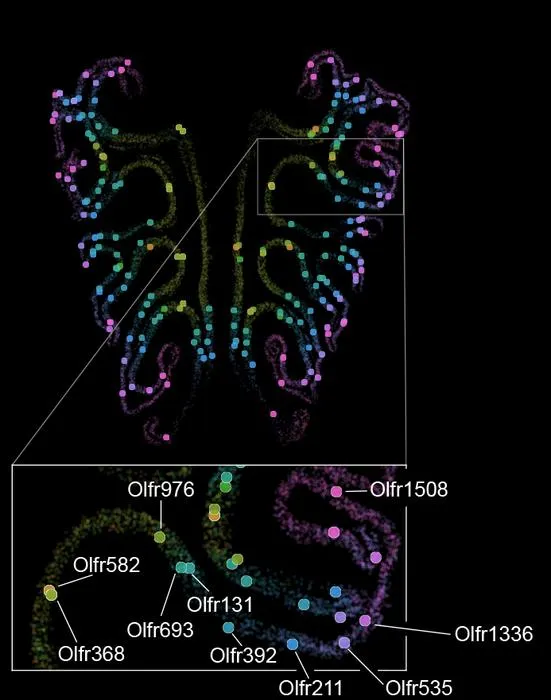
A colorful x-ray image of a mouse nose, showing various pathways with purple, blue and green lines.

A map of the thousand types of smell receptors in the scent-sensing tissue of a mouse nose, labeled by a color gradient. The bottom inset shows the precise spatial positions of specific smell receptors in the nose. (Image credit: Datta Lab)

The degree of complexity within the lining of the nose is remarkable, he added. "Mice, for example, have around 20 million olfactory neurons that express more than a thousand types of smell receptors, compared with only three main types of visual receptors for color vision," he said.

Interestingly, the positions of the roughly 1,100 types of receptors were essentially the same across every lab mouse the researchers examined. The work also identified a molecule called retinoic acid (RA) that likely guides each neuron to express the correct receptor based on the location. Adding or removing RA resulted in the receptor map shifting up or down, suggesting the molecule may help control the position and influence of the neurons.

Related stories

The researchers are now looking into why the stripes are arranged in that specific order. "[Another] question we're wondering about is, to what extent are human noses organized like this?" Datta said.

"The human olfactory system is, in many respects, similar to the mouse olfactory system [though we] have fewer odor receptors," he noted. "But we don't know much about whether these basic principles we're learning about in the mouse apply to humans." Understanding this could help develop treatments for loss of smell and its consequences, including an increased risk of depression.


See how much you know about the most complex organ in the human body with our brain quiz!

Payal Dhar (she/they) is a freelance journalist, writing on science, technology, and society. They cover AI, engineering, materials science, cybersecurity, space, games, online communities, and any shiny new technology that catches their eye. She has written for Science News, Scientific American, Nature, Washington Post, Guardian, Chemical & Engineering News, IEEE Spectrum, and others. They also write science-fiction and fantasty. You can follow her @payaldhar.bluesky.social or read her work at payaldhar.contently.com.