


惯性聚合 高效追踪和阅读你感兴趣的博客、新闻、科技资讯
阅读原文 在惯性聚合中打开

推荐订阅源

B
Blog RSS Feed
量子位
Recent Announcements
T
The Blog of Author Tim Ferriss
美团技术团队
Cyber Security Advisories - MS-ISAC
Blog — PlanetScale
Blog — PlanetScale
H
Help Net Security
freeCodeCamp Programming Tutorials: Python, JavaScript, Git & More
博客园 - Franky
让小产品的独立变现更简单 - ezindie.com
宝玉的分享
宝玉的分享
大猫的无限游戏
大猫的无限游戏
V
Visual Studio Blog
博客园 - 聂微东
aimingoo的专栏
aimingoo的专栏
Microsoft Security Blog
U
Unit 42
J
Java Code Geeks
钛媒体:引领未来商业与生活新知
钛媒体:引领未来商业与生活新知
IT之家
IT之家
Hugging Face - Blog
Hugging Face - Blog
腾讯CDC
L
LangChain Blog

Latest from Live Science

Naked mole rats wage bloody wars of succession to choose a new queen — but one colony did something scientists… Can the US be trusted with the moon? A law scholar raises concerns after Artemis II Lyrid meteor shower 2026: See spring's first rain of 'shooting stars' peak in moonless skies $3 million prize goes to duo whose research led to first sickle cell CRISPR therapy 700-year-old mummy from Bolivia contains earliest confirmed evidence of strep throat bacteria in the Americas New pain-relief opioid could be much less addictive than morphine, rodent study finds Experimental drug doubles one-year survival in pancreatic cancer Science news this week: Physicists witness faster-than-light darkness pinpricks, humans are still evolving, and some… Archaeologists discover perfectly circular ancient Egyptian temple that may have been used for sacred water rituals Some polar bears are adapting to their melting habitat. Will it be enough to save the iconic species? 2 supermassive black holes may collide 100 years from now ‪—‬ and Earth would feel it Anglo-Saxon burial holds an older sister cradling her little brother after they both died 1,400 years ago, possibly of… Colorado River may have pooled and spilled over to form the Grand Canyon, solving a long-standing mystery ‪—‬… 'We all screamed when it happened': Bright-green fireball meteor caught exploding over famous Viking raid site… Northern lights may be visible from several US states Friday and Saturday as giant hole opens up in sun Hackers used AI to steal hundreds of millions of Mexican government and private citizen records in one of the largest… The first black hole ever discovered is spewing 'dancing jets' at half the speed of light Stephen Hawking's black hole information paradox could be solved — if the universe has 7 dimensions 'Something's missing': Most thorough-ever study of the cosmos proves we still can't explain how the… 'Human evolution didn't slow down; we were just missing the signal': Large DNA study reveals natural selection led to more redheads and less male-pattern baldness Artemis II quiz: Is your knowledge of NASA New study confirms lobsters feel pain, driving scientists to call for a ban on boiling them alive This humanoid robot does all your housework for you ‪—‬ and its makers say it Ancient process that created rare earth elements discovered — and it could help us locate desperately needed deposits Strange mammal ancestor laid huge, leathery eggs —‬ and it was key to surviving the world 73 moon landings? NASA Diagnostic dilemma: A woman heard voices telling her she had a brain tumor ‪—‬ and scans confirmed she did Triassic croc relative from Ghost Ranch, New Mexico finally identified after nearly 80 years in museum basement There were Physicists witness pinpricks of darkness moving faster than the speed of light ‪—‬ without breaking the laws of relativity
Diagnostic dilemma: A woman turned black and blue weeks a...
Nicoletta La · 2026-05-06 · via Latest from Live Science

The patient: A 68-year-old woman in the U.S.

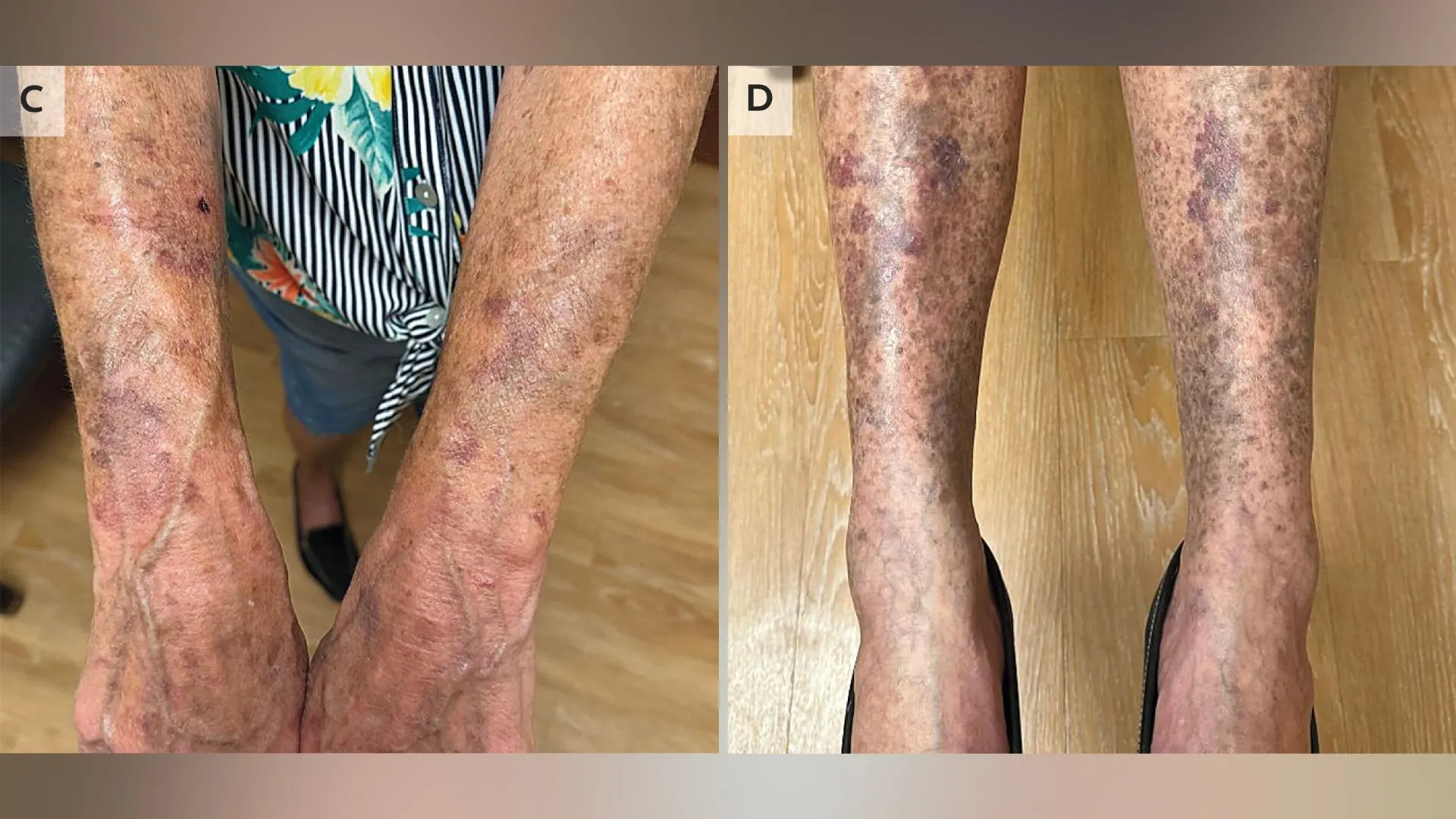
The symptoms: Over the course of six weeks, dark patches appeared on the woman's arms and legs. The splotches ranged from a bruise-like dark blue and purple to jet-black.

She also told doctors that, two weeks before the patches appeared, she'd started a course of minocycline, an oral antibiotic.

She had been prescribed a daily 100-milligram dose of the drug to treat symptoms of rosacea, which causes chronic inflammation and redness of the face. This inflammation can drive the formation of small, red bumps and pus-filled pimples on the skin, and evidence suggests that antibiotics like minocycline can help eliminate those bumps. In addition to killing bacteria, the drug is known to have anti-inflammatory effects, the latter of which may best explain how it treats rosacea.

The diagnosis: A well-established side effect of minocycline is hyperpigmentation, in which patches of skin become darker than the skin surrounding them. In this case, the woman was diagnosed with type II minocycline-induced hyperpigmentation, which is "defined by blue-gray discoloration of normal skin on the extensor surfaces of the arms and legs," according to a report of the case.

The antibiotic can also trigger two other types of hyperpigmentation. Type I shows up as blue-black discoloration on scarred or inflamed skin on the face, rather than on healthy skin on the limbs, and type III appears as muddy-brown pigmentation on sun-exposed areas of the body.
Get the world’s most fascinating discoveries delivered straight to your inbox.

A photo of a pale woman's arms, showing faded but visible blotches of hyperpigmentation, and a second photo showing the same pattern on her shins

At a six-month follow-up appointment, the woman's hyperpigmentation had faded a bit but was still visible.

(Image credit: The New England Journal of Medicine ©2026)

The treatment: Doctors advised the patient to stop taking minocycline and to avoid sun exposure, as ultraviolet light is thought to worsen hyperpigmentation in these cases. Six months later, the hyperpigmentation in her limbs had "abated somewhat" but was still visible.

What makes the case unique: Hyperpigmentation is not necessarily uncommon for minocycline users with rosacea; one frequently cited study estimates that the side effect shows up in about 28% of people in this population, although that research included only a small number of patients. The true incidence of the side effect is unclear.

This woman's case was notable, in part, because of how quickly the discoloration developed ‪—‬ within two weeks of starting minocycline. While type I minocycline-induced hyperpigmentation can show up soon after a person starts taking the drug, type II and type III usually take longer to appear.

"It typically develops after months of treatment but may rarely occur with shorter courses," the case report authors noted. Type II and type III are thought to be dose-dependent, in that a certain amount of the drug needs to build up in the body before the dark patches show up.

The cause of minocycline-induced hyperpigmentation isn't fully understood, but it's thought to result from how the antibiotic gets broken down in the body. The metabolites, or byproducts, created in this process bind to iron and are then picked up by immune cells called macrophages, in which they accumulate. Additionally, the drug may drive up the activity of cells that make melanin — the pigment that gives skin its color — while also binding to melanin, thereby creating complexes of dark pigment that linger in the skin.

Once a person stops taking minocycline, the pigmentation can take months to years to dissipate, reports suggest. In type III cases, it sometimes never goes away.

For more intriguing medical cases, check out our Diagnostic Dilemma archives.

Disclaimer

This article is for informational purposes only and is not meant to offer medical advice.


Can you guess the diagnosis in these strange medical cases? Find out with our diagnostic dilemma quiz!