


惯性聚合 高效追踪和阅读你感兴趣的博客、新闻、科技资讯
阅读原文 在惯性聚合中打开

推荐订阅源

博客园 - 聂微东
GbyAI
GbyAI
G
Google Developers Blog
大猫的无限游戏
大猫的无限游戏
H
Hackread – Cybersecurity News, Data Breaches, AI and More
博客园 - 叶小钗
A
About on SuperTechFans
M
MIT News - Artificial intelligence
宝玉的分享
宝玉的分享
雷峰网
雷峰网
钛媒体:引领未来商业与生活新知
钛媒体:引领未来商业与生活新知
Martin Fowler
Martin Fowler
Google DeepMind News
博客园 - Franky
B
Blog RSS Feed
Y
Y Combinator Blog
Stack Overflow Blog
Stack Overflow Blog
MongoDB | Blog
MongoDB | Blog
Last Week in AI
Last Week in AI
T
The Blog of Author Tim Ferriss
The GitHub Blog
The GitHub Blog
S
SegmentFault 最新的问题
罗磊的独立博客
Apple Machine Learning Research

Latest from Live Science

Naked mole rats wage bloody wars of succession to choose a new queen — but one colony did something scientists… Can the US be trusted with the moon? A law scholar raises concerns after Artemis II Lyrid meteor shower 2026: See spring's first rain of 'shooting stars' peak in moonless skies $3 million prize goes to duo whose research led to first sickle cell CRISPR therapy 700-year-old mummy from Bolivia contains earliest confirmed evidence of strep throat bacteria in the Americas New pain-relief opioid could be much less addictive than morphine, rodent study finds Experimental drug doubles one-year survival in pancreatic cancer Science news this week: Physicists witness faster-than-light darkness pinpricks, humans are still evolving, and some… Archaeologists discover perfectly circular ancient Egyptian temple that may have been used for sacred water rituals Some polar bears are adapting to their melting habitat. Will it be enough to save the iconic species? 2 supermassive black holes may collide 100 years from now ‪—‬ and Earth would feel it Anglo-Saxon burial holds an older sister cradling her little brother after they both died 1,400 years ago, possibly of… Colorado River may have pooled and spilled over to form the Grand Canyon, solving a long-standing mystery ‪—‬… 'We all screamed when it happened': Bright-green fireball meteor caught exploding over famous Viking raid site… Northern lights may be visible from several US states Friday and Saturday as giant hole opens up in sun Hackers used AI to steal hundreds of millions of Mexican government and private citizen records in one of the largest… The first black hole ever discovered is spewing 'dancing jets' at half the speed of light Stephen Hawking's black hole information paradox could be solved — if the universe has 7 dimensions 'Something's missing': Most thorough-ever study of the cosmos proves we still can't explain how the… 'Human evolution didn't slow down; we were just missing the signal': Large DNA study reveals natural selection led to more redheads and less male-pattern baldness Artemis II quiz: Is your knowledge of NASA New study confirms lobsters feel pain, driving scientists to call for a ban on boiling them alive This humanoid robot does all your housework for you ‪—‬ and its makers say it Ancient process that created rare earth elements discovered — and it could help us locate desperately needed deposits Strange mammal ancestor laid huge, leathery eggs —‬ and it was key to surviving the world 73 moon landings? NASA Diagnostic dilemma: A woman heard voices telling her she had a brain tumor ‪—‬ and scans confirmed she did Triassic croc relative from Ghost Ranch, New Mexico finally identified after nearly 80 years in museum basement There were Physicists witness pinpricks of darkness moving faster than the speed of light ‪—‬ without breaking the laws of relativity
Neanderthal toddlers grew faster than modern humans, prob...
kkillgrove@l · 2026-04-21 · via Latest from Live Science
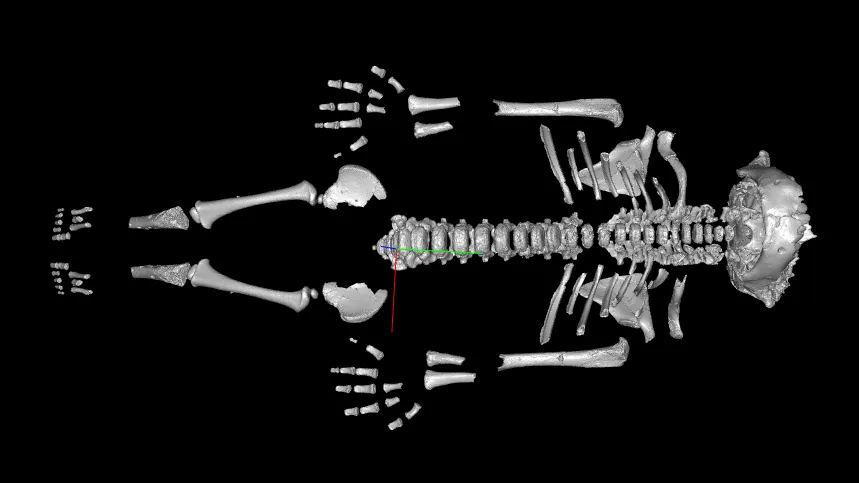
screencap of a 3D model of a Neanderthal child skeleton
The researchers made a 3D model of the Amud 7 Neanderthal skeleton. (Image credit: Been et al. (CC BY 4.0))

Neanderthal toddlers grew faster than their modern human counterparts, likely as an adaptation to living in a cold, harsh environment, new research suggests.

The discovery, which was made using the bones of a young Neanderthal discovered in Amud Cave in northern Israel in the 1990s, suggests that Neanderthals and modern humans (Homo sapiens) followed different evolutionary paths after they split from a common ancestor around 600,000 years ago, the researchers reported April 15 in the journal Current Biology.

The Amud 7 skeleton was found in more than 100 pieces, which included fragments of the child's arms, legs, chest and skull, all of which displayed distinctively Neanderthal anatomical features even at the child's young age. However, because Neanderthal infant skeletons are rarely found, the actual age at death of Amud 7 has been difficult for researchers to pin down.

Archaeologists typically estimate an ancient child's age based on the growth and eruption of teeth and on the size and completeness of various bones. The growth curves for the bones and teeth of modern human babies are well documented, but Amud 7 has revealed that at least one of the Neanderthals' growth stages was much faster than modern humans'.

When the researchers compared the tooth development of Amud 7 with that of modern humans, they found that the Neanderthal's lower front teeth yielded an age estimate of about 6 months. But Amud 7's bones were more in line with those of a 14-month-old modern human. This discrepancy is likely related to differing growth stages, the researchers wrote in the study.

While newborn Neanderthals were comparable with modern human newborns in terms of tooth formation, tooth eruption and the lengths of the arm and leg bones, they had significantly larger skulls. In the second growth stage — infants, toddlers and young children, or about 1 to 6 years old — Neanderthals' bodies grew significantly faster than their teeth, while modern human babies' teeth and bodies grew more proportionately. Then, in later childhood, Neanderthals' body growth and tooth development evened out and more closely matched modern human children's trajectories, the researchers found.

RELATED STORIES

"The results of this study suggest that the growth trajectory of young Neandertal infants may have differed from that of H. sapiens," the researchers wrote in the study. Specifically, Neanderthal babies' bodies developed more rapidly than modern humans' did in the first years of life but then evened out during later childhood. "This suggests an evolutionary strategy emphasizing accelerated development in the early years of life, likely advantageous in the harsh environments Neandertals inhabited," the researchers wrote.

Get the world’s most fascinating discoveries delivered straight to your inbox.

Although this new analysis of the Amud 7 skeleton reveals important information about Neanderthal children's growth and development, the researchers cautioned that more data is needed from other non-adult Neanderthal skeletons. They noted that a larger sample size may shed light on whether this pattern was widespread or a specific ecological adaptation.

Article Sources

Been, E., Hovered, E., Rak, Y., Le Cabec, A., Dean, C., Barash, A. (2026). Rapid growth in a Neandertal infant from Amud Cave in Israel. Current Biology 36. https://doi.org/10.1016/j.cub.2026.03.054


How much do you know about our closest relatives? Test your knowledge with our Neanderthal quiz!

Kristina Killgrove is a staff writer at Live Science with a focus on archaeology and paleoanthropology news. Her articles have also appeared in venues such as Forbes, Smithsonian, and Mental Floss. Kristina holds a Ph.D. in biological anthropology and an M.A. in classical archaeology from the University of North Carolina, as well as a B.A. in Latin from the University of Virginia, and she was formerly a university professor and researcher. She has received awards from the Society for American Archaeology and the American Anthropological Association for her science writing.

You must confirm your public display name before commenting

Please logout and then login again, you will then be prompted to enter your display name.