




The samurai of Japan are famous for being skilled warriors who followed a code of honor. In popular culture and museums, samurai are often depicted as men, which raises a question: Were any samurai women?
Female samurai existed and there is some evidence that they fought in battle, several experts told Live Science. But how often they fought is a matter of debate, with some scholars calling it very rare and others suggesting it happened more often.
Sign up for our newsletter

(Image credit: Marilyn Perkins / Future)
Sign up for our weekly Life's Little Mysteries newsletter to get the latest mysteries before they appear online.
"Any woman born in the samurai status group was a 'female samurai' even if she never picked up a weapon, just as any man born into that status group was a samurai, no matter how wimpy/untrained/etc. he may have been," Sean O'Reilly, a professor of Japan studies at Akita International University, told Live Science in an email.
It's unclear how often female samurai fought in battle, however. Women who fought in battle are sometimes called "onna-musha," which translates to "women warriors."
"I must say, as an historian, that onnamusha — female warriors — were probably not as frequent or as militarily significant as most people today believe," O'Reilly said.
Some particularly good evidence for female samurai participating in battle comes from the late 19th century, near the time when the samurai class was abolished, Diana Wright, who was a professor at Western Washington University, wrote in a 2001 article in the journal "War in History."
At that time, Japan was in a civil war as supporters of the Tokugawa Shogunate, which ruled Japan from around 1603 to 1868, battled those who wanted to overthrow the shogunate and return some of the military governor's powers to the emperor. The Boshin War, as it is sometimes called, lasted from January 1868 to June 1869. During that war, there were a number of recorded instances where female samurai, who fought on the side of the shogunate, engaged in battle, Wright noted in her article.
The shogunate forces were led by the Aizu domain (a regional government in northern Japan), and during the siege of the Aizu's capital of Aizu-Wakamatsu, a group of female samurai formed their own unit known as the "Joshigun."
"Although 20 to 30 women are believed to have made up the unit, the names of only 10 are known," Wright wrote. A 22 year-old woman named Nakano Takeko was the unit's unofficial leader.
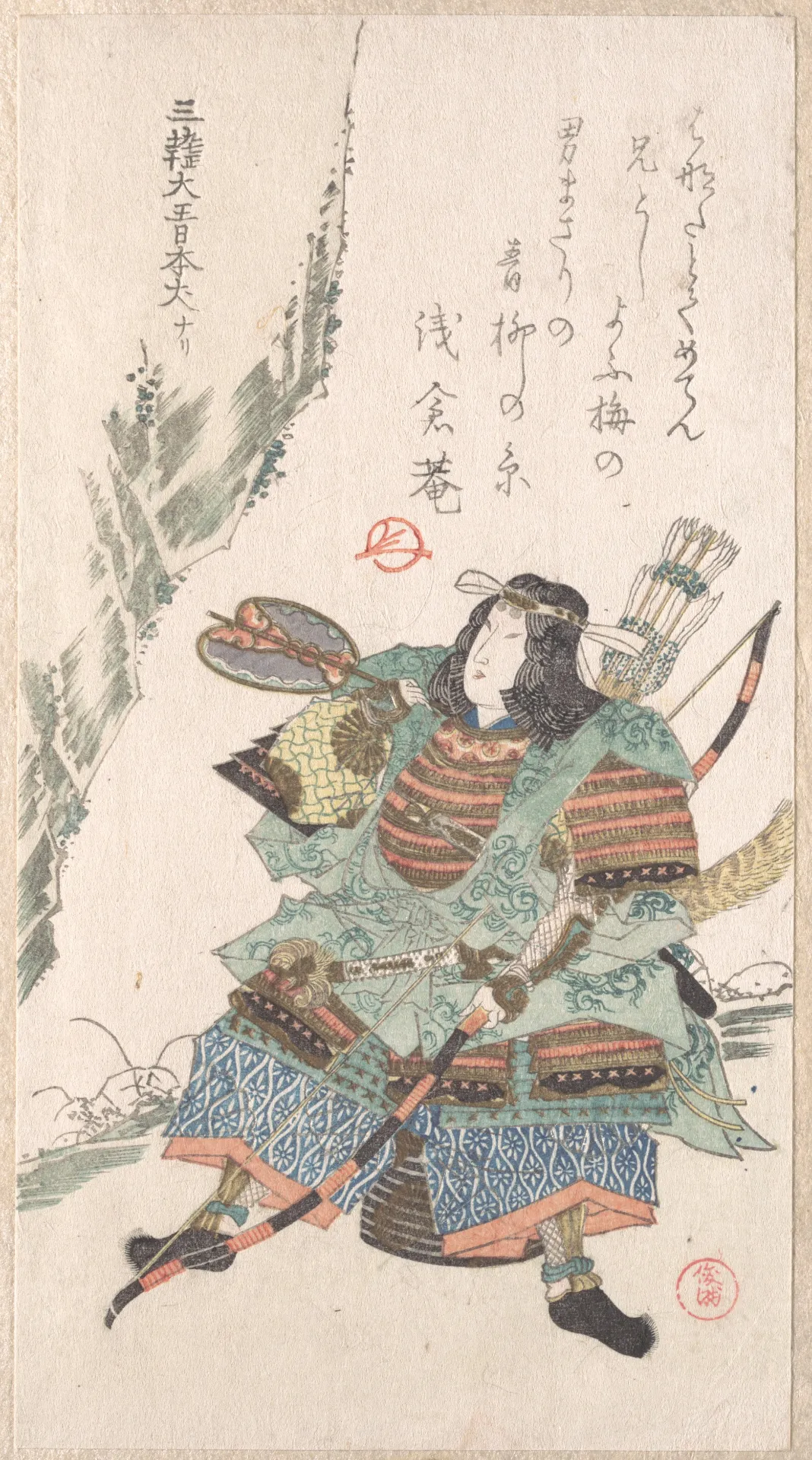
A 19th-century woodblock depicts a female warrior in armor.
(Image credit: H. O. Havemeyer Collection, Bequest of Mrs. H. O. Havemeyer, 1929, the Met Museum; Public Domain)
Armed with only swords and naginatas (pole weapons with curved blades that can both stab and slash), they fought in a battle at Yanagi bridge against a force equipped with rifles, Wright explained. Records indicate that Nakano Takeko killed five or six men with her naginata before she was shot down. Ultimately, the battle ended in defeat and the surviving members of the Joshigun, along with the male troops, had to withdraw to a castle.
During the time of the Tokugawa shogunate, women of the samurai class were required to undergo martial art training with the naginata so they could defend themselves and their families, Wright noted. The amount of training they received varied, with the women of the Aizu domain tending to receive a larger amount.
Remains of female warriors?
A mound located in Numazu, a city in central Japan, may hold the remains of female samurai who fought in battle, some scholars believe. The mound contains human skulls, along with other skeletal bones, and an analysis of the mound's remains was published in Japanese in 1989 in the Journal of Anthropology. The skulls are from about 105 people; all of them were young adults when they died, and about one-third were women. They date to the 16th century, and scientists interpreted them as being the remains of people who were killed in combat, likely in the Battle of Senbonhama (also known as the Battle of Senbon Matsubara), which was fought between the Takeda and Hojo clans.
This mound is "indicative that women of fighting age fought and died in sixteenth century battles," Thomas Conlan, a professor of medieval Japanese history at Princeton University, told Live Science in an email.
However, Karl Friday, a professor emeritus of history at the University of Georgia, said the mound should be regarded with caution, as we can't be sure everyone buried in it actually fought in a battle. It's possible that some of the people buried in the mound were noncombatants who were killed anyway, Friday told Live Science in an email.
Stories and legends of female samurai
A number of stories refer to female samurai fighting in battle. Perhaps the most famous was Tomoe Gozen, who lived during the late 12th century. Stories say she served a lord named Minamoto no Yoshinaka and fought in the Genpei War, which was fought between the Taira and Minamoto clans between about 1180 and 1185, Thomas Lockley, a law professor at Nihon University who has studied and written extensively about the samurai, wrote in a 2022 article in the magazine Medieval World: Culture & Conflict.
One of the chronicles, called "The Tale of the Heike," says that as "a fighter she was a match for a thousand ordinary men, skilled in arms, able to bend the stoutest bow, on horseback or on foot, ever ready with her sword to confront any devil or god that came her way" (translation by Thomas Lockley).
Another famous woman mentioned in stories was Ōhōri Tsuruhime, who lived circa 1526 to 1543. She became the chief priestess of Ōyamazumi Shrine, located on the island of Ōmishima, after her father and brothers were killed while defending the island from a daimyo (a regional governor) named Ōuchi Yoshitaka, Stephen Turnbull, a historian who has written extensively on the samurai, wrote in his book "Samurai Women: 1187-1877" (Osprey Publishing, 2012). Despite being just 16 years old, she took charge of the island's defense force and defended it from the invaders. During her defense, she claimed to have been aided by the shrine's kami (spirit) and has been compared to Joan of Arc, Turnbull noted.
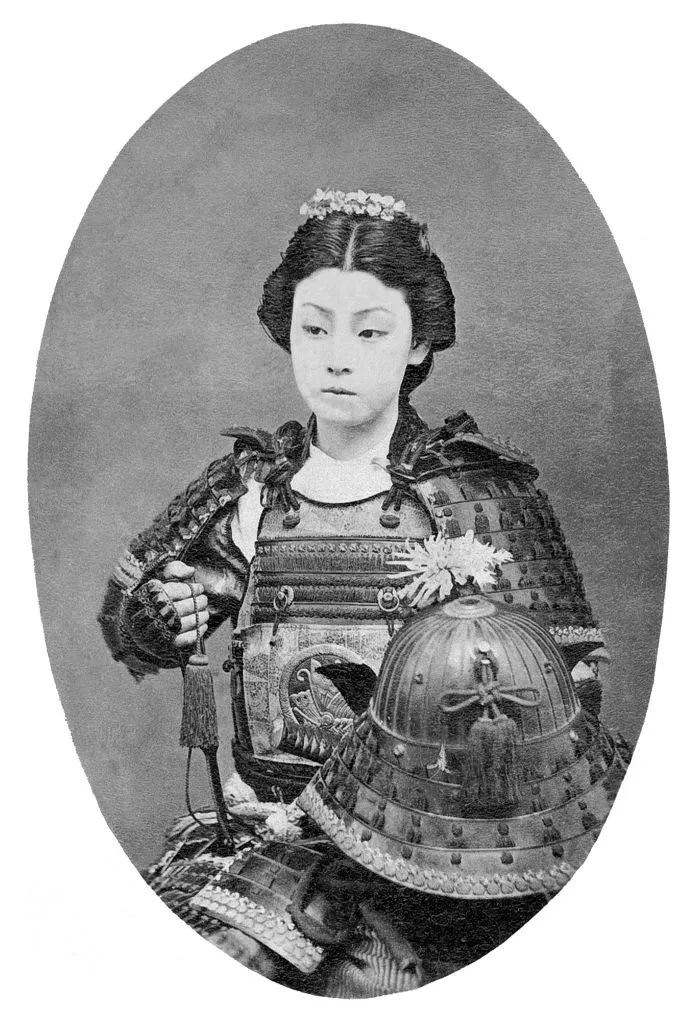
An 1870 photo of an actress dressed as a female samurai in armor.
(Image credit: Pictures from History via Getty Images)
Some of what's said to be Tsuruhime's armor survives today and is displayed at the shrine. Conlan said that it is a suit of 16th century armor that is "tailored to the female anatomy."
However, Friday said we should be cautious when interpreting stories like these. "We do have stories about female warriors, like Tomoe Gozen, Hangaku Gozen, Ohori Tsuruhime, Ueno Tsuruhime, and a few others, but these women are all semi-legendary — especially with regard to their participation in battles," Friday told Live Science in an email.
Regardless of how accurate the stories are, female warriors became famous. "Mythologizing female warriors of yore began in Japan's Kamakura period [circa 1185 to 1333] and intensified in the Edo period [circa 1603 to 1868], with a huge proliferation of woodblock prints showing women holding naginata and so forth," O'Reilly said. Friday said the "very fact that these women became so famous is a pretty good indication of how uncommon female warriors must have been."
Taboos about women and battle
Friday thinks it would have been very rare for female samurai to engage in battle because it was considered taboo.
"One fascinating primer on military conduct, passed down within a branch of the Hōjō family, enjoined against such things as sharing quarters with women for three days prior to battles, allowing pregnant women or women who had recently given birth to touch a warrior's weapons, riding in boats with female passengers while in route to battle, and even allowing women to look upon the backs of officers departing for campaigns!" Friday said.
"The bottom line is that while there almost certainly must have been at least a few cases of women participating in Japanese battles over the course of [the] 8th to 16th centuries … there's absolutely no good evidence to support the conclusion that women warriors were any more common in Japan than they were in medieval France or ancient Sparta, much less that this occurred often enough to justify calling it a practice or even a phenomenon," Friday said.
While the samurai class was effectively abolished during the 1870s, some of the training practices done by female samurai are still carried out today. Eric Shahan, a Japanese translator who specializes in translating martial arts texts, noted that the Yoshin School (a branch of traditional Japanese martial arts) "still practices Naginata in Kimono, reflecting the fact that women may have to suddenly take up arms — and therefore have no time to change into training gear."
Can you identify these historical objects of war? Test your smarts with our weapons of the world quiz!