

惯性聚合 高效追踪和阅读你感兴趣的博客、新闻、科技资讯
阅读原文 在惯性聚合中打开

推荐订阅源

量子位
雷峰网
雷峰网
博客园 - 三生石上(FineUI控件)
月光博客
月光博客
有赞技术团队
有赞技术团队
阮一峰的网络日志
阮一峰的网络日志
Last Week in AI
Last Week in AI
G
Google Developers Blog
腾讯CDC
B
Blog
Microsoft Azure Blog
酷 壳 – CoolShell
酷 壳 – CoolShell
Microsoft Security Blog
人人都是产品经理
人人都是产品经理
博客园_首页
T
Tailwind CSS Blog
C
Check Point Blog
博客园 - 【当耐特】
MongoDB | Blog
MongoDB | Blog
A
About on SuperTechFans
Y
Y Combinator Blog
L
LangChain Blog
Engineering at Meta
Engineering at Meta
GbyAI
GbyAI

Latest from Live Science

Naked mole rats wage bloody wars of succession to choose a new queen — but one colony did something scientists… Can the US be trusted with the moon? A law scholar raises concerns after Artemis II Lyrid meteor shower 2026: See spring's first rain of 'shooting stars' peak in moonless skies $3 million prize goes to duo whose research led to first sickle cell CRISPR therapy 700-year-old mummy from Bolivia contains earliest confirmed evidence of strep throat bacteria in the Americas New pain-relief opioid could be much less addictive than morphine, rodent study finds Experimental drug doubles one-year survival in pancreatic cancer Science news this week: Physicists witness faster-than-light darkness pinpricks, humans are still evolving, and some… Archaeologists discover perfectly circular ancient Egyptian temple that may have been used for sacred water rituals Some polar bears are adapting to their melting habitat. Will it be enough to save the iconic species? 2 supermassive black holes may collide 100 years from now ‪—‬ and Earth would feel it Anglo-Saxon burial holds an older sister cradling her little brother after they both died 1,400 years ago, possibly of… Colorado River may have pooled and spilled over to form the Grand Canyon, solving a long-standing mystery ‪—‬… 'We all screamed when it happened': Bright-green fireball meteor caught exploding over famous Viking raid site… Northern lights may be visible from several US states Friday and Saturday as giant hole opens up in sun Hackers used AI to steal hundreds of millions of Mexican government and private citizen records in one of the largest… The first black hole ever discovered is spewing 'dancing jets' at half the speed of light Stephen Hawking's black hole information paradox could be solved — if the universe has 7 dimensions 'Something's missing': Most thorough-ever study of the cosmos proves we still can't explain how the… 'Human evolution didn't slow down; we were just missing the signal': Large DNA study reveals natural selection led to more redheads and less male-pattern baldness Artemis II quiz: Is your knowledge of NASA New study confirms lobsters feel pain, driving scientists to call for a ban on boiling them alive This humanoid robot does all your housework for you ‪—‬ and its makers say it Ancient process that created rare earth elements discovered — and it could help us locate desperately needed deposits Strange mammal ancestor laid huge, leathery eggs —‬ and it was key to surviving the world 73 moon landings? NASA Diagnostic dilemma: A woman heard voices telling her she had a brain tumor ‪—‬ and scans confirmed she did Triassic croc relative from Ghost Ranch, New Mexico finally identified after nearly 80 years in museum basement There were Physicists witness pinpricks of darkness moving faster than the speed of light ‪—‬ without breaking the laws of relativity
'What are the odds': Superbright comet and exploding fire...
Harry Baker · 2026-04-23 · via Latest from Live Science
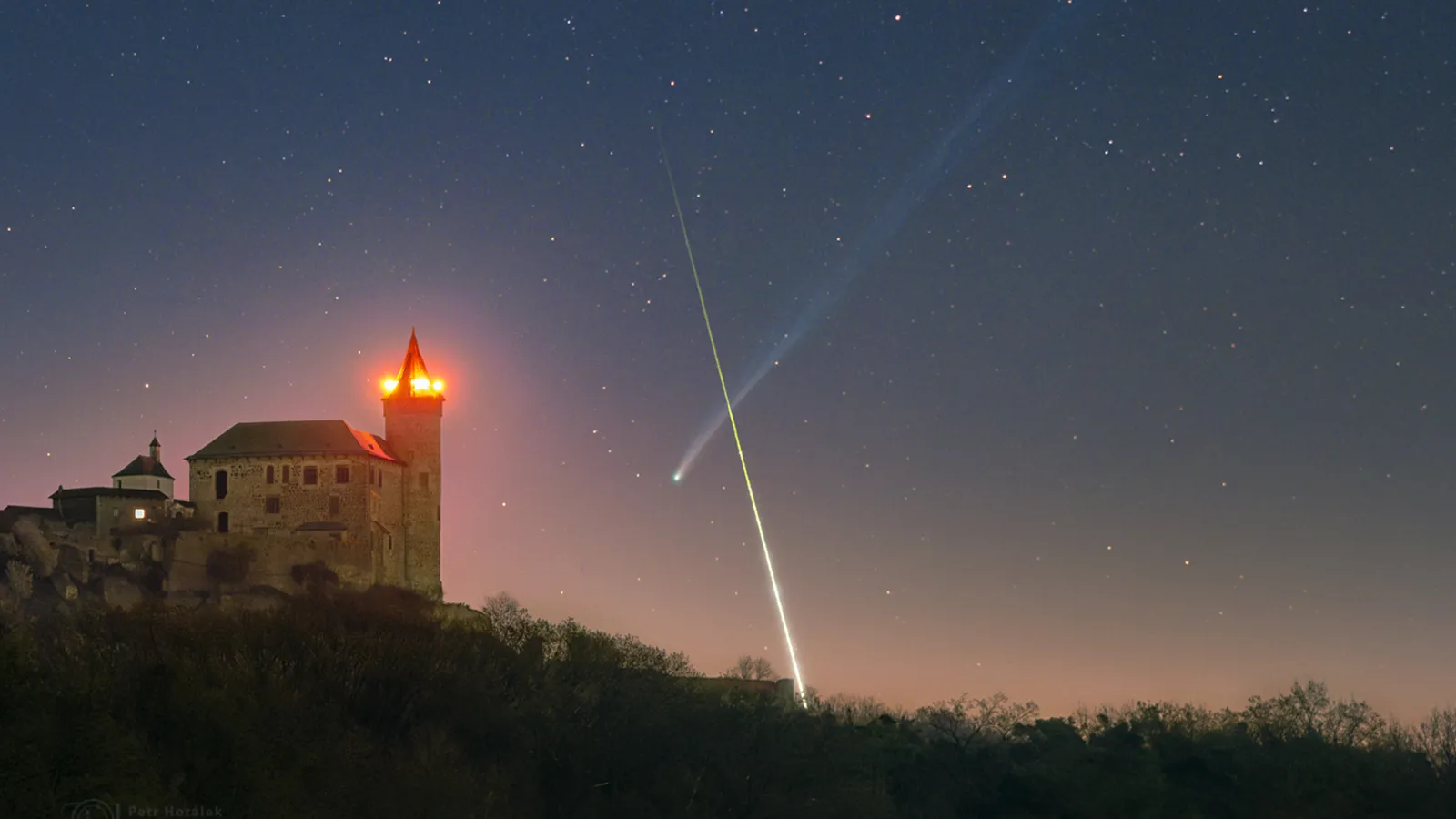
A timelapse image showing a bright streak of light crossing in front of a comet's long tail to form an X-like shape in the night sky. A medieval castle is illuminated in the foreground.
A brilliant fireball meteor was snapped streaking in front of the lengthy tail of Comet C/2025 R3 (PanSTARRS) over a Czech castle in the early hours of April 18. (Image credit: Petr Horálek/Josef Kujal)

A dramatic photo shows the extremely unlikely moment when a blazing fireball meteor photobombed a contender for the "Great Comet of 2026" as it shone in the night sky over a 500-year-old European castle.

Photographers Petr Horálek and Josef Kujal snapped the cosmic coincidence on April 18 in the skies over the ruins of the 15th-century Kunětická Hora Castle, in the central Czech Republic, at around 4:15 a.m. local time. They were initially attempting to capture the lengthy tail of Comet C/2025 R3 (PanSTARRS) when a bright streak of light flew across the sky in front of their target.

Reports from the European Fireball Network later confirmed that the streaking light was a fireball meteor that resulted from an asteroid exploding over Poland shortly after entering Earth's atmosphere, Horálek told Live Science. It is currently unclear how large the space rock was, how fast it was traveling or how long it shone in the sky.

"What are the odds," Horálek wrote in an Instagram post. By combining his photos with Kujal's, Horálek created a time-lapse image to "show the whole lucky moment," he added.

The photo is even more incredible considering that this was the "last chance to capture the comet from mid-Europe," due to adverse weather conditions the following nights, Horálek wrote on his personal website. If the incident had occurred just 15 minutes later, light from the rising sun likely would have obscured the comet's tail, he added.
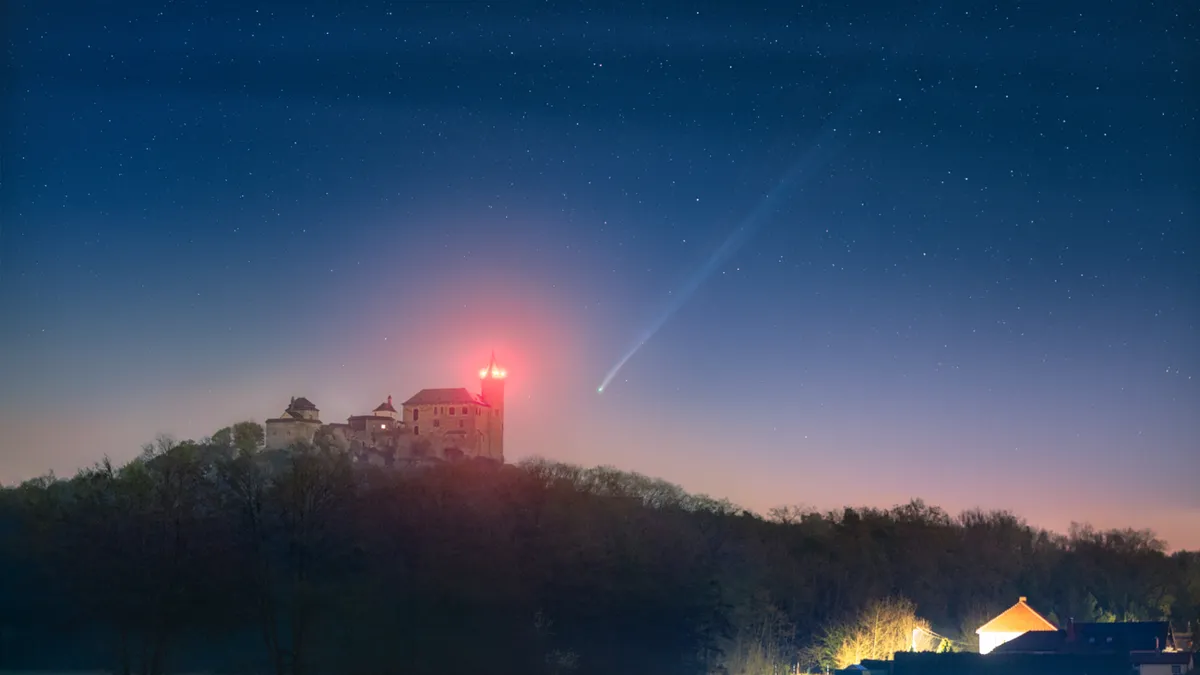
A photo of a long-tiled comet in the night sky. A medieval castle and house are illuminated in the foreground.

Horálek and Kujal were photographing the long tail of Comet PanSTARRS before the fireball made a surprise appearance. (Image credit: Petr Horálek)

A similarly unlikely photo was captured last October, when the tail of Comet Lemmon appeared to be entwined with a smoke trail left by a "shooting star." However, in this case, the photographer was able to intentionally align the comet with the smoke trail, which lingered in the air after the meteor burned up, making the newest photo arguably more impressive.

The Great Comet of 2026?

Comet PanSTARRS is a long-period comet, meaning it likely takes more than 200 years to orbit the sun. It probably originates from the Oort cloud, a giant reservoir of comets and other icy objects near the edge of the solar system.

Get the world’s most fascinating discoveries delivered straight to your inbox.

The comet passed its closest point to the sun, or perihelion, Sunday (April 19). It was clearly visible with a decent telescope or pair of stargazing binoculars beginning April 13. However, it has now largely disappeared from view.
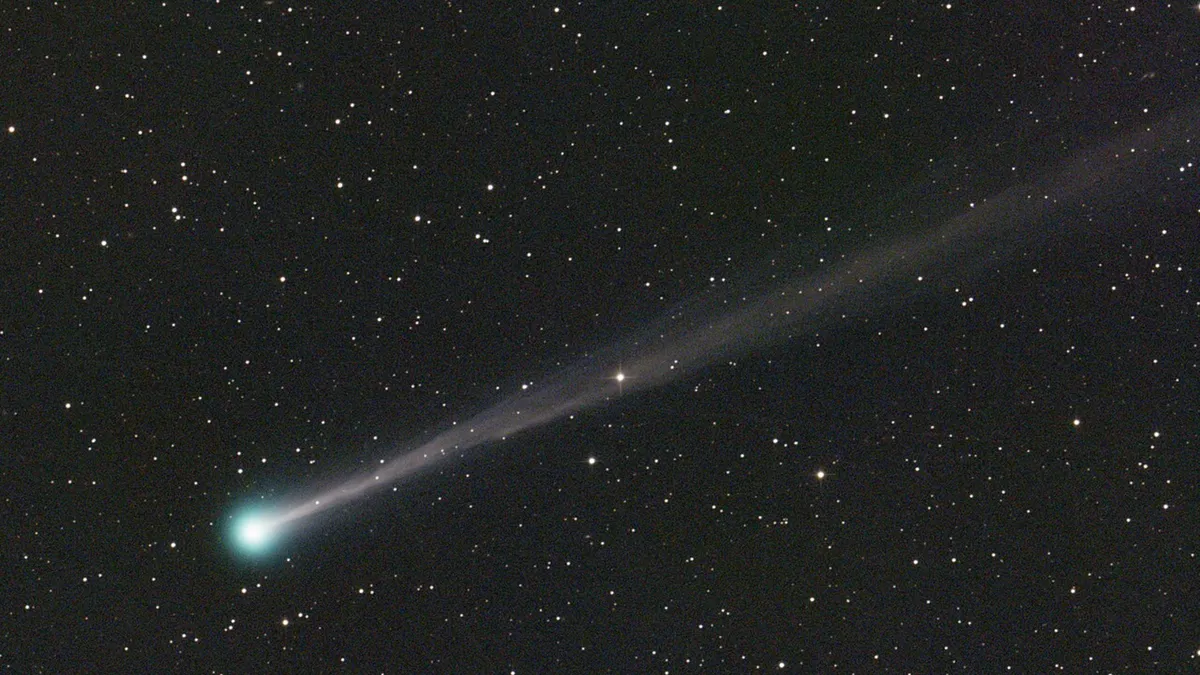
An astronomical photo of a comet and its long tail with the starry backdrop of space

Comet PanSTARRS reached perihelion on April 19 and reached a minimum distance of around 0.5 astronomical units (half the Earth-sun distance) from our home star. (Image credit: Dimitrios Katevainis via Wikimedia)

The comet was first spotted in September 2025, and some experts later suggested that it could become the most easily visible comet of 2026. So far, this prediction has held true, especially after its main competitor — the sungrazer comet C/2026 A1 (MAPS) — ripped apart during its superclose approach to the sun earlier this month, before it got a chance to shine properly.

However, there is always a chance that a previously unknown comet could emerge to steal the show, much like the interstellar comet 3I/ATLAS, which was discovered last July and went on to become one of the biggest space news stories of the year.

"Fireball season"

Fireball meteors occur when falling space rocks suddenly split apart due to strain on their surfaces caused by friction with the atmosphere. This releases energy in the form of bright light, which can shine in many potential colors depending on the meteor's chemical composition.

Photograph of Lindisfarne Castle at night with the band of the Milky Way on the left of the image and a streaking line of green light on the right hand side

A bright green fireball was also spotted shooting across the sky above Lindisfarne Castle in northeast England on April 13. (Image credit: Ian Sproat/@mje_photography_ne)

Fireballs are most likely between February and April, also known as "fireball season," when the number of exploding space rocks can rise by between 10% and 30% compared with the rest of the year, according to NASA. This is likely due to Earth's position relative to the sun and the rest of the solar system. However, experts are still not entirely sure why.

RELATED STORIES

This fireball season has been particularly eventful, especially March, when there were at least 10 major fireballs visible in the U.S. — the highest total for that month since 2012, according to AccuWeather.com. This included a cannonball-size meteor crashing through the roof of a house in Texas and a rare daytime explosion that triggered a powerful sonic boom over Ohio.

A bright fireball also exploded over Europe last month and showered a German town with meteorites, one of which also punched a football-size hole through the roof of a house. And just last week, on April 13, a bright-green fireball exploded over the North Sea and was spectacularly snapped streaking above Lindisfarne Castle in northeast England.

Harry is a U.K.-based senior staff writer at Live Science. He studied marine biology at the University of Exeter before training to become a journalist. He covers a wide range of topics including space exploration, planetary science, space weather, climate change, animal behavior and paleontology. His recent work on the solar maximum won "best space submission" at the 2024 Aerospace Media Awards and was shortlisted in the "top scoop" category at the NCTJ Awards for Excellence in 2023. He also writes Live Science's weekly Earth from space series.

You must confirm your public display name before commenting

Please logout and then login again, you will then be prompted to enter your display name.