
惯性聚合 高效追踪和阅读你感兴趣的博客、新闻、科技资讯
阅读原文 在惯性聚合中打开

推荐订阅源

博客园 - 司徒正美
M
MIT News - Artificial intelligence
博客园_首页
IT之家
IT之家
L
LangChain Blog
D
DataBreaches.Net
Cyber Security Advisories - MS-ISAC
Google DeepMind News
Blog — PlanetScale
Blog — PlanetScale
人人都是产品经理
人人都是产品经理
博客园 - Franky
云风的 BLOG
云风的 BLOG
罗磊的独立博客
量子位
G
Google Developers Blog
freeCodeCamp Programming Tutorials: Python, JavaScript, Git & More
博客园 - 【当耐特】
博客园 - 叶小钗
S
SegmentFault 最新的问题
Stack Overflow Blog
Stack Overflow Blog
B
Blog
T
Tailwind CSS Blog
A
About on SuperTechFans
让小产品的独立变现更简单 - ezindie.com

Latest from Live Science

Naked mole rats wage bloody wars of succession to choose a new queen — but one colony did something scientists… Can the US be trusted with the moon? A law scholar raises concerns after Artemis II Lyrid meteor shower 2026: See spring's first rain of 'shooting stars' peak in moonless skies $3 million prize goes to duo whose research led to first sickle cell CRISPR therapy 700-year-old mummy from Bolivia contains earliest confirmed evidence of strep throat bacteria in the Americas New pain-relief opioid could be much less addictive than morphine, rodent study finds Experimental drug doubles one-year survival in pancreatic cancer Science news this week: Physicists witness faster-than-light darkness pinpricks, humans are still evolving, and some… Archaeologists discover perfectly circular ancient Egyptian temple that may have been used for sacred water rituals Some polar bears are adapting to their melting habitat. Will it be enough to save the iconic species? 2 supermassive black holes may collide 100 years from now ‪—‬ and Earth would feel it Anglo-Saxon burial holds an older sister cradling her little brother after they both died 1,400 years ago, possibly of… Colorado River may have pooled and spilled over to form the Grand Canyon, solving a long-standing mystery ‪—‬… 'We all screamed when it happened': Bright-green fireball meteor caught exploding over famous Viking raid site… Northern lights may be visible from several US states Friday and Saturday as giant hole opens up in sun Hackers used AI to steal hundreds of millions of Mexican government and private citizen records in one of the largest… The first black hole ever discovered is spewing 'dancing jets' at half the speed of light Stephen Hawking's black hole information paradox could be solved — if the universe has 7 dimensions 'Something's missing': Most thorough-ever study of the cosmos proves we still can't explain how the… 'Human evolution didn't slow down; we were just missing the signal': Large DNA study reveals natural selection led to more redheads and less male-pattern baldness Artemis II quiz: Is your knowledge of NASA New study confirms lobsters feel pain, driving scientists to call for a ban on boiling them alive This humanoid robot does all your housework for you ‪—‬ and its makers say it Ancient process that created rare earth elements discovered — and it could help us locate desperately needed deposits Strange mammal ancestor laid huge, leathery eggs —‬ and it was key to surviving the world 73 moon landings? NASA Diagnostic dilemma: A woman heard voices telling her she had a brain tumor ‪—‬ and scans confirmed she did Triassic croc relative from Ghost Ranch, New Mexico finally identified after nearly 80 years in museum basement There were Physicists witness pinpricks of darkness moving faster than the speed of light ‪—‬ without breaking the laws of relativity
Why are some constellations visible for only part of the ...
Alice Sun · 2026-04-25 · via Latest from Live Science
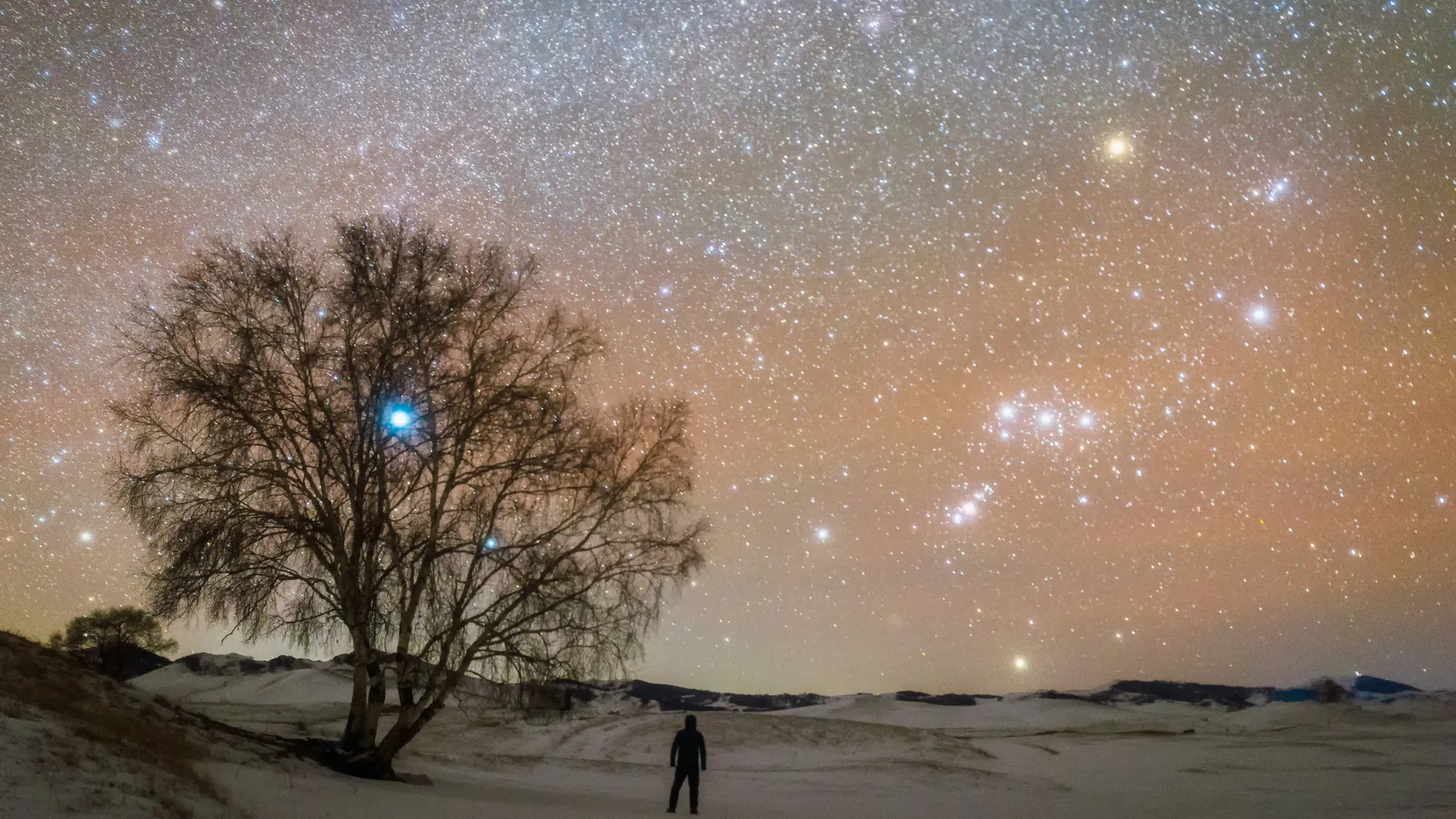
A glowing orange night sky is full of stars overlooking a winter landscape with a large tree in the left of the image
The Orion constellation can be clearly seen in the winter in the Northern Hemisphere. In the Southern Hemisphere, it's high in the night sky during the summer, but it appears upside down. (Image credit: wenbin via Getty Images)

Some stars and constellations are ever-present in the night sky; Polaris, for example, has served as a steady guiding light for millennia in the Northern Hemisphere.

But if you look closely at the sky night after night, you may notice that some stars move east to west from dusk to dawn, as well as change positions from season to season. For instance, Orion disappears from view for part of the year. So why do some constellations stay visible year-round, while others disappear and reappear depending on the season?

To make sense of this, it's helpful to note that when we look at the night sky, we're viewing only a section of the universe. "When the Earth turns to face away from the sun, that's when we have night time," Valerie Rapson, an astronomer at the State University of New York at Oneonta, told Live Science. "And whatever stars are in that direction … those are the stars we would see."

In addition, which constellations you'll see depends on where you are on the globe. Stargazers in the Northern Hemisphere see stars and constellations above the equator, whereas Southern Hemisphere observers see stars and constellations south of the equator.

As our tilted Earth revolves around the sun over a span of a year, different parts of space come into view while others shift away. In the Northern Hemisphere, for example, Orion's Belt ‪—‬ what looks like a line of three bright and blinking stars in the Orion constellation ‪—‬ is most clearly seen in the winter. But in the summer, as Earth orbits to the other side of the sun, Orion is in the part of space not visible from the Northern Hemisphere because it is obscured by daylight.

Visible yearlong

Some constellations don't disappear with the seasons. These are called circumpolar constellations, which are positioned near the celestial poles. These constellations are always visible, but will spin and change positions throughout the year, Rapson explained.

For example, in the Northern Hemisphere, there's Polaris, the North Star, which is almost right above the North Pole. The Big Dipper, a familiar series of stars known as an asterism, in the constellation Ursa Major, spins in Northern Hemisphere skies year-round.
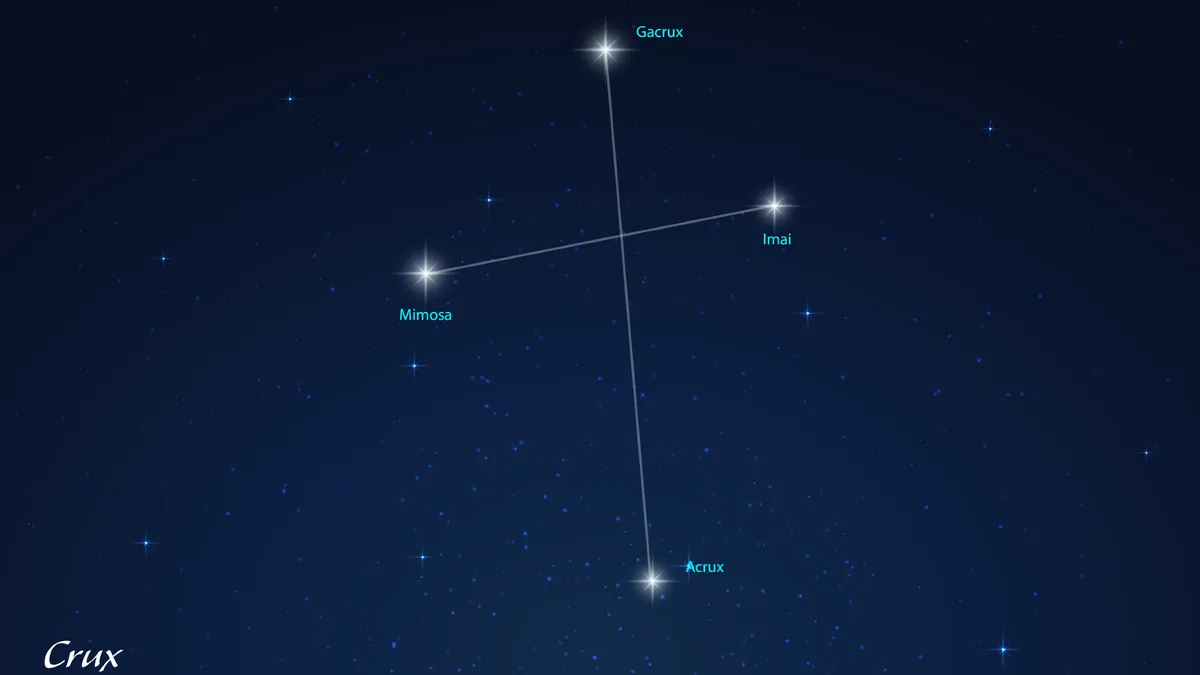
An illustration of a cross made by four different labeled stars in a dark blue night sky.

The Southern Cross can be seen all year round in the Southern Hemisphere. (Image credit: grebeshkovmaxim via Getty Images)

The Southern Hemisphere, where Brown is based, has fewer of these circumpolar constellations. "The south celestial pole [is] a blank bit of sky," he said, although southern skies do feature the Southern Cross year-round, a constellation of four bright stars.

In total, the International Astronomical Union recognizes 88 constellations in the night sky, and astronomers have mapped these constellations' regular motions using celestial coordinates. Today, there are interactive digital star charts ‪—‬ like Stellarium ‪—‬ that help stargazers navigate and find particular constellations based on the time of the year.

Wobbling Earth

These stars and constellations, however, won't look this way forever. Earth's spin has a slight wobble. This means that over thousands of years, constellations and their positions and movements in the skies will change slightly, at least from Earth's perspective. For example, the timings of sky's zodiac constellations, constellations found along the equator, are now shifted from what they were many millennia ago due to the Earth's wobble.
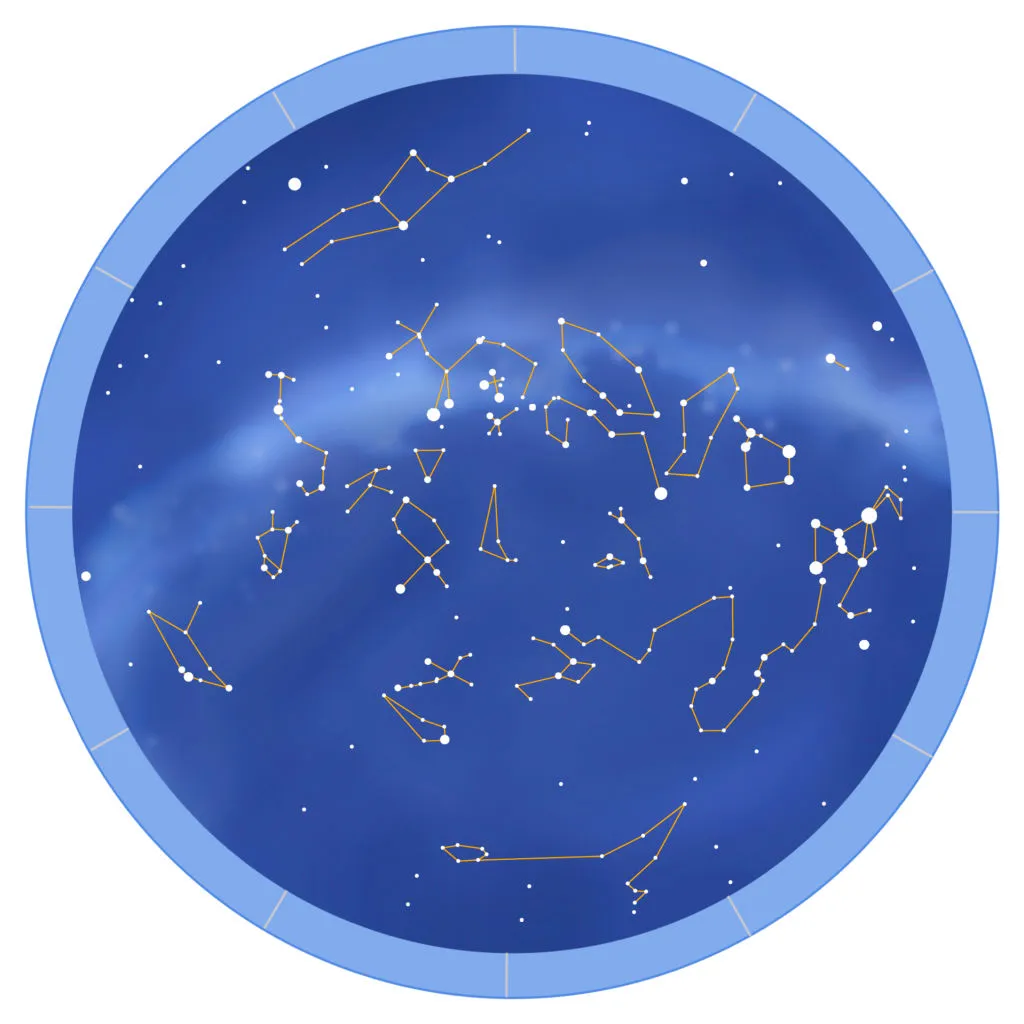
A circular blue chart shows various constellations on it.

An example of a star chart that people can use to find certain constellations in the night sky. This one is for the Northern Hemisphere. (Image credit: QAI Publishing via Getty Images)

The wobble also affects the North Star. Polaris, for instance, wasn't always the star in this position. In fact, in 2500 B.C., the spot was held by Thuban, a star in the constellation Draco. The north star of the future will change, too. "Five thousand years from now, we will have a totally different North Star, or maybe no technical north star at all, at least not one that lines up perfectly," Rapson said.

Understanding this nuance and getting the correct timing of when constellations are above the horizon is important for astronomy. Brown, who studies the evolution of galaxies, noted one constellation of interest.

Related mysteries

"Sagittarius is the center of our galaxy," he said. It's visible primarily in the winter in the Southern Hemisphere (summer in the Northern Hemisphere), and it's also right next to the Milky Way's supermassive black hole. "So people who study the Milky Way's black hole, they study at the particular times of year when [the black hole] is not blocked by the sun," Brown said.

Learning how the stars change with the seasons, therefore, is an important part of discoveries related to this mysterious celestial object and many others.

"Sometimes what initially seems a little bit confusing can become clearer when we shift our perspective a little bit," Brown said. By understanding the night sky and deciphering Earth's movements in relation to the stars, we can understand more about our position and wonders in the universe.


Can you name all the animals, objects and mythological figures hiding in the night sky? Find out with our constellations quiz!

Alice Sun is a science journalist based in Brooklyn. She covers a wide range of topics, including ecology, neuroscience, social science and technology. Her work has appeared in Audubon, Sierra, Inverse and more. For her bachelor's degree, she studied environmental biology at McGill University in Canada. She also has a master's degree in science, health and environmental reporting from NYU.

You must confirm your public display name before commenting

Please logout and then login again, you will then be prompted to enter your display name.