



惯性聚合 高效追踪和阅读你感兴趣的博客、新闻、科技资讯
阅读原文 在惯性聚合中打开

推荐订阅源

爱范儿
爱范儿
WordPress大学
WordPress大学
C
Check Point Blog
GbyAI
GbyAI
U
Unit 42
Google DeepMind News
B
Blog RSS Feed
Blog — PlanetScale
Blog — PlanetScale
J
Java Code Geeks
I
InfoQ
freeCodeCamp Programming Tutorials: Python, JavaScript, Git & More
Hugging Face - Blog
Hugging Face - Blog
Vercel News
Vercel News
博客园 - 【当耐特】
美团技术团队
小众软件
小众软件
S
SegmentFault 最新的问题
Jina AI
Jina AI
阮一峰的网络日志
阮一峰的网络日志
让小产品的独立变现更简单 - ezindie.com
The Cloudflare Blog
Last Week in AI
Last Week in AI
OSCHINA 社区最新新闻
OSCHINA 社区最新新闻
V
Visual Studio Blog

Latest from Live Science

Loneliness may contribute to memory issues, but not dementia — they are 'not the same thing' Naked mole rats wage bloody wars of succession to choose a new queen — but one colony did something scientists… Can the US be trusted with the moon? A law scholar raises concerns after Artemis II $3 million prize goes to duo whose research led to first sickle cell CRISPR therapy 700-year-old mummy from Bolivia contains earliest confirmed evidence of strep throat bacteria in the Americas New pain-relief opioid could be much less addictive than morphine, rodent study finds Experimental drug doubles one-year survival in pancreatic cancer Science news this week: Physicists witness faster-than-light darkness pinpricks, humans are still evolving, and some… Archaeologists discover perfectly circular ancient Egyptian temple that may have been used for sacred water rituals Some polar bears are adapting to their melting habitat. Will it be enough to save the iconic species? 2 supermassive black holes may collide 100 years from now ‪—‬ and Earth would feel it Anglo-Saxon burial holds an older sister cradling her little brother after they both died 1,400 years ago, possibly of… Colorado River may have pooled and spilled over to form the Grand Canyon, solving a long-standing mystery ‪—‬… 'We all screamed when it happened': Bright-green fireball meteor caught exploding over famous Viking raid site… Northern lights may be visible from several US states Friday and Saturday as giant hole opens up in sun Hackers used AI to steal hundreds of millions of Mexican government and private citizen records in one of the largest… The first black hole ever discovered is spewing 'dancing jets' at half the speed of light Stephen Hawking's black hole information paradox could be solved — if the universe has 7 dimensions 'Something's missing': Most thorough-ever study of the cosmos proves we still can't explain how the… 'Human evolution didn't slow down; we were just missing the signal': Large DNA study reveals natural selection led to more redheads and less male-pattern baldness Artemis II quiz: Is your knowledge of NASA New study confirms lobsters feel pain, driving scientists to call for a ban on boiling them alive This humanoid robot does all your housework for you ‪—‬ and its makers say it Ancient process that created rare earth elements discovered — and it could help us locate desperately needed deposits Strange mammal ancestor laid huge, leathery eggs —‬ and it was key to surviving the world 73 moon landings? NASA Diagnostic dilemma: A woman heard voices telling her she had a brain tumor ‪—‬ and scans confirmed she did Triassic croc relative from Ghost Ranch, New Mexico finally identified after nearly 80 years in museum basement There were Physicists witness pinpricks of darkness moving faster than the speed of light ‪—‬ without breaking the laws of relativity
Lyrid meteor shower 2026: See spring's first rain of 'sho...
Jamie Carter · 2026-04-19 · via Latest from Live Science
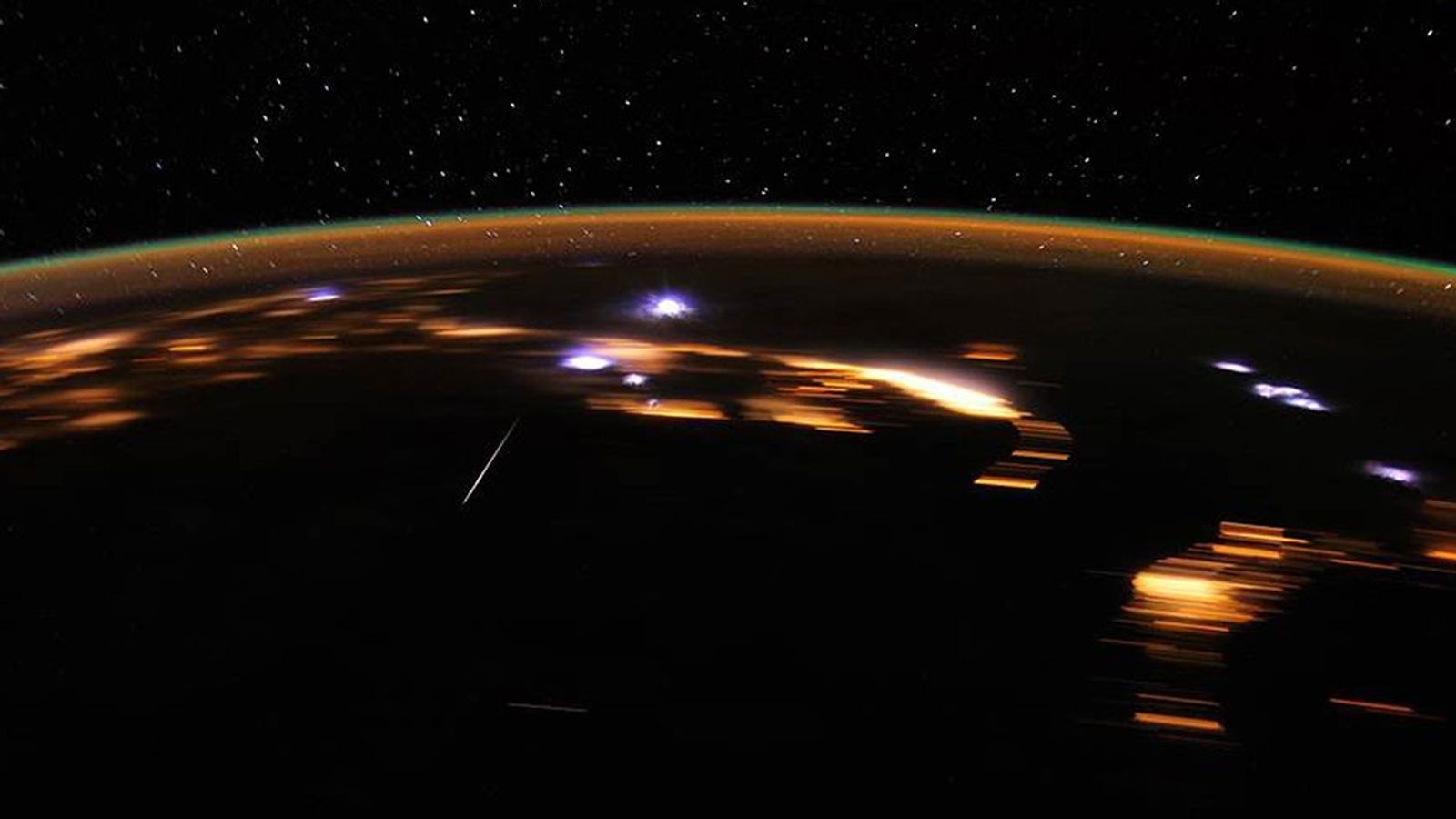
A view of the Earth from space, its dark surface showing glowing city lights with sparse purple glowing areas where meteors hit the atmosphere. "Shooting stars" from the Lyrid meteor shower as seen from the International Space Station. (Image credit: NASA/JSC/D. Pettit)

The night sky is set to deliver one of spring's most anticipated celestial events as the Lyrid meteor shower returns this week.

One of the oldest recorded meteor showers, the Lyrids peak Wednesday (April 22), offering stargazers a rare treat: a chance to witness "shooting stars" — and possibly bright "fireballs" — in dark, moonless skies.

The Lyrids officially run from April 14 through April 30, but their activity will peak in intensity during daylight on April 22 in North America and Europe, according to the American Meteor Society, when around 10 to 20 meteors per hour are expected. That creates two opportunities to catch the Lyrids: the predawn and post-sunset hours of April 22. The most favorable conditions are expected in the early morning hours, particularly around 5 a.m., when the radiant point — located in the constellation Lyra — rises higher in the sky.

Astronomical timing is working in favor of skywatchers this month. The new moon occurs on April 17, so it will still be a crescent by the time the Lyrids peak on April 22. That means the moon will be out of the sky before sunrise that day. Although it will be in the sky after dark later that day, the moon will set in the western sky as Lyra rises in the east, so it won't interfere.

While the Lyrid meteor shower's rate of "shooting stars" doesn't compare to more intense meteor showers like August's Perseids and December's Geminids, the Lyrids are known for their fast and bright "fireball" meteors that leave a persistent train, as well as for occasional bursts of activity ‪—‬ as many as 100 Lyrid meteors were reported per hour in 1803, 1922, 1945 and 1982, according to NASA. However, such outbursts are almost impossible to predict.

The Lyrids are the result of dust and debris left in the inner solar system by Comet C/1861 G1 (Thatcher), which orbits the sun every 415.5 years. When Earth passes through the comet's debris field each year, it causes meteors to burn up in our planet's atmosphere, giving the impression of "shooting stars" moving across the night sky. Comet Thatcher was last in the inner solar system in 1861, according to NASA. It isn’t due to return until around 2276.

For the best chance of seeing Lyrid meteors, check the weather forecast and a light pollution map for a location away from city lights. Allow your eyes to adjust to the darkness, and remain patient, as meteors can appear unpredictably in any part of the sky.

Get the world’s most fascinating discoveries delivered straight to your inbox.

Meteor showers are best seen with the naked eye, but you’ll need some special gear if you want to photograph them.

Jamie Carter is a Cardiff, U.K.-based freelance science journalist and a regular contributor to Live Science. He is the author of A Stargazing Program For Beginners and co-author of The Eclipse Effect, and leads international stargazing and eclipse-chasing tours. His work appears regularly in Space.com, Forbes, New Scientist, BBC Sky at Night, Sky & Telescope, and other major science and astronomy publications. He is also the editor of WhenIsTheNextEclipse.com.

You must confirm your public display name before commenting

Please logout and then login again, you will then be prompted to enter your display name.