
惯性聚合 高效追踪和阅读你感兴趣的博客、新闻、科技资讯
阅读原文 在惯性聚合中打开

推荐订阅源

奇客Solidot–传递最新科技情报
奇客Solidot–传递最新科技情报
L
LINUX DO - 最新话题
Recorded Future
Recorded Future
月光博客
月光博客
博客园 - 【当耐特】
博客园 - 叶小钗
宝玉的分享
宝玉的分享
量子位
雷峰网
雷峰网
博客园 - 三生石上(FineUI控件)
The Cloudflare Blog
Vercel News
Vercel News
L
LangChain Blog
B
Blog
Y
Y Combinator Blog
爱范儿
爱范儿
GbyAI
GbyAI
S
Security @ Cisco Blogs
T
The Blog of Author Tim Ferriss
A
About on SuperTechFans
博客园 - Franky
P
Palo Alto Networks Blog
Threat Intelligence Blog | Flashpoint
云风的 BLOG
云风的 BLOG
C
Cisco Blogs
Scott Helme
Scott Helme
I
Intezer
T
The Exploit Database - CXSecurity.com
MyScale Blog
MyScale Blog
T
Tor Project blog
D
Darknet – Hacking Tools, Hacker News & Cyber Security
T
Troy Hunt's Blog
N
News and Events Feed by Topic
大猫的无限游戏
大猫的无限游戏
F
Fortinet All Blogs
www.infosecurity-magazine.com
Application and Cybersecurity Blog
Cyber Security Advisories - MS-ISAC
S
Security Affairs
Cyberwarzone
Cyberwarzone
PCI Perspectives
PCI Perspectives
小众软件
小众软件
D
DataBreaches.Net
Exploit-DB.com RSS Feed
Know Your Adversary
Know Your Adversary
Forbes - Security
Forbes - Security
S
Securelist
cs.CV updates on arXiv.org
C
Cyber Attacks, Cyber Crime and Cyber Security
The Last Watchdog
The Last Watchdog

Latest from Live Science

Naked mole rats wage bloody wars of succession to choose a new queen — but one colony did something scientists… Can the US be trusted with the moon? A law scholar raises concerns after Artemis II Lyrid meteor shower 2026: See spring's first rain of 'shooting stars' peak in moonless skies $3 million prize goes to duo whose research led to first sickle cell CRISPR therapy 700-year-old mummy from Bolivia contains earliest confirmed evidence of strep throat bacteria in the Americas New pain-relief opioid could be much less addictive than morphine, rodent study finds Experimental drug doubles one-year survival in pancreatic cancer Science news this week: Physicists witness faster-than-light darkness pinpricks, humans are still evolving, and some… Archaeologists discover perfectly circular ancient Egyptian temple that may have been used for sacred water rituals Some polar bears are adapting to their melting habitat. Will it be enough to save the iconic species? 2 supermassive black holes may collide 100 years from now ‪—‬ and Earth would feel it Anglo-Saxon burial holds an older sister cradling her little brother after they both died 1,400 years ago, possibly of… Colorado River may have pooled and spilled over to form the Grand Canyon, solving a long-standing mystery ‪—‬… 'We all screamed when it happened': Bright-green fireball meteor caught exploding over famous Viking raid site… Northern lights may be visible from several US states Friday and Saturday as giant hole opens up in sun Hackers used AI to steal hundreds of millions of Mexican government and private citizen records in one of the largest… The first black hole ever discovered is spewing 'dancing jets' at half the speed of light Stephen Hawking's black hole information paradox could be solved — if the universe has 7 dimensions 'Something's missing': Most thorough-ever study of the cosmos proves we still can't explain how the… 'Human evolution didn't slow down; we were just missing the signal': Large DNA study reveals natural selection led to more redheads and less male-pattern baldness Artemis II quiz: Is your knowledge of NASA New study confirms lobsters feel pain, driving scientists to call for a ban on boiling them alive This humanoid robot does all your housework for you ‪—‬ and its makers say it Ancient process that created rare earth elements discovered — and it could help us locate desperately needed deposits Strange mammal ancestor laid huge, leathery eggs —‬ and it was key to surviving the world 73 moon landings? NASA Diagnostic dilemma: A woman heard voices telling her she had a brain tumor ‪—‬ and scans confirmed she did Triassic croc relative from Ghost Ranch, New Mexico finally identified after nearly 80 years in museum basement There were Physicists witness pinpricks of darkness moving faster than the speed of light ‪—‬ without breaking the laws of relativity Mini lake meets snowy rim of Canada's oldest ice mass — Earth from space Stone Age tombs in Scotland reveal 'webs of descent' among male relatives 'Oslo patient' likely cured of HIV after getting stem cell transplant from his brother, who is genetically… Antiseptic-tolerant germs spread through the air in hospitals, early study hints Homo erectus' tools include stunning geodes and fossils, possibly as a way to connect with the cosmos, study finds 'Really, really weird': Physicists entangle two moving atoms for the first time, validating 'spooky'… www.livescience.com Sperm quality is at its peak in the summer, study finds Scientists are trying to build a vaccine that works against almost any respiratory pathogen  — here's… Idol of Pomos: A 5,000-year-old fertility figurine from Cyprus that wears a miniature version of herself on a necklace Human ancestors butchered and ate elephants 1.8 million years ago, helping to fuel their large brains Ancient Egyptian stone monument depicting a Roman emperor as a pharaoh discovered in Luxor 'Human minds shouldn't have to go through' this: Artemis II crew recalls unreal moment when Earth disappeared — Space photo of the week Does the moon look the same from everywhere on Earth? I found a new meteor shower — and it comes from an asteroid getting baked to bits by the sun AI for breakup texts? How 'sycophantic' chatbots are messing with our ability to handle difficult social… Science news this week: Artemis II splashes down, the world's fattest parrot bounces back, and the Shroud of Turin… 10 Artemis II photos that define humanity's return to the moon Do the microbes in your gut influence what foods you like? 'I'm at a loss for words': Artemis II mission comes home to joy and cheers after historic 10-day mission There are 'reasons to be confident' about faulty Artemis II heat shield ahead of 25,000 mph reentry, space… The moon is green and brown? Why scientists are already excited about Artemis II's historic lunar photos 'I've seen the movies. What a horrible way to die': What it's like to be sucked into a tornado and… 'More questions than answers': Experts baffled by Alaskan mammal-eating orcas spotted near Seattle Changing 'just one DNA letter' in female mice triggers growth of male genitalia Aoshima: Japan's tiny 'Cat Island' where felines hugely outnumber humans 'Welcome home, Integrity': Artemis II crew return to Earth after 'bullseye landing' caps historic… AI war games almost always escalate to nuclear strikes, simulation shows Ancient Korean society practiced human sacrifice and high inbreeding, researchers find There's an issue with the Artemis II heat shield, but NASA isn't worried. Here's why. Chimpanzees in Uganda are locked in a deadly 'civil war' after their group split apart — and scientists… James Webb telescope spots 'stingray' galaxy system that could solve the mystery of 'little red… 'RIP, Comet MAPS': Watch the superbright sungrazer become a 'headless wonder' after being ripped… Scientists create new type of encryption that protects video files against quantum computing attacks Western states face above-normal wildfire threats this summer. New maps reveal which areas are most at risk. Science history: Doctor hypothesizes that 'transmissible proteins' can cause disease, contradicting a 'central dogma' of molecular biology — April 9, 1982 Keratin may act as a 'brake' for skin inflammation, pointing to potential treatments 'No one knows what they are': Researchers discover new type of cell that's seen only during pregnancy 16th-century silver coin discovered near Strait of Magellan marks the spot of a doomed Spanish colony How to see Comet PanSTARRS as it brightens in the night sky this week Diagnostic dilemma: Woman's 'biologically implausible' infection led her to sneeze 'worms' out… 'In every continent where humans are present, water bankruptcy is manifesting itself': Exiled Iranian scientist Kaveh Madani on our desperate need to preserve our most precious resource California declared war on smog in the 1970s. The knock-on effects were huge. 'They are literally everywhere': The shocking story of how forever chemicals polluted the world DNA reveals ancestry of man buried in Stone Age monument in Spain, but his religion remains a mystery 'So much magic': Artemis II shares first images from the far side of the moon, including new… AI 'mirages' mean tools used to analyze medical scans could fabricate their findings World's fattest parrot — on the verge of extinction 30 years ago — has record-breaking breeding season It's one of the best toothbrushes we have tested (and it's not Oral-B) Physicists moved volatile antimatter by truck for the first time ever — paving the way for groundbreaking new… Deadly, vivid-green mass sprawls across South African reservoir — Earth from space The Artemis II astronauts have just flown farther from Earth than any humans in history Artemis II moon flyby begins: How to watch and what to know AI-written code can beat humans at biomedical analysis, some studies find. What does that mean for the field? 'A cure on the horizon': Are we finally close to ending type 1 diabetes? 'They could spend 4 or 5 hours per day underwater': How humans adapted to the most challenging environments We went to Finland to hear about the new 'sand battery' that will turn stored renewable energy back into power… The hungriest black holes in the universe are running out of food, survey of 8,000 cosmic monsters reveals Beadnet dress: A 4,500-year-old ancient Egyptian funeral 'gown' that was in vogue during the Old Kingdom 'This generation's moment': How the Artemis missions will reframe humanity's relationship with the… Antarctica hides huge caches of gold, silver, copper and iron. As the ice melts, countries may race to harvest them. NASA telescope uncovers new mystery in supernova first spotted by Chinese astronomers 2,000 years ago —‬ Space… Diabetes rates are lower in high-altitude environments ‪‪—‬ and scientists may have discovered why Shroud of Turin, claimed to be Jesus' burial cloth, contaminated with carrot and red coral DNA What happened to the Minoan civilization? I've witnessed nearly 100 rocket launches. Artemis II was like nothing I've ever experienced. Science news this week: Artemis II lifts off, diabetes cured in mice, and smog in China shapes Arctic storms Fossil site in China reveals bevy of complex creatures lived prior to the Cambrian explosion, including a… Cheap, decades-old transplant drug delays full onset of type 1 diabetes Octopus quiz: Are you a sucker for cephalopod science?
'Eventually, it becomes you': Inventors of new 'living' knee replacement describe why this tech is desperately needed and how it works
Nicoletta La · 2026-04-25 · via Latest from Live Science
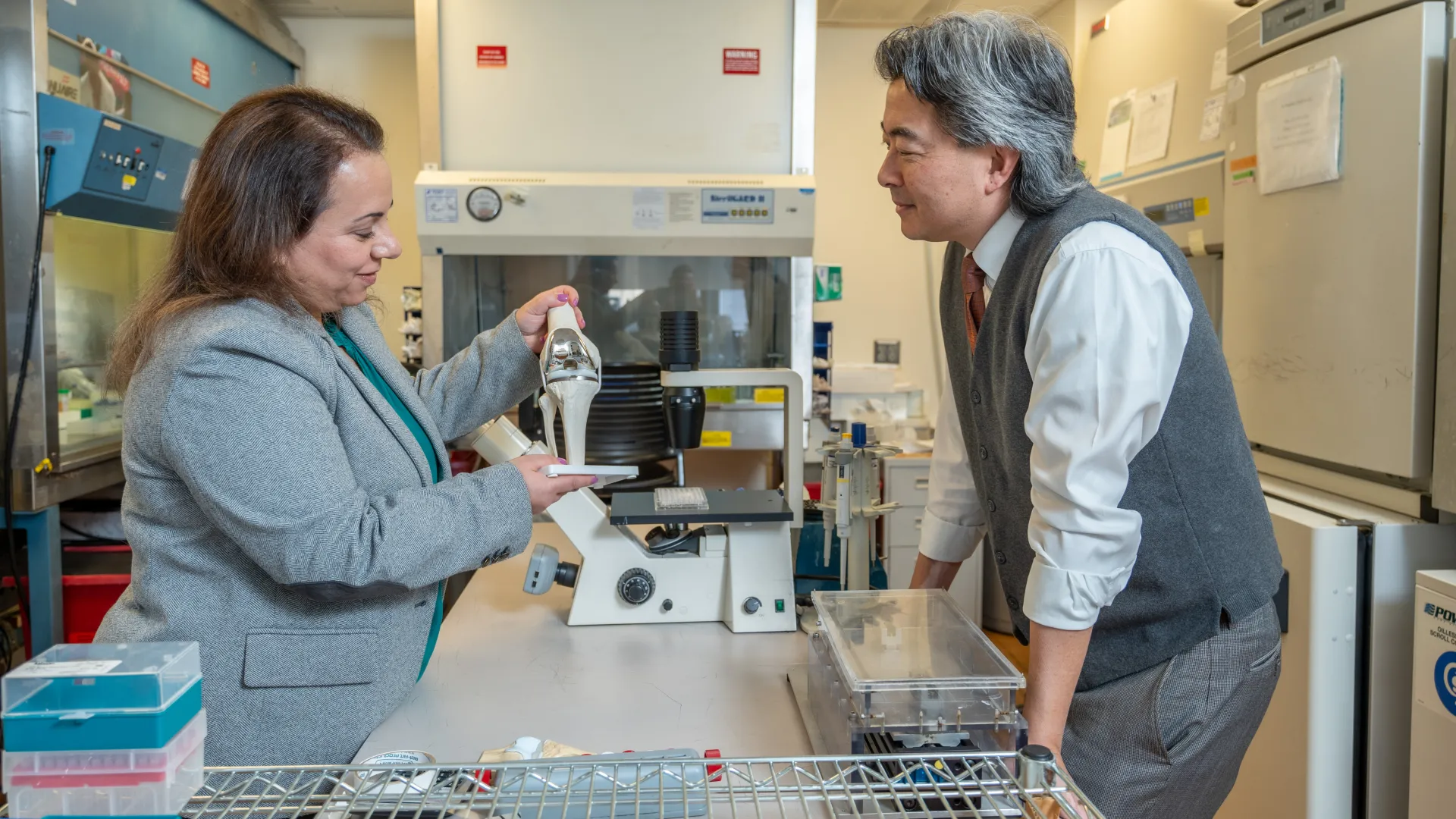
A man with long gray hair wearing a brown vest and white shirt speaks with a woman with long brown hair as they both look at various prosthetic limbs.
Nadeen Chahine and Clark Hung are working to develop a "living" knee implant that could be a better option for some patients in need of knee replacements. (Image credit: Columbia University)

Imagine getting a knee replacement made of living materials rather than metal and plastic.

Researchers at Columbia University and the University of Missouri are working to make that vision a reality. Their 3D-printed knee implant, called NOVAKnee, is composed of a biodegradable scaffold packed with stem-cell-derived bone and cartilage. The idea is that, once inside the body, the scaffold will gradually disappear as it's replaced by new bone and cartilage that will integrate into the patient's skeleton.

NOVAKnee could be a better option for these patients. The implant has been tested in lab mice, in experiments where a tiny version was placed beneath the animals' skin to see how the body reacted. It will soon be tested in larger animals in experiments that replicate how a knee replacement works in humans; the type of animal being used for those tests has not been disclosed yet.

If all goes well, the developers hope to launch their first human trials as soon as 2028. The work is being supported by a federally funded project called Novel Innovations for Tissue Regeneration in Osteoarthritis (NITRO).

Live Science spoke with two of the developers — Clark Hung, a professor and vice chair of the Department of Biomedical Engineering at Columbia University's School of Engineering, and Nadeen Chahine, a professor of biomedical engineering in orthopedic surgery at the Columbia University Vagelos College of Physicians and Surgeons — about the new technology.


Nicoletta Lanese: What are the issues with conventional knee implants that NOVAKnee aims to address?

Get the world’s most fascinating discoveries delivered straight to your inbox.

Clark Hung: Conventional knee replacements, metal and plastic implants, actually work really well. But they're limited to 15 to 20 years, basically until they fail, from a materials perspective. If you're not toward the last couple of decades of your life, there's a good chance that you're going to outlive your implant, which would require having another implant put in — that's called a revision surgery.

When it [the first implant] fails, the physician has to go in and try to pull that implant out without destroying the bone that's there. And they actually have to make a larger opening to put the new implant in.

Nadeen Chahine: When the patients are older, when they're having that revision, you're dealing with weaker bone, or higher bone mass loss, compared to that younger patient. So that comes with a higher risk of loosening [the implant becoming unstable within the knee joint] and higher risk of failure.

CH: So if you're a younger patient who's missing a lot of the anatomic surface of your cartilage, most surgeons will tell you to wait and take meds to relieve pain until you're older, to get the actual knee replacement.

The goal here is really to get people back to function and have no pain. One of the challenges, therefore, is to come up with a living version of a knee replacement, where it could possibly be your last knee replacement and something that will have a longer duration of success than current implants.

NL: Do you think NOVAKnee could be useful to older knee transplant patients, as well?

NC: It's not entirely fully clear, to be honest. The data has to play out to see what patient populations are going to benefit the most. I think we see that there is an opportunity to help younger adults who currently have no options — no treatments besides injections and stopgap measures to help them manage the pain and disability that they're going through.

NL: In terms of the surgery, should this knee replacement work just like a normal one?

CH: It's supposed to be pretty similar. … We are embracing, at least from a commercialization perspective, the orthopedic surgeon's role in this process in that we're coming up with a living version of something they're familiar with.
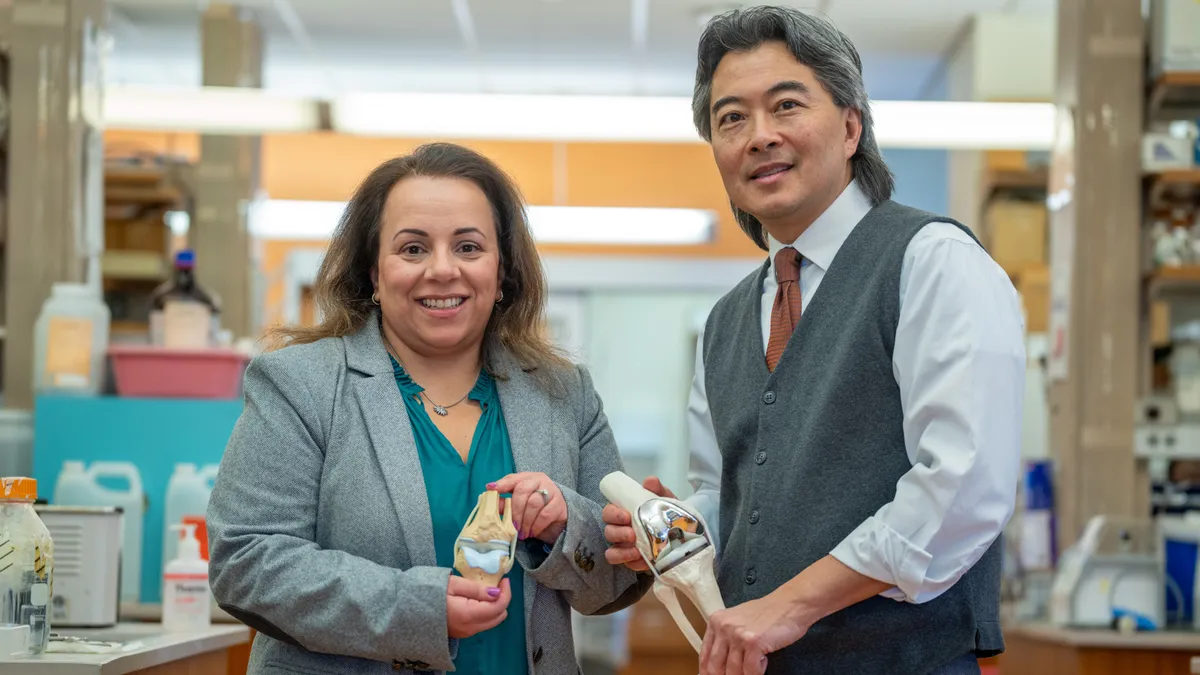
A man with long gray hair wearing a brown vest and white shirt speaks with a woman with long brown hair as they both look at various prosthetic limbs.

NITRO is supporting a number of research efforts, including NOVAKnee, aimed at developing new ways of helping the human body repair its own joints. (Image credit: Columbia University)

NL: Could you theoretically accomplish something similar without an implant, by introducing stem cells directly to the knee joint, for instance?

CH: Other projects in the NITRO portfolio are looking at injectables to regenerate bone and cartilage. As of now, there's nothing commercially available that can meet those demands. Most things on the market are there to relieve pain, whatever that mechanism is — from viscosupplementation, where you essentially inject Jell-O into the knee to try to cushion the joint, to corticosteroids. It's masking the inherent issue [of the joint being degraded]. The NITRO program as a whole is aimed at making the problem go away one way or the other.

[When it comes to injectables] I'm not really sure how these products will work if you have major damage to the articular surface [where the bones of the joint meet], where most of the cartilage is missing. In those situations, something like we're proposing might be more appropriate because you may or may not have the time [to regrow that tissue] if you're essentially bone-on-bone.

We did joke at the beginning of the program that, theoretically, if these injectables work, it would put us out of business. But in my mind, I think there are a lot of people who have implants already — conventional ones — and if those were to fail and need revision, our product would still have a role.

NL: How did you go about designing the implant's scaffold?

NC: The goal is that it's there to elicit a response that's controlled and well-defined ‪—‬ and then it will degrade over time, and that will result in components that are natural to the body that then get broken down through the normal mechanisms.

What we sought to do is to build on that by creating something that looks like a knee and functions like a knee but can't be a permanent material like metal and plastic.

NL: And where do the stem cells come in?

NC: We are developing two versions of the technology. One of them will be seeded with the patient's own cells. We would isolate stem cells from the patient and then use that to generate cartilage and bone cells, and that would be our "autologous" product [derived from the same individual]. Those cells then get put back on the scaffold, and then we would implant them.

On the other hand, there are some considerations where a patient might not be a good candidate for autologous therapy, or their regenerative potential is not quite what it needs to be. At that point maybe, we want to consider using allogeneic cell sources [cells from other people] and getting donor cells from a bank prepared using the same mechanisms.

We still need to understand a little more definitively who the ideal candidate is for autologous versus allogeneic, and how we decide on the clinical workflow of who should get one or the other. Right now we're still in this R&D phase.

NL: In a human patient, how long would the scaffold take to break down and leave the new cells on their own?

NC: That's a very hard thing for us to predict exactly. We've done studies both on the biodegradation, as well as studies on the matrix synthesis [the growth of bone and cartilage], and have some ideas of how those are happening. But to date, we've only studied them in small animal studies.

We have some idea of how much matrix is being synthesized and how much degradation is happening [once the implant is] in the body, but not necessarily in the knee. What we also don't yet know is how the presence of mechanical loading, the use of your knee implant, affects both how much it degrades and how much matrix is being synthesized.

That's what we're studying at this new phase of the project [in the large animal experiments]. These are really important questions that we want to be able to answer to modify our approach if needed, to address any potential shortcomings.

CH: In our large, preclinical animal studies, NITRO is mandating that we use an arthritis model. So we're basically going to create osteoarthritis in the animals and then do the living knee replacement. It's going to simulate better what clinically happens in people.
Runner with knee pain, conceptual computer illustration.

To be effective, NOVAKnee's scaffold will need to be robust enough to function as a knee joint until such time that the new bone and cartilage takes over. (Image credit: Getty Images)

NL: Since it sounds like human trials might start fairly soon, are you preparing for those already?

CH: This program we're in is a five-year program: two years of R&D, basically benchtop; 18 months of large animal studies; and then 18 months of Phase I [safety] clinical trials. Trials would be 18 months or two years from now if everything went perfectly with our animal studies and the FDA greenlit it and said, "Hey, this is perfect data; we're going to give you the option to go into humans." So it's probably really ambitious, but the whole program is ambitious.

NC: We've gotten a lot of interest from people all over the country and abroad who want to learn about the trial or who are asking us, "Should I postpone my knee replacement so that I could join your trial?" We obviously can't answer any of those questions yet, but we really value the enthusiasm and the interest. We have a form that should be going up on our website so that those individuals that want to stay engaged can learn about the progress.

Honestly, while we've been buried in technical research and sweating those details to make sure we're doing the best science we can to bring forward this technology, it's very refreshing and very eye-opening to hear about the needs of regular people everywhere who are telling us how desperately they are in need of something like this. I'm getting calls and texts from my friends' parents, from people that live in my community, everywhere — "Please tell me, what can I do?"

NL: For the people who reach out, are there particular trends? Are they mostly younger patients waiting on a future knee implant, for instance?

NC: I think there's a lot of that. They're too young, and waiting makes sense. And maybe they're not as advanced, as in they're not full bone-on-bone but they're still in a lot of pain and discomfort. Some of them have had to give up certain activities or sports that they've enjoyed that now they can't do. It's a lot of that.

CH: I've seen a couple where people just don't want foreign objects in them. Theoretically, if this all works out — and let's say you have cells from yourself, it's autologous, if everything absorbs away like it's supposed to — then eventually, it becomes you, your own bone and cartilage.

So some people are like, "If I could have something that's living, that's going to be part of me and not something that's going to be sticking around as an object in me, I'd prefer that."

NL: Zooming out, do you think this new technology could be useful for other joint replacements?

NC: If it was up to us to decide what joint to try this first, we wouldn't have picked the knee. I understand where the decision came from because that's where there is the greatest need. However, from a mechanical perspective and from a joint function and range-of-motion standpoint, it's probably one of the hardest. We would have started in a different joint, just to kind of build up the proof of concept in something that's a little bit more forgiving.

Given that context, I think we have a desire and a vision to see this as a platform technology that could be developed for other large joints, or even some smaller joints, depending on the function and the need. Hopefully, in due course, that's something that we'll want to pursue.

NL: If you had your pick, what joint would you have started with?

RELATED STORIES

NC: One of our collaborators tells us the thumb is a very important area that actually doesn't have very good technology currently, that is usable for [joint] replacement. Despite it looking like a very small joint, it actually undergoes a lot of high forces, but the range of motion is more limited. So that could be something that we could have worked on.

CH: And everybody likes to have their ability to grip things and "pincer action" [using the pointer finger and thumb to pick things up].

NC: And we're all going to get really bad OA [osteoarthritis] of our thumbs with all the texting we do. So it's been a problem, but it's only going to get worse with the aging population.

Disclaimer

This article is for informational purposes only and is not meant to offer medical advice.

Nicoletta Lanese is the health channel editor at Live Science and was previously a news editor and staff writer at the site. She is a recipient of the 2026 AHCJ International Health Study Fellowship, with a project focused on antibiotic stewardship practices in Japan and the U.S. They hold a graduate certificate in science communication from UC Santa Cruz and degrees in neuroscience and dance from the University of Florida. Beyond Live Science, Lanese's work has appeared in The Scientist, Science News, the Mercury News, Mongabay and Stanford Medicine Magazine, among other outlets. Based in NYC, she also remains involved in dance and performs in local choreographers' work.

You must confirm your public display name before commenting

Please logout and then login again, you will then be prompted to enter your display name.