

惯性聚合 高效追踪和阅读你感兴趣的博客、新闻、科技资讯
阅读原文 在惯性聚合中打开

推荐订阅源

Engineering at Meta
Engineering at Meta
G
Google Developers Blog
WordPress大学
WordPress大学
M
MIT News - Artificial intelligence
D
DataBreaches.Net
云风的 BLOG
云风的 BLOG
爱范儿
爱范儿
Microsoft Security Blog
钛媒体:引领未来商业与生活新知
钛媒体:引领未来商业与生活新知
H
Hackread – Cybersecurity News, Data Breaches, AI and More
Blog — PlanetScale
Blog — PlanetScale
T
Tailwind CSS Blog
S
SegmentFault 最新的问题
阮一峰的网络日志
阮一峰的网络日志
博客园 - 三生石上(FineUI控件)
酷 壳 – CoolShell
酷 壳 – CoolShell
Recent Announcements
T
The Blog of Author Tim Ferriss
I
InfoQ
MyScale Blog
MyScale Blog
V
V2EX
B
Blog
罗磊的独立博客
freeCodeCamp Programming Tutorials: Python, JavaScript, Git & More

Latest from Live Science

Naked mole rats wage bloody wars of succession to choose a new queen — but one colony did something scientists… Can the US be trusted with the moon? A law scholar raises concerns after Artemis II Lyrid meteor shower 2026: See spring's first rain of 'shooting stars' peak in moonless skies $3 million prize goes to duo whose research led to first sickle cell CRISPR therapy 700-year-old mummy from Bolivia contains earliest confirmed evidence of strep throat bacteria in the Americas New pain-relief opioid could be much less addictive than morphine, rodent study finds Experimental drug doubles one-year survival in pancreatic cancer Science news this week: Physicists witness faster-than-light darkness pinpricks, humans are still evolving, and some… Archaeologists discover perfectly circular ancient Egyptian temple that may have been used for sacred water rituals Some polar bears are adapting to their melting habitat. Will it be enough to save the iconic species? 2 supermassive black holes may collide 100 years from now ‪—‬ and Earth would feel it Anglo-Saxon burial holds an older sister cradling her little brother after they both died 1,400 years ago, possibly of… Colorado River may have pooled and spilled over to form the Grand Canyon, solving a long-standing mystery ‪—‬… 'We all screamed when it happened': Bright-green fireball meteor caught exploding over famous Viking raid site… Northern lights may be visible from several US states Friday and Saturday as giant hole opens up in sun Hackers used AI to steal hundreds of millions of Mexican government and private citizen records in one of the largest… The first black hole ever discovered is spewing 'dancing jets' at half the speed of light Stephen Hawking's black hole information paradox could be solved — if the universe has 7 dimensions 'Something's missing': Most thorough-ever study of the cosmos proves we still can't explain how the… 'Human evolution didn't slow down; we were just missing the signal': Large DNA study reveals natural selection led to more redheads and less male-pattern baldness Artemis II quiz: Is your knowledge of NASA New study confirms lobsters feel pain, driving scientists to call for a ban on boiling them alive This humanoid robot does all your housework for you ‪—‬ and its makers say it Ancient process that created rare earth elements discovered — and it could help us locate desperately needed deposits Strange mammal ancestor laid huge, leathery eggs —‬ and it was key to surviving the world 73 moon landings? NASA Diagnostic dilemma: A woman heard voices telling her she had a brain tumor ‪—‬ and scans confirmed she did Triassic croc relative from Ghost Ranch, New Mexico finally identified after nearly 80 years in museum basement There were Physicists witness pinpricks of darkness moving faster than the speed of light ‪—‬ without breaking the laws of relativity
Watch an AI-powered table tennis robot beat elite players
Kenna Hughes · 2026-04-22 · via Latest from Live Science
— Net Bounce

The world of table tennis may be in for a shake-up after Sony's AI division unveiled Ace — an autonomous robot that can compete with expert table tennis players.

This is the first time a robot has achieved "expert-level play in a commonly played competitive sport in the physical world," Sony AI representatives said in a statement.

Article continues below

"This breakthrough is much bigger than table tennis," Peter Stone, chief scientist at Sony AI, said in the statement. "It represents a landmark moment in AI research, showing, for the first time, that an AI system can perceive, reason, and act effectively in complex, rapidly changing real-world environments that demand precision and speed."

A study detailing how the robot works was published April 22 in the journal Nature.
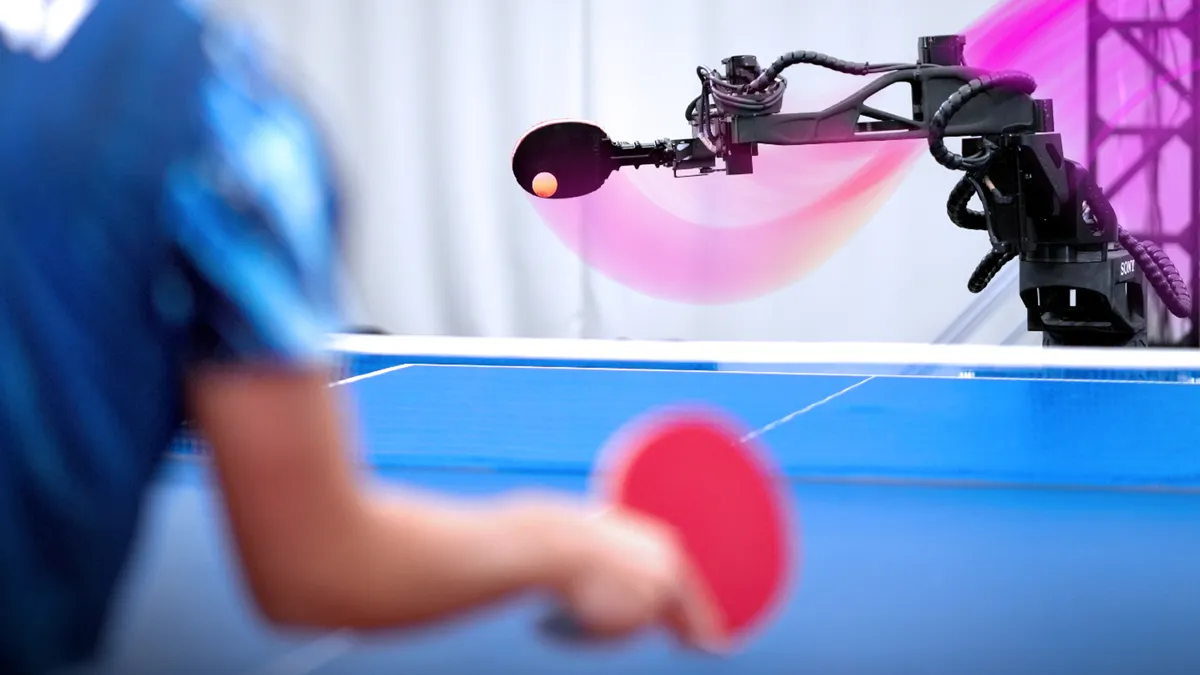
A black arm with a ovular paddle on the end passes a ball forward on a blue table tennis to a person with a red paddle in the foreground

Ace the table tennis robot returns a volley during a game. (Image credit: Sony AI)

Where hardware meets software

AI systems have already shown prowess in strategy games, such as Go, chess and role-playing games.

However, moving AI into a robotic body, where quick reflexes are paired with physical movements, can be more challenging. Here, the software and hardware components have to work seamlessly — and in table tennis, where speed and hand-eye coordination are vital, this pairing has to work to win.

Get the world’s most fascinating discoveries delivered straight to your inbox.

"Table tennis is a game of enormous complexity that requires split-second decisions as well as speed and power," Peter Dürr, director of Sony AI in Zurich and project lead for Ace, said in the statement. "This research breakthrough highlights the potential of physical AI agents to perform real-time interactive tasks, and represents a significant step toward creating robots with broader applications in fast, precise, and real-time human interactions."

Ace's strategy builds on Sony AI's previous research on its AI agent Gran Turismo Sophy, with Ace using advanced sensors and high-speed software to perceive its environment. These sensors include nine active pixel sensor cameras that help Ace identify the ball's exact position in 3D space, along with three gaze systems that use mirrors and event-based vision cameras to measure the ball's spin and angular velocity as it moves through the air.

Running these cameras is Sony AI's proprietary AI control system, which is based on model-free reinforcement learning, where an AI agent learns directly from interactions in its environment without making a predictive model first. This technology allows Ace to adapt and make decisions faster, without relying on a preprogrammed model.

— Gaze control system

Lastly, Ace's robotic body, which includes a swiveling arm with a paddle-like appendage at its end, was created with the company's robotic hardware.

Beating the pros

In April 2025, scientists had Ace play against five elite players (each with over 10 years of experience and around 20 hours of weekly training) and two professional table tennis players (Minami Ando and Kakeru Sone, both in the Japanese professional league). While players in both tiers are skilled at table tennis, professional athletes make their living by playing table tennis, whereas elite players may not have the same caliber to make the sport their livelihood.

Ace won three out of five matches with the elite players and boasted a 75% serve return rate. Its autonomous system also allowed the robot to return unusual shots, such as balls bouncing off the net. It however lost both matches against the pros.

RELATED STORIES

Then, in December 2025, Sony AI had Ace play a series of separate matches in which it competed against two professional and two elite players. This time, Ace beat both elite players and one of the professionals. Company representatives said the robot moved closer to the table edge, had higher shot speeds and launched faster-paced volleys against its opponents.

Given that less than two years ago, Google DeepMind's robotic table tennis robot was defeated by elite players, Ace's victories show how quickly this field of robotics is advancing in a short time.

"Once AI can operate at an expert human level under these conditions, it opens the door to an entirely new class of real-world applications that were previously out of reach," Stone said in the statement.

Kenna Hughes-Castleberry is the Content Manager at Live Science. Formerly, she was the Content Manager at Space.com and before that the Science Communicator at JILA, a physics research institute. Kenna is also a book author, with her upcoming book 'Octopus X' scheduled for release in spring of 2027. Her beats include physics, health, environmental science, technology, AI, animal intelligence, corvids, and cephalopods.

You must confirm your public display name before commenting

Please logout and then login again, you will then be prompted to enter your display name.