
惯性聚合 高效追踪和阅读你感兴趣的博客、新闻、科技资讯
阅读原文 在惯性聚合中打开

推荐订阅源

D
DataBreaches.Net
IT之家
IT之家
The Cloudflare Blog
Apple Machine Learning Research
WordPress大学
WordPress大学
N
Netflix TechBlog - Medium
阮一峰的网络日志
阮一峰的网络日志
P
Proofpoint News Feed
L
LangChain Blog
博客园 - Franky
美团技术团队
J
Java Code Geeks
Microsoft Security Blog
博客园 - 叶小钗
小众软件
小众软件
Y
Y Combinator Blog
B
Blog RSS Feed
Cyber Security Advisories - MS-ISAC
D
Docker
Hugging Face - Blog
Hugging Face - Blog
Jina AI
Jina AI
罗磊的独立博客
大猫的无限游戏
大猫的无限游戏
Vercel News
Vercel News

Latest from Live Science

Naked mole rats wage bloody wars of succession to choose a new queen — but one colony did something scientists… Can the US be trusted with the moon? A law scholar raises concerns after Artemis II Lyrid meteor shower 2026: See spring's first rain of 'shooting stars' peak in moonless skies $3 million prize goes to duo whose research led to first sickle cell CRISPR therapy 700-year-old mummy from Bolivia contains earliest confirmed evidence of strep throat bacteria in the Americas New pain-relief opioid could be much less addictive than morphine, rodent study finds Experimental drug doubles one-year survival in pancreatic cancer Science news this week: Physicists witness faster-than-light darkness pinpricks, humans are still evolving, and some… Archaeologists discover perfectly circular ancient Egyptian temple that may have been used for sacred water rituals Some polar bears are adapting to their melting habitat. Will it be enough to save the iconic species? 2 supermassive black holes may collide 100 years from now ‪—‬ and Earth would feel it Anglo-Saxon burial holds an older sister cradling her little brother after they both died 1,400 years ago, possibly of… Colorado River may have pooled and spilled over to form the Grand Canyon, solving a long-standing mystery ‪—‬… 'We all screamed when it happened': Bright-green fireball meteor caught exploding over famous Viking raid site… Northern lights may be visible from several US states Friday and Saturday as giant hole opens up in sun Hackers used AI to steal hundreds of millions of Mexican government and private citizen records in one of the largest… The first black hole ever discovered is spewing 'dancing jets' at half the speed of light Stephen Hawking's black hole information paradox could be solved — if the universe has 7 dimensions 'Something's missing': Most thorough-ever study of the cosmos proves we still can't explain how the… 'Human evolution didn't slow down; we were just missing the signal': Large DNA study reveals natural selection led to more redheads and less male-pattern baldness Artemis II quiz: Is your knowledge of NASA New study confirms lobsters feel pain, driving scientists to call for a ban on boiling them alive This humanoid robot does all your housework for you ‪—‬ and its makers say it Ancient process that created rare earth elements discovered — and it could help us locate desperately needed deposits Strange mammal ancestor laid huge, leathery eggs —‬ and it was key to surviving the world 73 moon landings? NASA Diagnostic dilemma: A woman heard voices telling her she had a brain tumor ‪—‬ and scans confirmed she did Triassic croc relative from Ghost Ranch, New Mexico finally identified after nearly 80 years in museum basement There were Physicists witness pinpricks of darkness moving faster than the speed of light ‪—‬ without breaking the laws of relativity
Icy object beyond Pluto has an atmosphere that shouldn't ...
Patrick Pest · 2026-05-06 · via Latest from Live Science

Astronomers have detected an atmosphere that shouldn't exist on an icy object beyond the orbit of Pluto — sparking calls for follow-up observations.

Japanese astronomers found evidence for a thin atmosphere surrounding the body, which is located within the Kuiper Belt in the cold outer reaches of the solar system, according to a new study published May 4 in the journal Nature Astronomy.

The new observations challenge assumptions about which objects can sustain atmospheres in our solar system. However, these initial findings must be verified by outside researchers, with some experts keen to make follow-up observations with the James Webb Space Telescope (JWST) to confirm the atmosphere exists.

"This is an amazing development, but it sorely needs independent verification," Alan Stern, a planetary scientist and principal investigator for NASA's New Horizons mission to explore Pluto and the Kuiper Belt, who was not involved in the new study, told the Associated Press. "The implications are profound if verified."

Oddball ice ball

Researchers observed (612533) 2002 XV93 as it passed directly in front of a distant star in January 2024. The observations were made by a team of professional and amateur astronomers from three sites in Japan. Their data hinted at attenuation — or gradual loss of starlight caused by an atmosphere, according to the study.

"The observation data showed a smooth change of the star's brightness near the edge of the shadow, lasting about 1.5 seconds," study first author Ko Arimatsu, an associate professor and senior lecturer at the National Astronomical Observatory of Japan, told CNN. "This kind of smooth brightness change is naturally explained if the starlight was bent by a very thin atmosphere around the object."

Get the world’s most fascinating discoveries delivered straight to your inbox.

Conceptual video for Arimatsu et al. (2026) - YouTube Conceptual video for Arimatsu et al. (2026) - YouTube
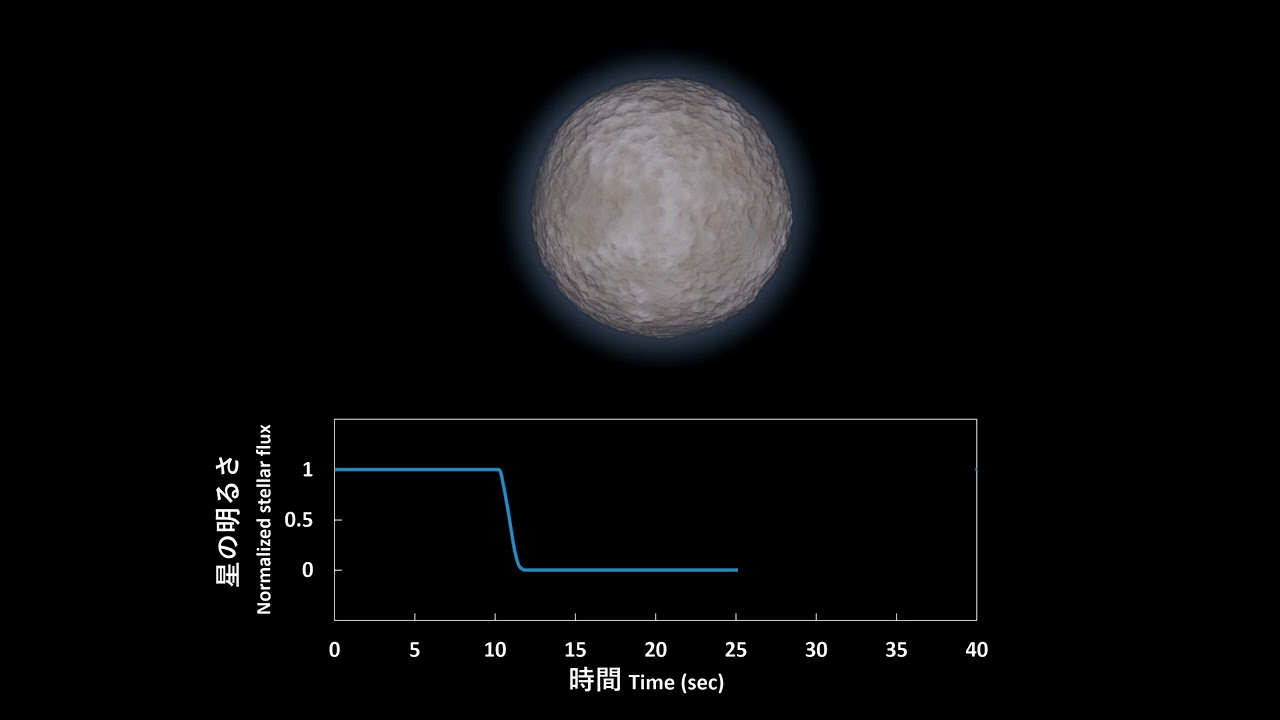
Watch On

The team's observations suggested that the atmosphere is extremely thin, around 5 million to 10 million times thinner than Earth's atmosphere — too thin to support life. The potential atmosphere is also not permanent, with calculations suggesting that it will last less than 1,000 years unless it's restocked with gas.

The discovery raises questions about how an atmosphere could have formed around this small, cold world. Previous JWST observations revealed that the object's surface doesn't appear to have any frozen gas that could have sublimated to produce an atmosphere. The researchers speculated that the atmosphere could be sustained by cryovolcanoes (ice volcanoes), with some unknown event forcing gases to the object's surface.

Another possibility is that the object was hit by another icy body, such as a comet, which then produced gases to form an atmosphere. Future observations, particularly by JWST — an infrared telescope designed to probe atmospheres around alien worlds — could help solve the mystery, according to Arimatsu.

"That is why future monitoring is so important," Arimatsu told the Associated Press. "If the atmosphere fades over the next several years, that would support an impact origin. If it persists, or varies seasonally, that would point more toward ongoing internal gas supply."

Article Sources

Arimatsu, K., Yoshida, F., Hayamizu, T., Takita, S., Hosoi, K., Ootsubo, T., & Watanabe, J. (2026). Detection of an atmosphere on a trans-Neptunian object beyond Pluto. Nature Astronomy. https://doi.org/10.1038/s41550-026-02846-1


See how well you know our planetary neighborhood with our solar system quiz!