




惯性聚合 高效追踪和阅读你感兴趣的博客、新闻、科技资讯
阅读原文 在惯性聚合中打开

推荐订阅源

H
Help Net Security
爱范儿
爱范儿
V
Visual Studio Blog
Last Week in AI
Last Week in AI
阮一峰的网络日志
阮一峰的网络日志
雷峰网
雷峰网
Hugging Face - Blog
Hugging Face - Blog
博客园 - 【当耐特】
freeCodeCamp Programming Tutorials: Python, JavaScript, Git & More
博客园 - 三生石上(FineUI控件)
博客园 - Franky
博客园 - 叶小钗
OSCHINA 社区最新新闻
OSCHINA 社区最新新闻
The Cloudflare Blog
大猫的无限游戏
大猫的无限游戏
人人都是产品经理
人人都是产品经理
M
MIT News - Artificial intelligence
罗磊的独立博客
L
LangChain Blog
Jina AI
Jina AI
IT之家
IT之家
J
Java Code Geeks
Microsoft Azure Blog
博客园_首页

Latest from Live Science

Naked mole rats wage bloody wars of succession to choose a new queen — but one colony did something scientists… Can the US be trusted with the moon? A law scholar raises concerns after Artemis II Lyrid meteor shower 2026: See spring's first rain of 'shooting stars' peak in moonless skies $3 million prize goes to duo whose research led to first sickle cell CRISPR therapy 700-year-old mummy from Bolivia contains earliest confirmed evidence of strep throat bacteria in the Americas New pain-relief opioid could be much less addictive than morphine, rodent study finds Experimental drug doubles one-year survival in pancreatic cancer Science news this week: Physicists witness faster-than-light darkness pinpricks, humans are still evolving, and some… Archaeologists discover perfectly circular ancient Egyptian temple that may have been used for sacred water rituals Some polar bears are adapting to their melting habitat. Will it be enough to save the iconic species? 2 supermassive black holes may collide 100 years from now ‪—‬ and Earth would feel it Anglo-Saxon burial holds an older sister cradling her little brother after they both died 1,400 years ago, possibly of… Colorado River may have pooled and spilled over to form the Grand Canyon, solving a long-standing mystery ‪—‬… 'We all screamed when it happened': Bright-green fireball meteor caught exploding over famous Viking raid site… Northern lights may be visible from several US states Friday and Saturday as giant hole opens up in sun Hackers used AI to steal hundreds of millions of Mexican government and private citizen records in one of the largest… The first black hole ever discovered is spewing 'dancing jets' at half the speed of light Stephen Hawking's black hole information paradox could be solved — if the universe has 7 dimensions 'Something's missing': Most thorough-ever study of the cosmos proves we still can't explain how the… 'Human evolution didn't slow down; we were just missing the signal': Large DNA study reveals natural selection led to more redheads and less male-pattern baldness Artemis II quiz: Is your knowledge of NASA New study confirms lobsters feel pain, driving scientists to call for a ban on boiling them alive This humanoid robot does all your housework for you ‪—‬ and its makers say it Ancient process that created rare earth elements discovered — and it could help us locate desperately needed deposits Strange mammal ancestor laid huge, leathery eggs —‬ and it was key to surviving the world 73 moon landings? NASA Diagnostic dilemma: A woman heard voices telling her she had a brain tumor ‪—‬ and scans confirmed she did Triassic croc relative from Ghost Ranch, New Mexico finally identified after nearly 80 years in museum basement There were Physicists witness pinpricks of darkness moving faster than the speed of light ‪—‬ without breaking the laws of relativity
The universe may end trillions of years sooner than we th...
pmsutter@gma · 2026-04-28 · via Latest from Live Science
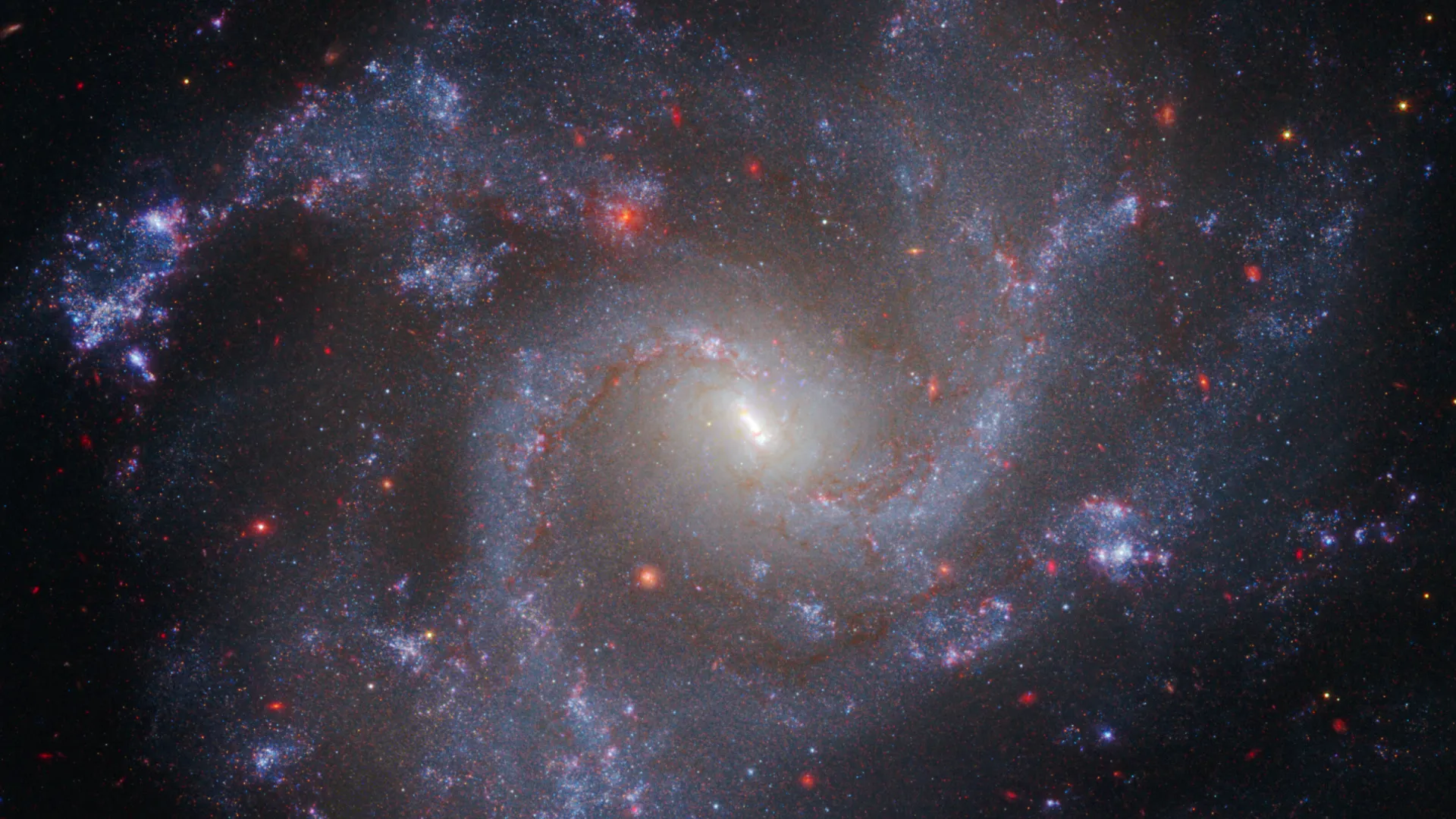
A swirl of purple and blue gas dotted with red stars moves around a central glowing core, blending together to make a giant spiral galaxy.
Astronomers use twinkling stars in galaxies like this one (NGC 5468) to confirm the universe’s expansion rate. But what if cosmic expansion were to slow down and reverse? New research looks at the implications on the lifespan of the universe. (Image credit: NASA, ESA, CSA, STScI, A. Riess (JHU/STScI), CC BY 4.0 INT)

Scientists have long assumed our universe would continue on for trillions of years, but a new study presents a much shorter life span for the cosmos: Our universe might last only another 33 billion years.

That's just a cosmic blink before everything collapses in on itself ‪—‬ a process dubbed the "Big Crunch," where expansion reverses, causing all matter and space-time to collapse back into an extremely dense state similar to the conditions of the Big Bang. While long considered a discarded possibility for the fate of the universe, because of accelerating cosmic expansion, this new research has reopened the surprising — and slightly unsettling — option.

The journey to this dramatic conclusion started with our quest to map the cosmos, where we've focused on dark energy, the mysterious force that's pushing the universe apart at an accelerating rate. Recent data from the Dark Energy Survey (DES) and the Dark Energy Spectroscopic Instrument (DESI) mapped hundreds of millions of galaxies to probe this expansion. These crucial tools suggest, with extremely high confidence that the dark energy "equation of state" — its pressure-to-energy density relationship, which dictates its effect on expansion — isn't simply a static number. Instead, its influence appears to be changing over time.

This strange dynamic opens the door for alternative explanations for what dark energy might be made of . This has led to the axion dark energy (aDE) model, which proposes that dark energy comprises both an axion field, which would be an ultra-light form of dark matter that sloshes around the universe, plus a cosmological constant, or fixed background expansion baked into the structure of space-time.

In the new paper, which was uploaded to the preprint server arXiv, the researchers applied this hybrid model to DES measurements. They discovered that this combination likely can explain the DES and DESI results, but with a twist: In the far future of the universe, the interplay of the axion field and the cosmological constant actually actively pulls the universe back together, leading to that ultimate Big Crunch.
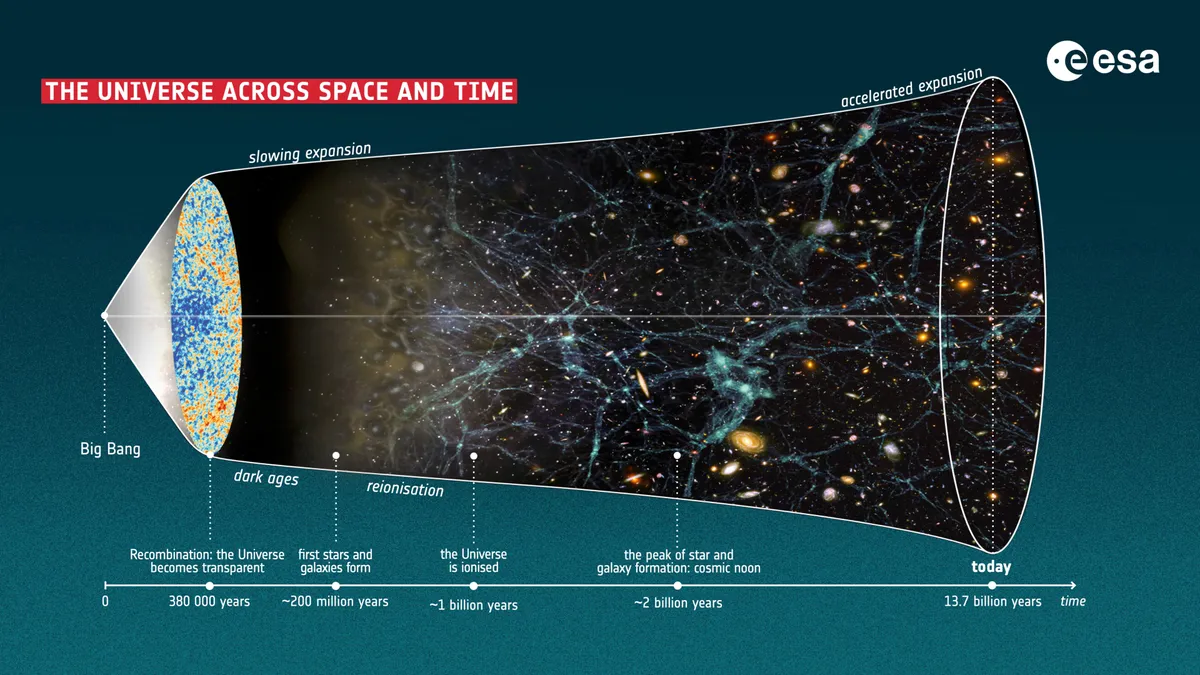
A scientific illustration showing a cylindrical shape on its side, with various stars and images inside, and labels along the bottom showing the timeline of the universe's evolution.

The standard model of cosmology suggests that cosmic expansion will continue to accelerate over time. However, if dark energy is dynamic, as some recent surveys hint, then the universe could one day reverse course and collapse on itself. (Image credit: ESA, CC BY-SA 3.0 IGO)

By taking the model that best matched observations and running the simulation forward in time, researchers calculated a precise moment of cosmic demise: 33.3 billion years from now. This dramatically shorter future contrasts sharply with the trillion-year lifespan often traditionally considered. Instead of cosmic expansion stretching the universe out like a lonely, eternal highway, we get a cosmic U-turn that takes us back to the start of our journey.

Related stories

This is fresh territory, and while evidence compels us, science always comes with caveats. The DES and DESI observations suggesting the cosmological constant isn't static are intriguing, but it still needs verification. This model depends on many variables, and several different combinations of them could still explain observations, though a negative cosmological constant ‪—‬ and a resulting Big Crunch ‪—‬ remains the most likely in their analysis.

Get the world’s most fascinating discoveries delivered straight to your inbox.

More data is needed to rigorously test this model. The cosmos is a complicated beast; our understanding continually evolves. As we pursue increasing data streams, we piece together the greatest story ever told — but that story might end sooner than we expected.

Paul M. Sutter is a research professor in astrophysics at  SUNY Stony Brook University and the Flatiron Institute in New York City. He regularly appears on TV and podcasts, including  "Ask a Spaceman." He is the author of two books, "Your Place in the Universe" and "How to Die in Space," and is a regular contributor to Space.com, Live Science, and more. Paul received his PhD in Physics from the University of Illinois at Urbana-Champaign in 2011, and spent three years at the Paris Institute of Astrophysics, followed by a research fellowship in Trieste, Italy.