


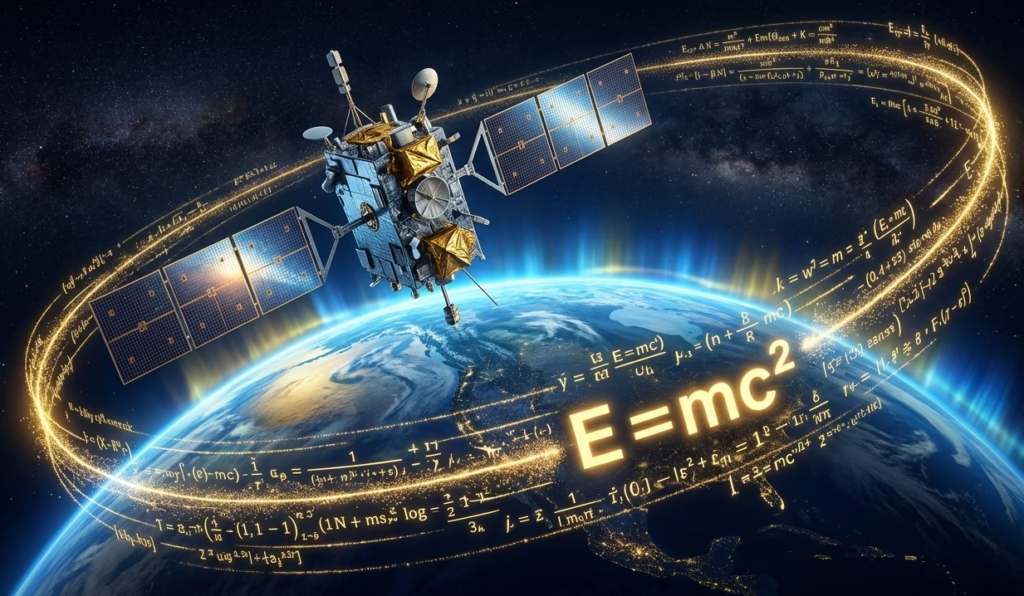
Have you ever been told you are not smart enough? Albert Einstein heard that from his own teachers. Yet this same man became the most influential scientist in the history of the modern world. This is the full history of Albert Einstein — a story of failure, brilliance, and ideas that still shape our world today.
Albert Einstein was a German-born theoretical physicist born on March 14, 1879, in Ulm, Germany. He developed the Theory of Relativity, which completely transformed how humanity understands space, time, and gravity. His equation E = mc² became the most famous equation ever written — proving that energy and mass are the same thing in different forms. In 1921, he won the Nobel Prize in Physics and is widely considered the greatest scientist of the 20th century.
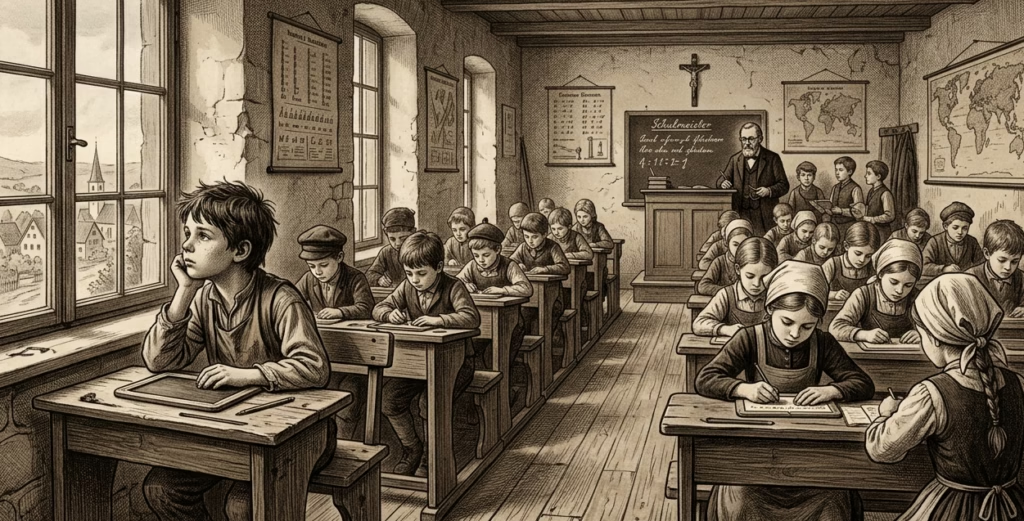
Einstein grew up in a middle-class Jewish family in Munich, Germany. As a young child, he was so slow to speak that his parents feared something was seriously wrong with him. He did not speak full sentences until age four and did not read until age seven. His teachers called him slow, unsociable, and permanently distracted. One teacher told him directly — “You will never amount to anything.” At 15, Einstein dropped out of school entirely, frustrated by the rigid and authoritarian teaching style. He later failed his entrance exam to the Swiss Federal Polytechnic School in Zurich on his first attempt. Rejected, sent home, and told to try again — this was the early life of the man the world would one day call the greatest genius in history.
After finally graduating, Einstein could not find a single teaching job. No school wanted him and no university hired him. In 1901, he accepted a humble position as a technical assistant at the Swiss Patent Office in Bern, reviewing other people’s inventions eight hours a day. But while the world ignored him, Einstein’s mind never stopped working. In his spare time — quietly, after long days at the office — he was solving mysteries that had puzzled scientists for centuries. Then in 1905, at just 26 years old, something extraordinary happened. Einstein published four groundbreaking scientific papers in a single year. Historians call this his Annus Mirabilis — his miracle year. Any single one of those papers would have made a scientist famous for life. One of them introduced E = mc² to the world, explaining how the sun burns, how nuclear energy works, and how a tiny amount of matter holds an unimaginable amount of energy.
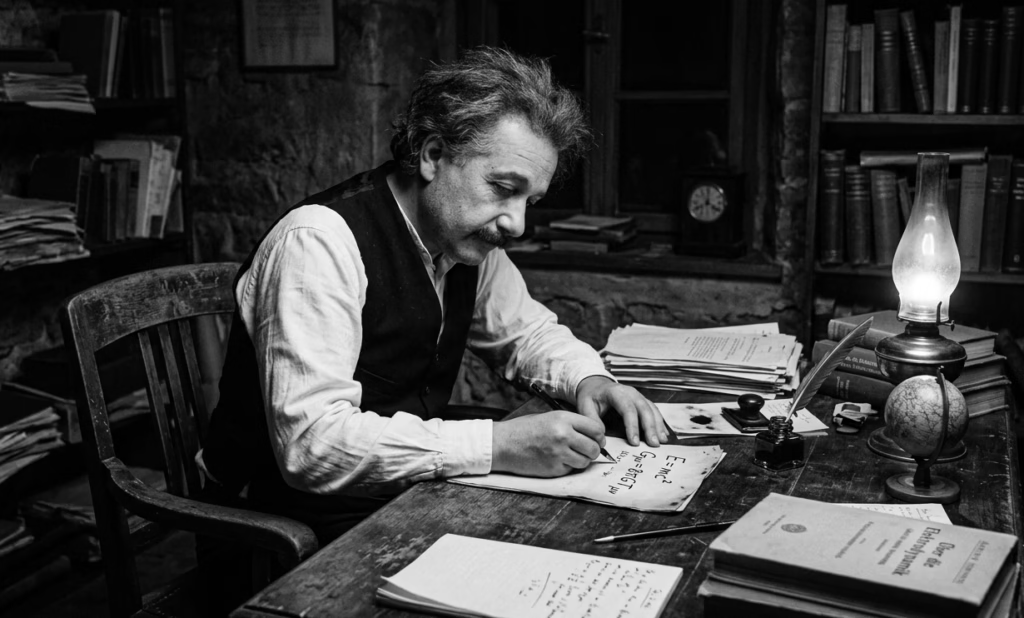
In 1915, Einstein published his General Theory of Relativity — and physics was never the same again. Before Einstein, scientists followed Isaac Newton’s idea that gravity was simply a pulling force between objects. Einstein said something completely different. Gravity, he said, is not a force at all. It is a curve in the fabric of space and time itself. Imagine placing a heavy ball on a stretched rubber sheet — it bends the sheet around it. A smaller ball rolling nearby curves toward it, not because it is being pulled, but because the very surface beneath it is bent. That is exactly how Einstein described the universe, but with space and time as the rubber sheet. When scientists confirmed this theory by observing a solar eclipse in 1919, Einstein became an overnight global celebrity. Newspapers across the world ran his photograph on their front pages. The failed student, the rejected teacher, the patent clerk nobody noticed — was now the most famous man on the planet.
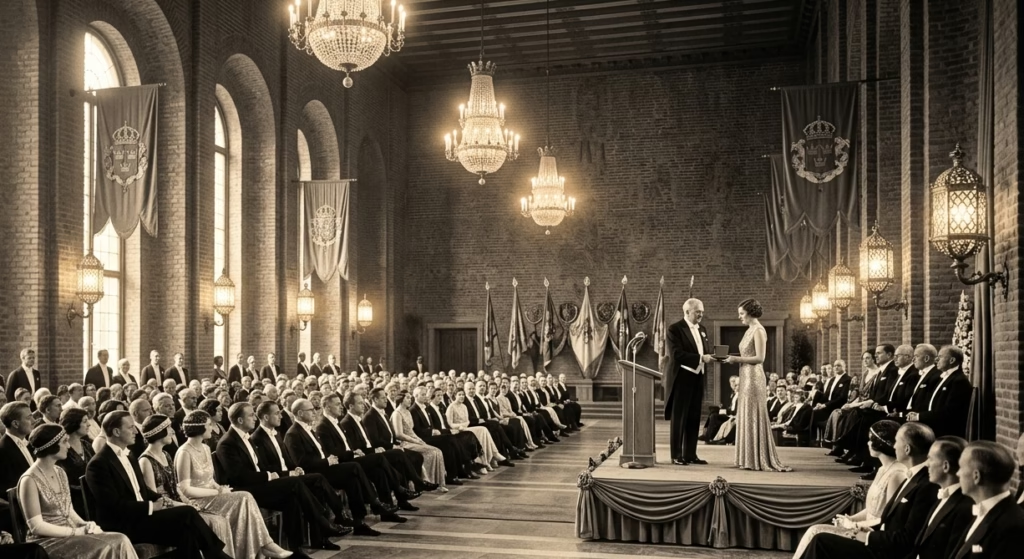
In 1921, Einstein received the Nobel Prize in Physics — one of the highest honors in all of science. Surprisingly, the prize was not awarded for his Theory of Relativity, which was still debated by some scientists at the time. Instead, he won it for explaining the photoelectric effect — his discovery of how light causes electrons to be released from metal surfaces. This discovery later became the scientific foundation for solar panels, television technology, and modern digital cameras. In a remarkable gesture, Einstein gave the entire Nobel Prize money to his first wife Mileva Maric as part of their divorce agreement — a promise he had made years before the prize was ever awarded.
As a Jewish man in Germany, Einstein watched in horror as Adolf Hitler rose to power during the 1930s. The Nazi regime declared his work “Jewish physics” and banned it from German institutions. They raided his home and placed his name on a list of state enemies. Einstein fled to the United States in 1933 and never returned to Germany again. In 1939, he signed a letter to US President Franklin D. Roosevelt warning that Nazi Germany was developing an atomic bomb and urging America to build one first. That letter helped launch the Manhattan Project — the secret program that produced the atomic bombs dropped on Japan in 1945, killing over 200,000 people. Einstein was not involved in building the bomb, but for the rest of his life he was haunted by the role his discoveries played in creating the deadliest weapon in human history. “I made one great mistake in my life,” he said, “when I signed that letter to President Roosevelt.”
Einstein never failed mathematics — this is one of history’s most repeated myths, as he mastered calculus entirely on his own before the age of 15. After Einstein died in 1955, a pathologist named Thomas Harvey removed his brain without permission during the autopsy and secretly kept it for over 40 years. In 1952, Einstein was formally offered the presidency of the newly established State of Israel and politely declined. He slept 10 hours every night and took regular afternoon naps, believing that deep sleep was the key to clear scientific thinking. He never wore socks, dismissing them as pointless since they always developed holes anyway. When asked for his phone number, Einstein looked it up in the phone book, saying “Why memorize something I can simply look up?” The FBI secretly kept a 1,427-page file investigating whether Einstein was a communist spy — and found absolutely nothing. He was also an accomplished violin player who performed regularly at charity concerts throughout his life.
Albert Einstein died on April 18, 1955, in Princeton, New Jersey, at the age of 76. The cause was an aortic aneurysm — a sudden rupture of the major blood vessel near his heart. When doctors told him surgery could extend his life, Einstein refused without hesitation. “I want to go when I want to go,” he said. “It is tasteless to prolong life artificially. I have done my share. It is time to go. I will do it elegantly.” He died peacefully in his sleep that same night. His body was cremated and his ashes scattered at an undisclosed location — exactly as he had wished. He wanted no grave, no monument, and no place where people might come to worship him.
Albert Einstein has been gone for over 70 years — yet his ideas quietly power the modern world every single day. Every time you use GPS on your phone, Einstein’s Theory of Relativity is being calculated in real time, and without corrections based on his equations your GPS would drift by several miles within just minutes. Every surgery that uses laser technology exists because of Einstein’s work on the behavior of light. Every MRI machine in every hospital in the world is rooted in Einstein’s discoveries about magnetic fields and energy. Solar panels powering millions of homes today were made possible directly by Einstein’s Nobel Prize discovery — the photoelectric effect. When scientists detect gravitational waves — ripples in the very fabric of space and time — they are confirming predictions Einstein made over one hundred years ago. His face remains one of the most recognized images on earth and his name has become a universal word for genius itself. And yet he started as a boy who could not speak until age four, a student his teachers gave up on, a patent clerk no university wanted to hire. That may be the most important lesson in the entire history of Albert Einstein — the world does not always recognize genius when it first appears, but true genius, in the end, makes itself impossible to ignore.
Enjoyed this article? Explore more fascinating stories from history at HistoryMix.com!

Administrator
此内容由惯性聚合(RSS阅读器)自动聚合整理,仅供阅读参考。 原文来自 — 版权归原作者所有。