
惯性聚合 高效追踪和阅读你感兴趣的博客、新闻、科技资讯
阅读原文 在惯性聚合中打开

推荐订阅源

Security Archives - TechRepublic
T
The Exploit Database - CXSecurity.com
P
Proofpoint News Feed
Scott Helme
Scott Helme
NISL@THU
NISL@THU
Cisco Talos Blog
Cisco Talos Blog
C
Cybersecurity and Infrastructure Security Agency CISA
AWS News Blog
AWS News Blog
V
Vulnerabilities – Threatpost
J
Java Code Geeks
U
Unit 42
The GitHub Blog
The GitHub Blog
H
Help Net Security
T
Tenable Blog
aimingoo的专栏
aimingoo的专栏
Jina AI
Jina AI
Spread Privacy
Spread Privacy
Apple Machine Learning Research
人人都是产品经理
人人都是产品经理
L
Lohrmann on Cybersecurity
T
Threatpost
让小产品的独立变现更简单 - ezindie.com
Engineering at Meta
Engineering at Meta
A
About on SuperTechFans
I
InfoQ
Microsoft Azure Blog
B
Blog
L
LINUX DO - 最新话题
K
Kaspersky official blog
cs.CV updates on arXiv.org
T
Threat Research - Cisco Blogs
C
Check Point Blog
T
The Blog of Author Tim Ferriss
有赞技术团队
有赞技术团队
宝玉的分享
宝玉的分享
Help Net Security
Help Net Security
Google DeepMind News
A
Arctic Wolf
Y
Y Combinator Blog
N
News | PayPal Newsroom
M
MIT News - Artificial intelligence
Latest news
Latest news
H
Hacker News: Front Page
Blog — PlanetScale
Blog — PlanetScale
腾讯CDC
I
Intezer
爱范儿
爱范儿
F
Fortinet All Blogs
P
Palo Alto Networks Blog
C
CERT Recently Published Vulnerability Notes

Microsoft Security Blog

Least privilege for AI agents: Identity, access, and tool binding | Microsoft Security Blog Unpacking the AsyncAPI npm supply chain compromise and import-time payload delivery | Microsoft Security Blog Turning threat intelligence into decisive action with Defender Experts | Microsoft Security Blog Defending SaaS-based applications against ShinyHunters OAuth abuse | Microsoft Security Blog Microsoft Entra ID security updates: Passkeys are the default authentication method in Entra ID | Microsoft Security Blog Securing our future: July 2026 progress report on Microsoft's Secure Future Initiative | Microsoft Security Blog GigaWiper: Anatomy of a destructive backdoor assembled from multiple malware | Microsoft Security Blog Protecting Microsoft at AI speed: How SFI proactively hardens our cloud   | Microsoft Security Blog 5 insights from Frost & Sullivan’s 2025 Frost Radar™ for Cloud Security Posture Management | Microsoft Security Blog Improving security posture across the Microsoft partner ecosystem | Microsoft Security Blog Microsoft named a leader in the Frost Radar for cloud and application runtime security | Microsoft Security Blog Accelerating the quantum-safe timeline | Microsoft Security Blog ​​What’s new in Microsoft Security: June 2026 | Microsoft Security Blog Securing AI agents: When AI tools move from reading to acting | Microsoft Security Blog Chromium extension uses AI‑related branding to redirect browser search | Microsoft Security Blog Photo ZIP campaign targeting hospitality industry delivers Node.js implant for persistent access | Microsoft Security Blog Microsoft a Leader in The Forrester Wave™ for Endpoint Management Platforms | Microsoft Security Blog CNAPP evolution: How Microsoft aligns with leading cloud risk management platforms | Microsoft Security Blog StealC and Amadey: Breaking down infostealers and the cybercrime services that deliver them | Microsoft Security Blog Guarding AI memory | Microsoft Security Blog One intrusion, two cyberattackers: Uncovering parallel threat activity | Microsoft Security Blog AutoJack: How a single page can RCE the host running your AI agent  | Microsoft Security Blog New Forrester study shows customers who unified with Microsoft Security benefited from 124% ROI | Microsoft Security Blog From package to postinstall payload: Inside the Mastra npm supply chain compromise | Microsoft Security Blog Crypto Clipper uses Tor and worm-like propagation for persistence and control | Microsoft Security Blog Beyond the benchmark: Advancing security at AI speed  | Microsoft Security Blog ​​Forrester names Microsoft a Leader in the 2026 Extended Detection and Response Platforms Wave™ report | Microsoft Security Blog AI is accelerating cyberattacks—here’s how to stay ahead Microsoft Defender email security benchmarking: Key insights from one year of data | Microsoft Security Blog Reconstructing AI activity in investigations AI brands as bait: How threat actors are using the AI hype in social engineering Securing CI/CD in an agentic world: Claude Code Github action case Updating the taxonomy of failure modes in agentic AI systems: What a year of red teaming taught us Preinstall to persistence: Inside the Red Hat npm Miasma credential-stealing campaign Turn specs into evals for any agent with ASSERT Microsoft Build 2026: Securing code, agents, and models across the development lifecycle Malicious npm packages abuse dependency confusion to profile developer environments Microsoft is named a Leader in the 2026 Gartner® Magic Quadrant™ for Endpoint Protection Typosquatted npm packages used to steal cloud and CI/CD secrets The Gentlemen ransomware: Dissecting a self-propagating Go encryptor From poisoned search results to GPU mining: A cryptojacking campaign abusing ScreenConnect and Microsoft .NET utilities Microsoft recognized as a Leader in The Forrester Wave™ for Workforce Identity Security Platforms From edge appliance to enterprise compromise: Multi-stage Linux intrusion via F5 and Confluence Microsoft Security success stories: How St. Luke’s and ManpowerGroup are securing AI foundations What’s new in Microsoft Security: May 2026 Mini Shai Hulud: Compromised @antv npm packages enable CI/CD credential theft Securing the gaming culture of cultures Introducing RAMPART and Clarity: Open source tools to bring safety into Agent development workflow Exposing Fox Tempest: A malware-signing service operation How Storm-2949 turned a compromised identity into a cloud-wide breach Defense in depth for autonomous AI agents When configuration becomes a vulnerability: Exploitable misconfigurations in AI apps Accelerating detection engineering using AI-assisted synthetic attack logs generation Defending consumer web properties against modern DDoS attacks Undermining the trust boundary: Investigating a stealthy intrusion through third-party compromise Active attack: Dirty Frag Linux vulnerability expands post-compromise risk When prompts become shells: RCE vulnerabilities in AI agent frameworks World Passkey Day: Advancing passwordless authentication ​​Microsoft named an overall leader in KuppingerCole Analyst’s 2026 Emerging AI Security Operations Center (SOC) report ​​ ClickFix campaign uses fake macOS utilities lures to deliver infostealers Breaking the code: Multi-stage ‘code of conduct’ phishing campaign leads to AiTM token compromise CVE-2026-31431: Copy Fail vulnerability enables Linux root privilege escalation across cloud environments Microsoft Agent 365, now generally available, expands capabilities and integrations What’s new, updated, or recently released in Microsoft Security Email threat landscape: Q1 2026 trends and insights 8 best practices for CISOs conducting risk reviews Simplifying AWS defense with Microsoft Sentinel UEBA AI-powered defense for an AI-accelerated threat landscape Detection strategies across cloud and identities against infiltrating IT workers Making opportunistic cyberattacks harder by design Cross‑tenant helpdesk impersonation to data exfiltration: A human-operated intrusion playbook Containing a domain compromise: How predictive shielding shut down lateral movement Building your cryptographic inventory: A customer strategy for cryptographic posture management Dissecting Sapphire Sleet’s macOS intrusion from lure to compromise Incident response for AI: Same fire, different fuel The agentic SOC—Rethinking SecOps for the next decade Investigating Storm-2755: “Payroll pirate” attacks targeting Canadian employees Intent redirection vulnerability in third-party SDK exposed millions of Android wallets to potential risk Inside an AI‑enabled device code phishing campaign Storm-1175 focuses gaze on vulnerable web-facing assets in high-tempo Medusa ransomware operations Threat actor abuse of AI accelerates from tool to cyberattack surface Cookie-controlled PHP webshells: A stealthy tradecraft in Linux hosting environments Mitigating the Axios npm supply chain compromise Critical Infrastructure at Risk | Security Insider
How to better protect your growing business in an AI-powered world
Alym Rayani · 2026-05-19 · via Microsoft Security Blog

AI is rapidly reshaping how work gets done in companies and organizations. In celebrating National Small Business Month, we want to acknowledge the unique challenges that growing business leaders face as AI creates both opportunity and risk. They face constant tradeoffs between moving fast, managing risk, and keeping operations stable under pressure. At the same time, cybercriminals are moving faster, their attacks are becoming more targeted, and AI is helping increase efficacy of the threats. In fact, AI-automated phishing is 4.5 times more effective than traditional cyberattacks. It takes only one convincing phishing email, and one stray click to enable a breach.1

The key question is: How can we maximize the benefits of AI while staying protected in a rapidly evolving threat landscape?

Cybersecurity—from IT issue to business risk

Today’s cybersecurity landscape is defined by speed, scale, and automation—trends that disproportionately affect growing businesses. According to the 2025 Microsoft Digital Defense Report, Microsoft now processes more than 100 trillion security signals every day and blocks 4.5 million new malware files daily, underscoring just how industrialized cybercrime has become. Increasingly, cyberattackers are using AI to automate phishing, generate highly convincing scams, and rapidly adapt malware, making cyberattacks more frequent and harder to detect.

For businesses that often lack dedicated security teams or round-the-clock monitoring, this shift has real business consequences: disrupted operations, financial loss from ransomware or fraud, and lasting damage to customer trust. The report also notes that most modern cyberattacks now target identities, like user accounts and access—a challenge for organizations relying on cloud services and remote work without strong protections in place for accounts and access. As AI continues to amplify both the volume and sophistication of cyberattacks, cybersecurity is no longer just an IT issue for businesses—it’s a core business risk that can directly affect resilience and growth.
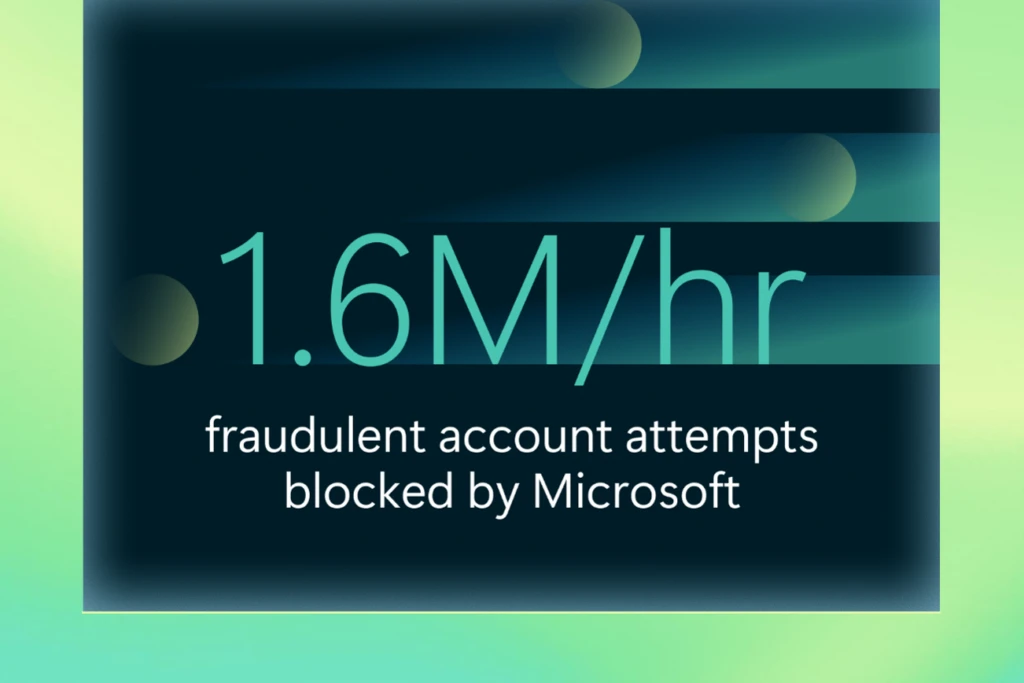
A graphic showing that 1.6 million fraudulent account attempts are blocked by Microsoft every hour.
Source: Cyber Signals Issue 9.2

Building a foundation of trust

In this new reality, security becomes the foundation of trust—helping growing businesses protect their operations, preserve customer trust, and move forward with confidence. For business owners, cybersecurity isn’t just about stopping cyberattacks; it’s about keeping the business running day to day. When systems go down, orders can’t be processed, employees can’t do their work, and customers are left waiting or wondering whether their data is safe. Even short disruptions can have outsized consequences for growing businesses, from lost revenue and stalled growth to reputational damage that’s hard to repair. By making security a core part of how the business operates—not an afterthought—even the smallest businesses put themselves in a stronger position to withstand disruptions, maintain credibility with customers, and create a stable foundation for long-term growth.
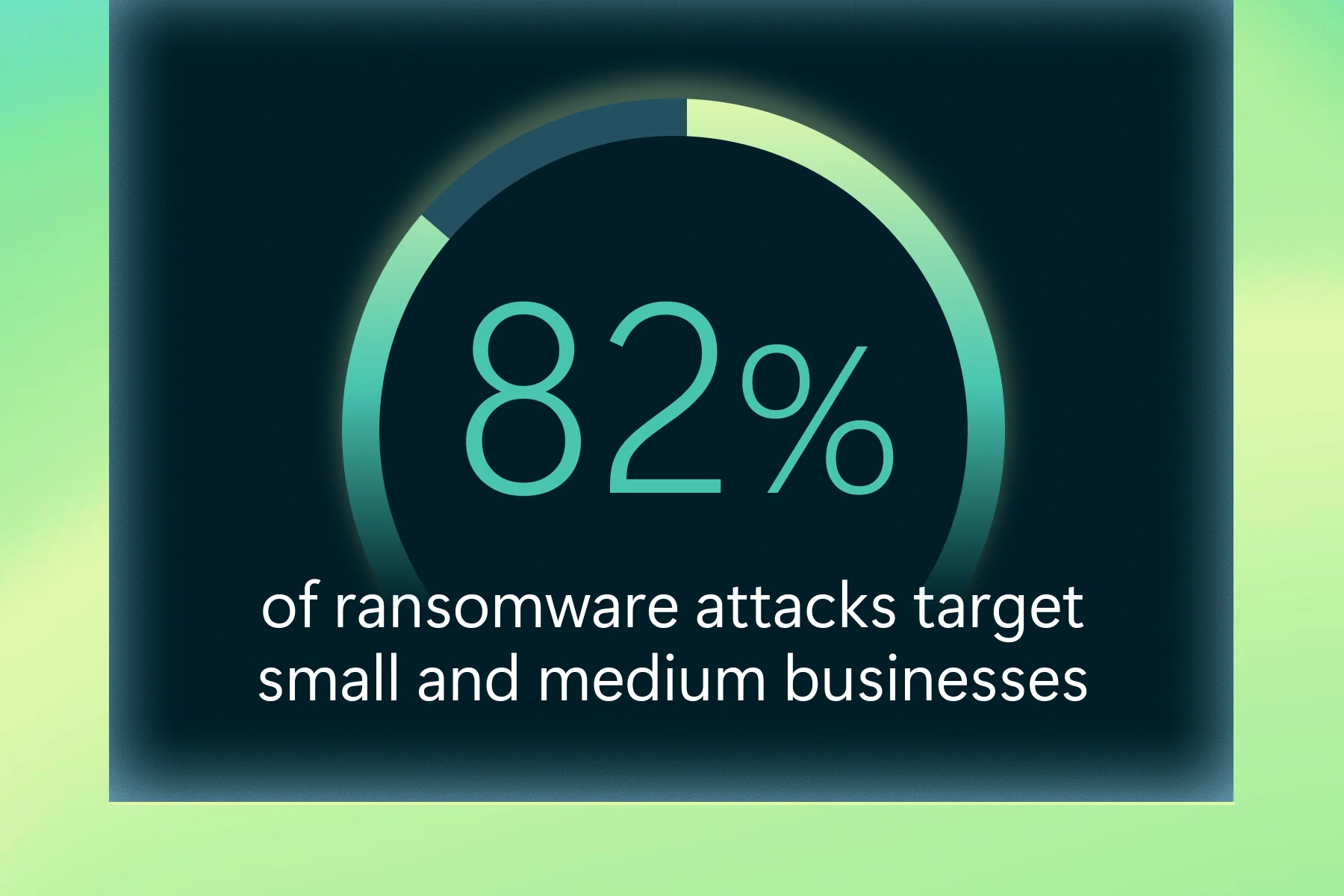
A graphic showing that 82% of ransomware attacks target small and medium businesses.
Source: The Devastating Impact of Ransomware Attacks on Small Businesses.3

Simple, built‑in security for your growing business

Effective security must be simple, approachable, and fit the realities of running a business with limited time and resources. Many growing businesses don’t have dedicated security teams or the time and resources to manage complex tools, yet they still need protection that keeps pace with modern threats. Microsoft Security is built with this in mind, offering integrated, easy‑to‑manage protections that help safeguard devices, identities, email, and cloud apps without adding unnecessary complexity. Microsoft 365 Business Premium combines productivity and built-in security in one streamlined solution, with centralized visibility and automation that reduces manual effort. It helps protect your users, devices, and data across your business, so you can stay focused on customers and day-to-day operations. By providing security that works quietly in the background—and scales as the business grows—Microsoft helps businesses of all sizes protect what matters most without slowing them down.

Allowing people to operate devices and applications without conditional access increases risks. Getting that done was a huge success for us.

—Theo Mouchteros, Head of IT Operations, Acumen

Take the next step

To discover the right security plan for growing business, read our small and medium business plans and pricing options or contact Microsoft Sales for more support.

To learn more about Microsoft Security solutions, visit our website. Bookmark the Security blog to keep up with our expert coverage on security matters. Also, follow us on LinkedIn (Microsoft Security) and X (@MSFTSecurity) for the latest news and updates on cybersecurity.


1Microsoft Digital Defense Report 2025.

2Cyber Signals Issue 9.

3The Devastating Impact of Ransomware Attacks on Small Businesses.