
惯性聚合 高效追踪和阅读你感兴趣的博客、新闻、科技资讯
阅读原文 在惯性聚合中打开

推荐订阅源

D
DataBreaches.Net
P
Proofpoint News Feed
The Cloudflare Blog
宝玉的分享
宝玉的分享
OSCHINA 社区最新新闻
OSCHINA 社区最新新闻
月光博客
月光博客
美团技术团队
Spread Privacy
Spread Privacy
Latest news
Latest news
Cisco Talos Blog
Cisco Talos Blog
T
Threatpost
Project Zero
Project Zero
博客园 - 司徒正美
D
Darknet – Hacking Tools, Hacker News & Cyber Security
Simon Willison's Weblog
Apple Machine Learning Research
腾讯CDC
cs.CL updates on arXiv.org
钛媒体:引领未来商业与生活新知
钛媒体:引领未来商业与生活新知
F
Fortinet All Blogs
Security Latest
Security Latest
Blog — PlanetScale
Blog — PlanetScale
T
Tailwind CSS Blog
Cyberwarzone
Cyberwarzone
The Hacker News
The Hacker News
Scott Helme
Scott Helme
T
Tor Project blog
Engineering at Meta
Engineering at Meta
H
Help Net Security
Recorded Future
Recorded Future
Microsoft Azure Blog
CTFtime.org: upcoming CTF events
I
Intezer
freeCodeCamp Programming Tutorials: Python, JavaScript, Git & More
P
Privacy & Cybersecurity Law Blog
T
The Blog of Author Tim Ferriss
I
InfoQ
C
Cybersecurity and Infrastructure Security Agency CISA
大猫的无限游戏
大猫的无限游戏
F
Full Disclosure
Threat Intelligence Blog | Flashpoint
Microsoft Security Blog
博客园 - 三生石上(FineUI控件)
L
LINUX DO - 热门话题
V
Vulnerabilities – Threatpost
S
SegmentFault 最新的问题
人人都是产品经理
人人都是产品经理
G
GRAHAM CLULEY
A
Arctic Wolf
P
Privacy International News Feed

KrASIA

GoodMe takes ready-to-drink beverages beyond its own stores Mi Liangchuan’s exit deepens pressure on Xpeng’s robotics push Surging users, widening losses, and leased compute: Behind SiliconFlow’s IPO filing BYD spots North America foothold amid US-Canada tariff discord Momenta makes public debut in Hong Kong, puts physical AI in spotlight IPO aspirant SAIC Mobility grows orders, but platforms capture much of the upside Chinese automakers overtake Japanese rivals in Europe despite EV tariffs Li Auto cuts out middle layer in latest R&D restructuring Growatt’s energy storage shift drives third bid for Hong Kong IPO Deals in brief: Vynn Capital to finance Etaily’s expansion, CATL backs CarbonScape as partner, 17 China investments, and more UBTech’s UWorld U1 tests demand for humanoid robots at home 31-year-old founder steers Direct Drive Tech toward Hong Kong IPO Asia's AI rally winners face a rising leverage problem Can a smart ring make health monitoring part of daily life? Chinese-owned Lotus bets on hybrid SUV for US turnaround Chinese door-to-door logistics networks grow in US to counter trade war Hong Kong's hub ambitions are not a zero-sum game Volcano Engine bets better models, not lower prices, will decide the MaaS race Singapore moves ahead with autonomous taxis as trials expand Hong Kong courts GBA-ASEAN connector role as trade and investment ties grow Deals in brief: Airwallex raises Series H funding, Igloo acquires Eazy Digital, nine China investments, and more CaoCao Mobility’s RoboX plan targets autonomous driving’s next phase Chinese appliance brands gain ground in Southeast Asia Robotics will not get its “GPT moment” by following LLMs, Agibot chief scientist says Flanked by DJI and Insta360, this company has grown 50% a year for five straight years Hong Kong pushes Beijing's bay area dream as it advances first five-year plan Asian streaming services go big on microdramas and AI content RayNeo extends AR glasses lead as smart eyewear demand shifts Huawei lays out six priorities for AI-era mobile networks Seer Robotics rides 24-hour market swing in Hong Kong debut HJ Science stumbles in Hong Kong debut after gray market surge China’s game makers split as giants chase prestige and others target profit Why world models alone will not solve robotics’ deployment problem Geely seeks to double Zeekr sales abroad, eyeing Malaysia output 12306 moves beyond tickets as OTA traffic comes under pressure China’s Aima bets on Black Wing to broaden the appeal of electric two-wheelers 5 things to know about Seer Robotics ahead of its Hong Kong IPO China expo draws Nvidia, Apple, Micron as Beijing guards AI supply chain Deals in brief: Singapore-based ChemT, Synvo, and H3 Zoom raise funding; 100x100 launches climate fund; seven China investments; and more Chinese electronics maker Longcheer bets on US growth Hotpot chain Banu posts stronger profit growth in updated IPO prospectus Wenge AI gears up for Hong Kong IPO at valuation above HKD 10.5 billion HIMA brings in secondary battery suppliers, with Gotion set to power Aito car models China's hydrogen push outstrips Japan's in new fuel race Tata-Chery collaboration highlights Indian EV makers' China reliance What BYD’s Rayong factory reveals about the limits of China’s overseas playbook How AI is changing stock trades for retail investors Plaud reaches USD 100 million ARR in two years as AI hardware gains traction Tsing Micro nears becoming China’s first listed reconfigurable chip company Baidu’s Apollo Go expands Europe plans with Swiss permit Could replacement technology become longevity medicine’s next frontier? Middle East weekly: Invest Qatar and QNB host dialogue, Keeta launches UAE restaurant SME program, China becomes Saudi’s top vehicle supplier, and more World Cup tests Lenovo's ambitions to challenge AI champions Deals in brief: Tin Men Capital backs Pints AI, Malaysia’s GreatAsic raises funding, latest China investments, and more Can a bedside lamp track sleep? A Xiaomi veteran thinks so BYD brand ambassador Wang Leehom uses fee to buy shares Seres-backed AIVA debuts, with first car model set for unveiling this year Xiaomi’s Luo Fuli says Claude Fable 5 is an interim step in AI’s evolution What naphtha shortage? China extends petrochemicals lead amid US-Iran conflict Chinese entrepreneur's e-truck startup Windrose faces unpaid wage claims How China's Anta joined Nike and Adidas on the world sportswear podium ByteDance spins out drug discovery unit to test AI4S commercialization China’s electric SUV makers chase high-end buyers TSMC "not afraid of competition" as CEO wishes Elon Musk good luck on chips Middle East weekly: Dubai plans smart medical visa, Saudi fund expands overseas project support, Qatar updates business activity classifications, and more Will Li-Ning’s Stephen Curry deal cut both ways? China's BYD, SAIC Motor eye EVs with all-solid-state batteries in 2027 Deals in brief: Handshake Finance, Clear Robotics raise funding; VoidZero joins Cloudflare; GIC invests in Supabase and Ramp; and more Xpeng loses product lead before Iron robot enters critical phase WeChat opens the door to phone-based AI agents, on its own terms Longsys targets edge AI storage in Hong Kong dual listing push Why Curry Brand chose Li-Ning over Anta ByteDance sets four AI priorities for 2026 AI demand strains supplies of lasers, fiber, and other optical tech ByteDance raises Volcano Engine’s MaaS revenue target on Seedance 2.0 growth Kuaishou’s Kling AI seeks fresh funding ahead of planned 2027 IPO CRP advances Hong Kong IPO plan as it expands in industrial robotics Middle East weekly: Invest Qatar concludes China roadshow, Core42 secures HSBC financing, Salwa REIT Fund launches, and more Keenon Robotics prioritizes function over form in its robot lineup Thailand's Line Man pushes beyond food delivery, eyes 2027 IPO Doubao prepares paid subscriptions as ByteDance seeks AI returns Autolink makes its Hong Kong IPO case with smart vehicle architecture Chinese dessert soups are getting a modern makeover, and Mak Kee wants to lead it China's Chery to debut EV minicar in Japan, following BYD's lead MiniMax explores Star Market listing after Hong Kong debut Deals in brief: SG Enviro completes Series A round, Return Helper raises USD 4 million, 14 new China investments, and more Huawei says new Kirin chip for phones overcomes US clampdown China drops hammer on cross-border stock trading: 5 things to know Chinese rivals push GoPro from pioneer to takeover target Chinese EV makers awaken Western rivals' zombie production lines EufyMake: Inside Anker’s push to turn UV printing into a consumer product Pony.ai raises 2026 robotaxi targets as revenue growth accelerates Middle East weekly: Jetour opens UAE service center, Dubai launches second stimulus package, Aramco deploys Saudi Arabia’s first quantum computer, and more AISpeech targets Star Market IPO as demand for conversational AI grows Geespace’s next test is building a business case for satellite infrastructure Why world models must do more than simulate: Pony.ai CTO Index providers reshape Asian financial markets with exacting standards Why AI shopping can finally move from recommendations to checkout Lenovo’s “AI factory” approach starts to show results Huawei proposes “Tau scaling law” to extend chip advances beyond Moore’s law
Huawei Cloud shifts the AI cloud fight beyond token prices
Cheng Zi · 2026-06-10 · via KrASIA

Huawei Cloud is taking a different route in artificial intelligence as China’s token economy takes shape.

Tokens are the units of text processed by AI models, and they have become a key measure of usage, cost, and scale in the AI cloud business.

“At a time when domestic computing power is growing, Huawei Cloud does not care that much about total token volume, nor about total revenue. What we care about is the health of tokens produced by domestic computing systems, and whether they represent productivity gains rather than just emotional value,” Huawei Cloud CEO Peter Zhou said on June 5 at the 2026 Huawei Cloud Inspire conference in Shanghai.

Zhou gave a simple example. A person casually asking AI a question on a phone also generates tokens, but the value of those tokens is difficult to assess. In his view, a cloud platform should not be evaluated by how many trillions of tokens it runs, but by how much efficiency those tokens create for enterprises.
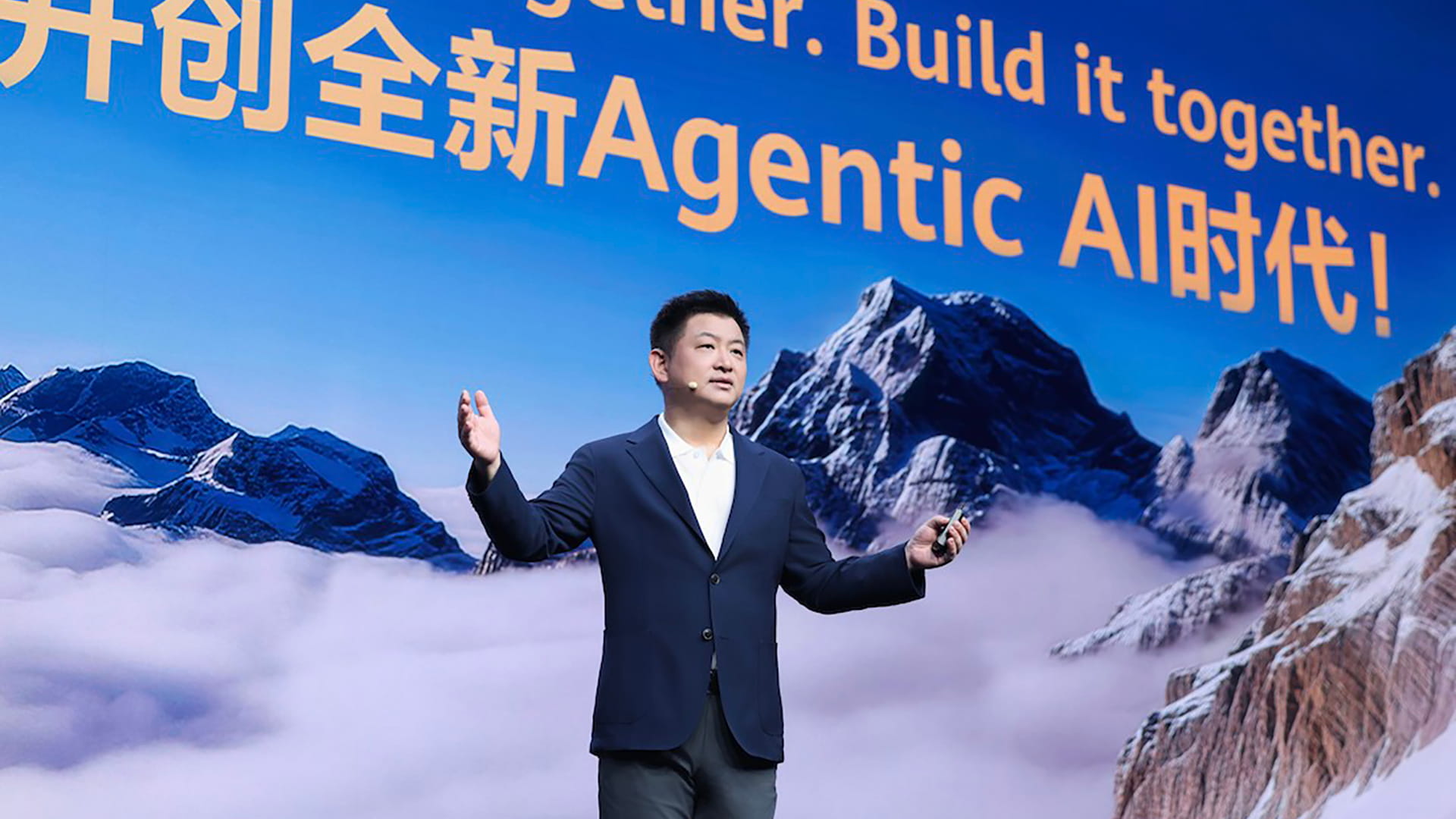
Photo shows Peter Zhou, CEO of Huawei Cloud.
Peter Zhou, CEO of Huawei Cloud. Photo source: Huawei.

Over the past two years, Chinese cloud vendors have fought a prolonged token price war. In May 2024, after DeepSeek V2 triggered the first major round of price cuts, ByteDance’s Volcano Engine doubled down by setting Doubao’s price at RMB 0.0008 per 1,000 tokens. Alibaba, Baidu, Tencent, and iFlytek soon followed.

The premise was to use low-priced models to attract traffic and drive public cloud sales, even if gross margins for inference computing were pushed into negative territory. After DeepSeek R1 shifted mainstream attention toward reasoning models, coding and video models brought price competition back into focus.

At the conference, Huawei Cloud did not respond with another price cut. Instead, it proposed a new paradigm called “Agentic Infra,” aimed at supporting domestic computing power for AI agents. While others compete on cheaper tokens and higher call volumes, Huawei Cloud is choosing another route: controlled domestic computing infrastructure and enterprise productivity.

Built on domestic hardware

Huawei Cloud presented a full infrastructure stack for Agentic Infra. It defined the system across four layers: efficient “token factories,” continuous learning, integrated scheduling for general-purpose and intelligent computing, and secure autonomy. The company announced four corresponding products.

The primary product is what Huawei Cloud calls an AI cluster service, built to support clusters with up to 100,000 accelerator cards and total computing power of 200 exaflops. According to the company, it can reduce token generation latency to less than ten milliseconds, achieve throughput of 5 million tokens per second per 1,000 cards, and offer online service availability of 99.95%. Huawei Cloud calls this its “token factory.”

Its CCE Volcano scheduling engine pools training and inference resources while integrating fragmented capacity, improving resource utilization by more than 30%, according to the company. Its agentic memory storage solution uses direct access to NPUs, or neural processing units, to create petabyte-level memory space, while AgentSphere provides a secure runtime environment for agents with 100-millisecond startup.

At the model layer, Huawei Cloud launched ModelArts, a new training and inference platform. Its model routing function automatically dispatches requests to the most suitable model based on request characteristics. Huawei Cloud said the platform currently connects to more than 15 advanced models, with routing accuracy above 95% and average call costs reduced by 20%.

Huawei Cloud also released enterprise features for sectors where it has an established presence. ModelArts packages reinforcement learning as an enterprise service and offers confidential inference for sensitive scenarios such as finance and coding, keeping data inside protected environments.

The foundation for this route is the Ascend ecosystem. Earlier this year, when DeepSeek was released to the public, Huawei Cloud and SiliconFlow deployed DeepSeek R1 and V3 on the Ascend CloudMatrix 384 supernode. At the time, its inference efficiency could match Nvidia H800, suggesting that domestic computing power can offer usable performance for mainstream AI inference.

From computing base to industry deployment

If infrastructure answers where computing comes from, Huawei Cloud now wants to answer where tokens go: vertical productivity.

Huawei Cloud opened public testing for AgentArts, an enterprise agent platform, and launched the open-source version, OpenJiuwen, whose core is more than 90% shared with the enterprise version.

Zhou emphasized Huawei Cloud’s ecosystem advantages in the AI era, citing the openness of Ascend and Kunpeng computing, OpenEuler, and the open-source ModelArts toolchain. He described Huawei Cloud as “the most open cloud in the agent era.”

That openness extends to the model ecosystem. At the conference, Huawei Cloud joined more than 20 model developers, including Zhipu AI (also known as Z.ai), DeepSeek, Moonshot AI, StepFun, and Baidu, to launch a broad collaboration plan.

Industry scenarios are the productivity endpoints Zhou sees as most important. Huawei Cloud said it has already helped enterprises apply AI across several sectors. In embodied intelligence, for example, it launched the CloudRobo development platform, allowing small and midsize companies to access computing power and share data and models at lower cost.

“China has more than 300 embodied intelligence startups, and most are not large. The pressure of each building its own computing and data chain is too high,” Zhou said.

Healthcare is another focus. Huawei formed a healthcare corps in March 2025 and made AI-assisted diagnosis a corps-level strategic direction. Huawei Cloud now has a representative case: a pathology large model jointly developed with Ruijin Hospital. China has only about 20,000 doctors who can read pathology slides, while remote hospitals face higher misdiagnosis risks. The model allows county- and city-level hospitals to call advanced diagnostic capabilities through the cloud, reducing the need for patients to travel long distances.

Huawei Cloud also released a hybrid cloud white paper and confidential computing solution for agents, targeting the data security and localization concerns of governments, financial institutions, and state-owned enterprises. The approach combines public and private cloud routes.

By Zhou’s description, Huawei aims to build a second computing plane. That means it is not trying to match the scale of Nvidia-centered global infrastructure, but to give developers another technical route and ecosystem option.

KrASIA features translated and adapted content that was originally published by 36Kr. This article was written by Deng Yongyi for 36Kr.

Note: RMB figures are converted to USD at rates of RMB 6.79 = USD 1 based on estimates as of June 10, 2026, unless otherwise stated. USD conversions are presented for ease of reference and may not fully match prevailing exchange rates.