


惯性聚合 高效追踪和阅读你感兴趣的博客、新闻、科技资讯
阅读原文 在惯性聚合中打开

推荐订阅源

美团技术团队
W
WeLiveSecurity
Stack Overflow Blog
Stack Overflow Blog
L
LangChain Blog
S
SegmentFault 最新的问题
Apple Machine Learning Research
Google DeepMind News
F
Full Disclosure
奇客Solidot–传递最新科技情报
奇客Solidot–传递最新科技情报
The Register - Security
G
Google Developers Blog
C
Check Point Blog
GbyAI
GbyAI
A
About on SuperTechFans
V
Vulnerabilities – Threatpost
T
The Blog of Author Tim Ferriss
T
Tor Project blog
AWS News Blog
AWS News Blog
Cyberwarzone
Cyberwarzone
C
CERT Recently Published Vulnerability Notes
MongoDB | Blog
MongoDB | Blog
Latest news
Latest news
aimingoo的专栏
aimingoo的专栏
U
Unit 42
Y
Y Combinator Blog
P
Privacy International News Feed
Cisco Talos Blog
Cisco Talos Blog
S
Securelist
S
Schneier on Security
雷峰网
雷峰网
cs.CV updates on arXiv.org
Attack and Defense Labs
P
Proofpoint News Feed
C
Cisco Blogs
Webroot Blog
Webroot Blog
T
Troy Hunt's Blog
Google Online Security Blog
月光博客
月光博客
P
Privacy & Cybersecurity Law Blog
Security Archives - TechRepublic
罗磊的独立博客
Cloudbric
Cloudbric
钛媒体:引领未来商业与生活新知
钛媒体:引领未来商业与生活新知
Recent Commits to openclaw:main
Application and Cybersecurity Blog
Hacker News: Ask HN
Hacker News: Ask HN
H
Hackread – Cybersecurity News, Data Breaches, AI and More
博客园 - 司徒正美
freeCodeCamp Programming Tutorials: Python, JavaScript, Git & More
Microsoft Security Blog

NVIDIA Blog

GeForce NOW Turns Up the Heat With New GeForce RTX 5080-Powered Toronto Server NVIDIA Nemotron Achieves Benchmark-Leading Performance With LangChain Deep Agents Harness AI Innovators Adopt NVIDIA Vera — Why Max Single-Threaded CPU at Scale Matters NVIDIA and Hugging Face Bring New Models and Frameworks to LeRobot for the Open Robotics Community How Open Models Are Driving AI Research How Nations Are Deploying AI for Strategic Priorities Joyride Through July With 12 Games Coming to GeForce NOW NVIDIA Unlocks AI Compute at Scale, Inviting Partners to Power the AI Infrastructure Buildout NVIDIA and Partners Build in America, for America NVIDIA BioNeMo Agent Toolkit Brings Accelerated AI to Life Sciences Researchers in Claude Science How NVIDIA’s Inference Software Stack Powers the Lowest Token Cost How Jaiveer Singh Is Helping Robots — and Developers — Move Faster Into the Omniverse: Three Workflows for Improving Vision AI Agent Accuracy With Synthetic Data and Fine-Tuning Claude Meets Blackwell Ultra: Anthropic’s Models Now Run on NVIDIA GB300 in Azure Firefly Aerospace Operates NVIDIA Jetson in Lunar Orbit for the First Time Open Models, Closed Environments: Palantir Brings Secure AI to US Agencies With NVIDIA Nemotron The Ultimate Summer Sale Pairing: Steam Sale Meets GeForce NOW Discounts NVIDIA and AWS Collaborate to Bring AI to Production at Scale How Businesses Are Building Specialized AI They Can Trust NVIDIA Powers Over 400 of the World’s 500 Fastest Supercomputers NVIDIA Brings Trusted, 24/7 AI Agents to Telecom Operations At ISC, JUPITER Shows What Exascale Science Looks Like NAIRR Science Program Reshapes Scientific Research, Powered by NVIDIA AI Infrastructure From Materials Simulation to Experimental Astronomy, New NVIDIA AI Software Unlocks Scientific Discoveries NVIDIA Vera CPU Opens the Way for Agentic Scientific AI at Los Alamos National Laboratory Eco Wave Power Turns Waves Into Watts With NVIDIA AI Infrastructure and Digital Twins Hotter Than a Hot Tub: The 45°C Breakthrough to Cool AI’s Biggest Machines How FERC’s Large-Load Interconnection Actions Help Address Grid Stress, Improve Affordability At Cannes Lions, NVIDIA Partners Reshape Advertising and Marketing With AI Sync and Stream: GeForce NOW Connects to Members’ Game Libraries Across Devices France Advances Europe’s AI Future With NVIDIA Technologies Hands Free, AIs Forward: NVIDIA XR AI Brings Agents to AR Glasses Coherent Breaks Ground on Expanded Texas Facility, Scaling AI’s Optical Backbone HPE AI Factory With NVIDIA Expands for the Era of Agents Fastest, Largest, Strongest: NVIDIA Blackwell Sweeps MLPerf Training 6.0 NVIDIA Blackwell Leads on First Agentic AI Infrastructure Benchmark Save Big and Play Bigger: GeForce NOW Summer Sale Brings Major Membership Savings For Robotaxis, Safety Must Be Built In, Not Bolted On NVIDIA Accelerates Google DeepMind’s DiffusionGemma for Local AI NVIDIA Confidential Computing to Help Expand Apple’s Private Cloud Compute How the UK Is Turning Sovereign AI Ambition Into Action With NVIDIA Technologies NVIDIA and LG Group Build an AI Factory to Advance Physical AI, Mobility and AI Infrastructure NVIDIA and Doosan Group Collaborate to Advance Physical AI and AI Factory Infrastructure NVIDIA, KRAFTON, NC and Reigning ‘League of Legends’ Champions T1 Celebrate RTX Spark at Korea’s PC Bangs Seoul Purpose: How NVIDIA and South Korea Are Building the Future of AI Forecast: Fun Ahead — 18 Games Join in June to Stream on GeForce NOW NVIDIA Research Unlocks Advanced Grasping, Smarter Autonomous Driving and Agent Training at Scale NVIDIA Enables the Next Era Of Physical AI Research With Agent Skills For Autonomous Vehicles, Robotics And Vision AI Industrial Software Leaders Build Secure, Autonomous AI Engineers With NVIDIA NemoClaw NVIDIA Partners With Microsoft on Unified Stack for Agentic AI Deployment, From Windows Devices to Cloud to Local Why Financial Institutions Are Converging on Transaction Foundation Models to Build Their Own Intelligence NVIDIA Jetson Brings Agentic AI to the Physical World NVIDIA AI Cloud Ecosystem Expands Worldwide to Meet Global AI Compute Demand NVIDIA Factory Operations Blueprint Gives Factories a New AI Brain Taiwan’s Industry Titans Turbocharge World’s AI Infrastructure Buildout With NVIDIA How Cosmos 3 Helps Physical AI Think Before It Acts NVIDIA Levels Up Local AI Agents Across RTX PCs and DGX Spark NVIDIA Research Advances Robotics From Simulation to the Real World The Name’s Gaming … Cloud Gaming: ‘007 First Light’ Launches on GeForce NOW AI Factories: The New Infrastructure of Intelligence NVIDIA Vera CPU Is ‘Packing a Heavy-Hitting Punch’ Against Competition NVIDIA GTC Taipei at COMPUTEX: Live Updates on What’s Next in AI License to Stream: ‘007 First Light’ Coming to GeForce NOW With an Ultimate Bundle NVIDIA and Google Cloud Empower the Next Wave of AI Builders NVIDIA CEO Jensen Huang at Dell Technologies World: ‘Demand Is Going Parabolic, Utterly Parabolic’ Vera Arrives: NVIDIA’s First CPU Built for Agents Lands at Top AI Labs Sea You in the Cloud: ‘Subnautica 2’ Early Access Dives Onto GeForce NOW NVIDIA, Ineffable Intelligence Team Up to Build the Future of Reinforcement Learning Infrastructure Hermes Unlocks Self-Improving AI Agents, Powered by NVIDIA RTX PCs and DGX Spark NVIDIA and SAP Bring Trust to Specialized Agents Linked and Loaded: Gaijin Single Sign-On Now Available on GeForce NOW NVIDIA and ServiceNow Partner on New Autonomous AI Agents for Enterprises It’s Gonna Be May: 16 Games Hit the Cloud This Month, With More NVIDIA GeForce RTX 5080 Power NVIDIA Launches Nemotron 3 Nano Omni Model, Unifying Vision, Audio and Language for up to 9x More Efficient AI Agents Into the Omniverse: Manufacturing’s Simulation-First Era Has Arrived Tag, You’re It: GeForce NOW Levels Up Game Discovery With Xbox Game Pass and Ubisoft+ Labels Making Sense of the Early Universe From Rainforests to Recycling Plants: 5 Ways NVIDIA AI Is Protecting the Planet NVIDIA and Google Cloud Collaborate to Advance Agentic and Physical AI Autonomous AI at Scale: Adobe Agents Unlock Breakthrough Creative Intelligence With NVIDIA and WPP No Need for Space Gear — Capcom’s ‘PRAGMATA’ Joins GeForce NOW on Launch Day Rethinking AI TCO: Why Cost per Token Is the Only Metric That Matters New Adobe Premiere Color Grading Mode Accelerated on NVIDIA GPUs Strength and Destiny Collide: ‘Samson: A Tyndalston Story’ Arrives in the Cloud National Robotics Week — Latest Physical AI Research, Breakthroughs and Resources From RTX to Spark: NVIDIA Accelerates Gemma 4 for Local Agentic AI Press Start on April: GeForce NOW Brings 10 Games to the Cloud Efficiency at Scale: NVIDIA, Energy Leaders Accelerating Power‑Flexible AI Factories to Fortify the Grid Into the Omniverse: NVIDIA GTC Showcases Virtual Worlds Powering the Physical AI Era Game On: Five New Titles Now Streaming on GeForce NOW The Future of AI Is Open and Proprietary Blowing Off Steam: How Power-Flexible AI Factories Can Stabilize the Global Energy Grid Advancing Open Source AI, NVIDIA Donates Dynamic Resource Allocation Driver for GPUs to Kubernetes Community How Autonomous AI Agents Become Secure by Design With NVIDIA OpenShell NVIDIA GTC 2026: Live Updates on What’s Next in AI Smooth Moves: 90 Frames-Per-Second Virtual Reality Arrives on GeForce NOW From Simulation to Production: How to Build Robots With AI More Than Meets the Eye: NVIDIA RTX-Accelerated Computers Now Connect Directly to Apple Vision Pro NVIDIA, Telecom Leaders Build AI Grids to Optimize Inference on Distributed Networks GTC Spotlights NVIDIA RTX PCs and DGX Sparks Running Latest Open Models and AI Agents Locally
Snap Decisions: How Open Libraries for Accelerated Data Processing Boost A/B Testing for Snapchat
2026-03-17 · via NVIDIA Blog

The features on social media apps like Snapchat evolve nearly as fast as what’s trending. To keep pace, its parent company Snap has adopted open data processing libraries from NVIDIA on Google Cloud services to boost development. 

Every new feature rolled out to Snapchat’s more than 940 million monthly active users goes through a set of controlled experiments before it’s launched. During this A/B testing cycle, the development team studies different variables with a subset of users, measuring nearly 6,000 metrics that analyze engagement, app performance and monetization. 

Snap runs thousands of these experiments each month — processing over 10 petabytes of data within a three-hour window each morning using the Apache Spark distributed framework. By adopting Apache Spark accelerated by NVIDIA cuDF, the company is boosting these data processing workloads on NVIDIA GPUs to achieve 4x speedups in runtime with the same number of machines, providing a cost-effective path to scale.

By pairing NVIDIA’s GPU-optimized software, including NVIDIA CUDA-X libraries, with Google’s infrastructure management services such as Google Kubernetes Engine, Snap is harnessing a full-stack platform for data processing at scale. 

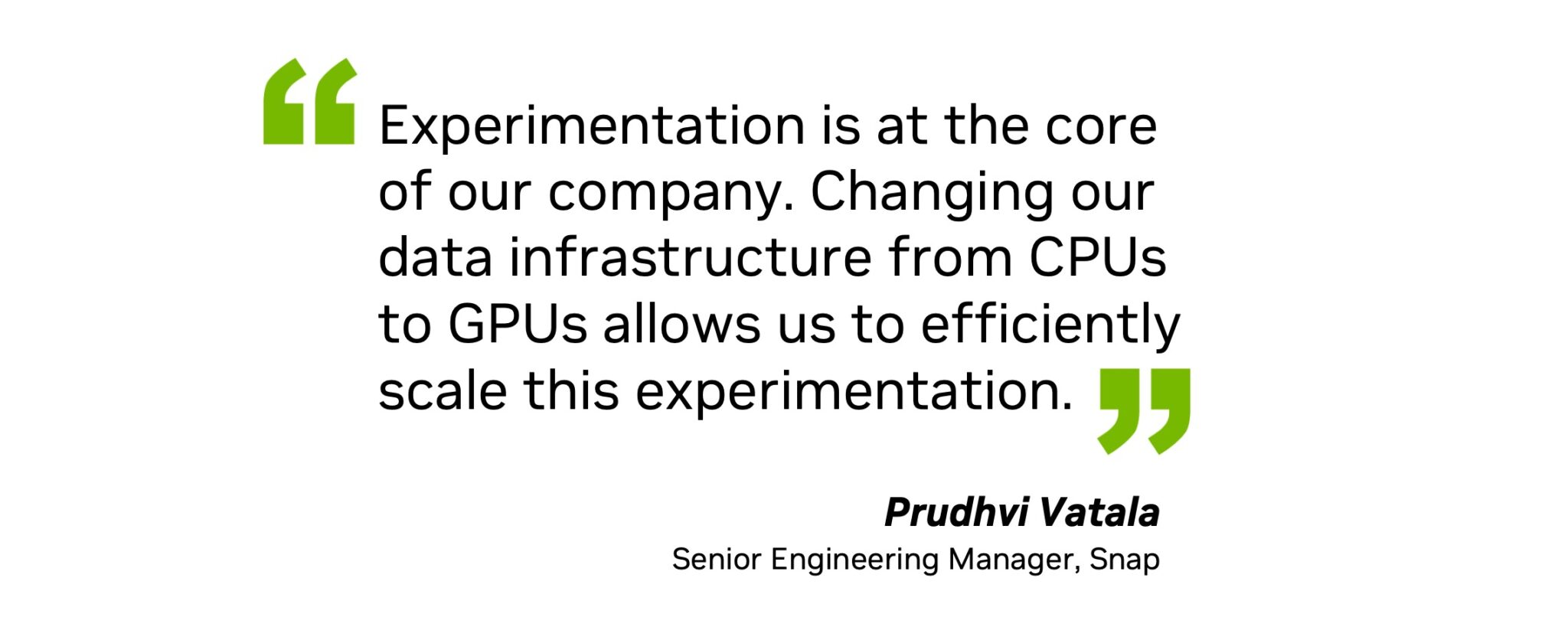
“Experimentation is at the core of our company. Changing our data infrastructure from CPUs to GPUs allows us to efficiently scale this experimentation to more features, more metrics and more users over time,” said Prudhvi Vatala, senior engineering manager at Snap. “The more experiments we’re able to run, the more innovative experiences we can deliver for Snapchat users.”

A Sustainable Way to Scale

Snapchat fans frequently see new features in the app — from arrival notifications to AI-generated stickers — but Snap is also continuously rolling out behind-the-scenes updates such as performance optimizations and compatibility updates for new operating system versions. 

The A/B testing for all these new features now runs on cuDF, which allows developers to run existing Apache Spark applications on NVIDIA GPUs with no code changes for easy deployment. The open library for accelerated data processing builds on the power of the NVIDIA cuDF GPU DataFrame library while scaling it for the Apache Spark distributed computing framework.

With this migration, the team has — based on Snap internal data collected between January 1 and February 28 — realized 76% daily cost savings using NVIDIA GPUs on Google Kubernetes Engine compared with CPU-only workflows.

“We were projecting an ambitious roadmap to scale up experimentation that would have blown up our computing costs based on our existing infrastructure,” Vatala said. “Switching to GPU-accelerated pipelines with cuDF gave us a way to flatten the scaling curve, and the results were tremendous.”
To support workload migration, the team also harnessed cuDF suite of microservices that automatically qualify, test, configure and optimize Spark workloads for GPU acceleration at scale. 

Working with NVIDIA experts, the Snap team optimized its pipelines on Google Cloud’s G2 virtual machines powered by NVIDIA L4 GPUs so they required just 2,100 GPUs running concurrently — as opposed to the initial projection that around 5,500 GPUs would need to run concurrently, according to data Snap collected between January 1 and March 13.

“When I saw the results of the initial experiments, they were pretty crazy — we saw much higher cost savings than we had expected,” said Joshua Sambasivam, a backend engineer on the A/B testing team. “The Spark accelerator is a perfect match for our workloads.”

Looking ahead, the Snap team plans to integrate the Spark accelerator beyond the A/B team to a broader range of production workloads. 

“We didn’t realize we were sitting on this gold mine,” Vatala said. “We’ve so far migrated our two biggest pipelines, but there’s a lot of opportunity ahead.” 

Learn more by tuning into Vatala’s session at NVIDIA GTC, taking place Tuesday, March 17 at 1 p.m. PT

Read more about NVIDIA cuDF and get started with GPU acceleration for Apache Spark.

Main image above courtesy of Snap, depicting A/B test of its Maps feature.