





惯性聚合 高效追踪和阅读你感兴趣的博客、新闻、科技资讯
阅读原文 在惯性聚合中打开

推荐订阅源

Google DeepMind News
Cisco Talos Blog
Cisco Talos Blog
O
OpenAI News
C
Cybersecurity and Infrastructure Security Agency CISA
L
LINUX DO - 最新话题
T
Tenable Blog
SecWiki News
SecWiki News
cs.AI updates on arXiv.org
TaoSecurity Blog
TaoSecurity Blog
S
Security @ Cisco Blogs
Threat Intelligence Blog | Flashpoint
Latest news
Latest news
N
News and Events Feed by Topic
N
News and Events Feed by Topic
A
Arctic Wolf
AWS News Blog
AWS News Blog
I
Intezer
Scott Helme
Scott Helme
cs.CL updates on arXiv.org
W
WeLiveSecurity
K
KPMG report finds enterprise disconnect between AI and its ROI | CIO
T
Threatpost
Project Zero
Project Zero
N
News | PayPal Newsroom
Hacker News: Ask HN
Hacker News: Ask HN
Cyberwarzone
Cyberwarzone
P
Privacy & Cybersecurity Law Blog
V
Vulnerabilities – Threatpost
Application and Cybersecurity Blog
Hacker News - Newest:
Hacker News - Newest: "LLM"
Forbes - Security
Forbes - Security
Security Archives - TechRepublic
Cloudbric
Cloudbric
T
Tor Project blog
Know Your Adversary
Know Your Adversary
H
Heimdal Security Blog
K
Kaspersky official blog
The Hacker News
The Hacker News
NISL@THU
NISL@THU
P
Palo Alto Networks Blog
Schneier on Security
PCI Perspectives
PCI Perspectives
Spread Privacy
Spread Privacy
Help Net Security
Help Net Security
G
GRAHAM CLULEY
T
Threat Research - Cisco Blogs
L
Lohrmann on Cybersecurity
cs.CV updates on arXiv.org
Recent Commits to openclaw:main
T
The Exploit Database - CXSecurity.com

NVIDIA Blog

GeForce NOW Turns Up the Heat With New GeForce RTX 5080-Powered Toronto Server NVIDIA Nemotron Achieves Benchmark-Leading Performance With LangChain Deep Agents Harness AI Innovators Adopt NVIDIA Vera — Why Max Single-Threaded CPU at Scale Matters NVIDIA and Hugging Face Bring New Models and Frameworks to LeRobot for the Open Robotics Community How Open Models Are Driving AI Research How Nations Are Deploying AI for Strategic Priorities Joyride Through July With 12 Games Coming to GeForce NOW NVIDIA Unlocks AI Compute at Scale, Inviting Partners to Power the AI Infrastructure Buildout NVIDIA and Partners Build in America, for America NVIDIA BioNeMo Agent Toolkit Brings Accelerated AI to Life Sciences Researchers in Claude Science How NVIDIA’s Inference Software Stack Powers the Lowest Token Cost How Jaiveer Singh Is Helping Robots — and Developers — Move Faster Into the Omniverse: Three Workflows for Improving Vision AI Agent Accuracy With Synthetic Data and Fine-Tuning Claude Meets Blackwell Ultra: Anthropic’s Models Now Run on NVIDIA GB300 in Azure Firefly Aerospace Operates NVIDIA Jetson in Lunar Orbit for the First Time Open Models, Closed Environments: Palantir Brings Secure AI to US Agencies With NVIDIA Nemotron The Ultimate Summer Sale Pairing: Steam Sale Meets GeForce NOW Discounts NVIDIA and AWS Collaborate to Bring AI to Production at Scale How Businesses Are Building Specialized AI They Can Trust NVIDIA Powers Over 400 of the World’s 500 Fastest Supercomputers NVIDIA Brings Trusted, 24/7 AI Agents to Telecom Operations At ISC, JUPITER Shows What Exascale Science Looks Like NAIRR Science Program Reshapes Scientific Research, Powered by NVIDIA AI Infrastructure From Materials Simulation to Experimental Astronomy, New NVIDIA AI Software Unlocks Scientific Discoveries NVIDIA Vera CPU Opens the Way for Agentic Scientific AI at Los Alamos National Laboratory Eco Wave Power Turns Waves Into Watts With NVIDIA AI Infrastructure and Digital Twins Hotter Than a Hot Tub: The 45°C Breakthrough to Cool AI’s Biggest Machines How FERC’s Large-Load Interconnection Actions Help Address Grid Stress, Improve Affordability At Cannes Lions, NVIDIA Partners Reshape Advertising and Marketing With AI Sync and Stream: GeForce NOW Connects to Members’ Game Libraries Across Devices France Advances Europe’s AI Future With NVIDIA Technologies Hands Free, AIs Forward: NVIDIA XR AI Brings Agents to AR Glasses Coherent Breaks Ground on Expanded Texas Facility, Scaling AI’s Optical Backbone HPE AI Factory With NVIDIA Expands for the Era of Agents Fastest, Largest, Strongest: NVIDIA Blackwell Sweeps MLPerf Training 6.0 NVIDIA Blackwell Leads on First Agentic AI Infrastructure Benchmark Save Big and Play Bigger: GeForce NOW Summer Sale Brings Major Membership Savings For Robotaxis, Safety Must Be Built In, Not Bolted On NVIDIA Accelerates Google DeepMind’s DiffusionGemma for Local AI NVIDIA Confidential Computing to Help Expand Apple’s Private Cloud Compute How the UK Is Turning Sovereign AI Ambition Into Action With NVIDIA Technologies NVIDIA and LG Group Build an AI Factory to Advance Physical AI, Mobility and AI Infrastructure NVIDIA and Doosan Group Collaborate to Advance Physical AI and AI Factory Infrastructure NVIDIA, KRAFTON, NC and Reigning ‘League of Legends’ Champions T1 Celebrate RTX Spark at Korea’s PC Bangs Seoul Purpose: How NVIDIA and South Korea Are Building the Future of AI Forecast: Fun Ahead — 18 Games Join in June to Stream on GeForce NOW NVIDIA Research Unlocks Advanced Grasping, Smarter Autonomous Driving and Agent Training at Scale NVIDIA Enables the Next Era Of Physical AI Research With Agent Skills For Autonomous Vehicles, Robotics And Vision AI Industrial Software Leaders Build Secure, Autonomous AI Engineers With NVIDIA NemoClaw NVIDIA Partners With Microsoft on Unified Stack for Agentic AI Deployment, From Windows Devices to Cloud to Local Why Financial Institutions Are Converging on Transaction Foundation Models to Build Their Own Intelligence NVIDIA Jetson Brings Agentic AI to the Physical World NVIDIA AI Cloud Ecosystem Expands Worldwide to Meet Global AI Compute Demand NVIDIA Factory Operations Blueprint Gives Factories a New AI Brain Taiwan’s Industry Titans Turbocharge World’s AI Infrastructure Buildout With NVIDIA How Cosmos 3 Helps Physical AI Think Before It Acts NVIDIA Levels Up Local AI Agents Across RTX PCs and DGX Spark NVIDIA Research Advances Robotics From Simulation to the Real World The Name’s Gaming … Cloud Gaming: ‘007 First Light’ Launches on GeForce NOW AI Factories: The New Infrastructure of Intelligence NVIDIA Vera CPU Is ‘Packing a Heavy-Hitting Punch’ Against Competition NVIDIA GTC Taipei at COMPUTEX: Live Updates on What’s Next in AI License to Stream: ‘007 First Light’ Coming to GeForce NOW With an Ultimate Bundle NVIDIA and Google Cloud Empower the Next Wave of AI Builders NVIDIA CEO Jensen Huang at Dell Technologies World: ‘Demand Is Going Parabolic, Utterly Parabolic’ Vera Arrives: NVIDIA’s First CPU Built for Agents Lands at Top AI Labs Sea You in the Cloud: ‘Subnautica 2’ Early Access Dives Onto GeForce NOW NVIDIA, Ineffable Intelligence Team Up to Build the Future of Reinforcement Learning Infrastructure Hermes Unlocks Self-Improving AI Agents, Powered by NVIDIA RTX PCs and DGX Spark NVIDIA and SAP Bring Trust to Specialized Agents Linked and Loaded: Gaijin Single Sign-On Now Available on GeForce NOW NVIDIA and ServiceNow Partner on New Autonomous AI Agents for Enterprises It’s Gonna Be May: 16 Games Hit the Cloud This Month, With More NVIDIA GeForce RTX 5080 Power NVIDIA Launches Nemotron 3 Nano Omni Model, Unifying Vision, Audio and Language for up to 9x More Efficient AI Agents Into the Omniverse: Manufacturing’s Simulation-First Era Has Arrived Tag, You’re It: GeForce NOW Levels Up Game Discovery With Xbox Game Pass and Ubisoft+ Labels Making Sense of the Early Universe From Rainforests to Recycling Plants: 5 Ways NVIDIA AI Is Protecting the Planet NVIDIA and Google Cloud Collaborate to Advance Agentic and Physical AI Autonomous AI at Scale: Adobe Agents Unlock Breakthrough Creative Intelligence With NVIDIA and WPP No Need for Space Gear — Capcom’s ‘PRAGMATA’ Joins GeForce NOW on Launch Day New Adobe Premiere Color Grading Mode Accelerated on NVIDIA GPUs Strength and Destiny Collide: ‘Samson: A Tyndalston Story’ Arrives in the Cloud National Robotics Week — Latest Physical AI Research, Breakthroughs and Resources From RTX to Spark: NVIDIA Accelerates Gemma 4 for Local Agentic AI Press Start on April: GeForce NOW Brings 10 Games to the Cloud Efficiency at Scale: NVIDIA, Energy Leaders Accelerating Power‑Flexible AI Factories to Fortify the Grid Into the Omniverse: NVIDIA GTC Showcases Virtual Worlds Powering the Physical AI Era Game On: Five New Titles Now Streaming on GeForce NOW The Future of AI Is Open and Proprietary Blowing Off Steam: How Power-Flexible AI Factories Can Stabilize the Global Energy Grid Advancing Open Source AI, NVIDIA Donates Dynamic Resource Allocation Driver for GPUs to Kubernetes Community How Autonomous AI Agents Become Secure by Design With NVIDIA OpenShell NVIDIA GTC 2026: Live Updates on What’s Next in AI Smooth Moves: 90 Frames-Per-Second Virtual Reality Arrives on GeForce NOW From Simulation to Production: How to Build Robots With AI More Than Meets the Eye: NVIDIA RTX-Accelerated Computers Now Connect Directly to Apple Vision Pro NVIDIA, Telecom Leaders Build AI Grids to Optimize Inference on Distributed Networks GTC Spotlights NVIDIA RTX PCs and DGX Sparks Running Latest Open Models and AI Agents Locally Snap Decisions: How Open Libraries for Accelerated Data Processing Boost A/B Testing for Snapchat
Rethinking AI TCO: Why Cost per Token Is the Only Metric That Matters
2026-04-15 · via NVIDIA Blog

Traditional data centers only stored, retrieved and processed data. In the generative and agentic AI era, these facilities have evolved into AI token factories. With AI inference becoming their primary workload, their primary output is intelligence manufactured in the form of tokens. 

This transformation demands a corresponding shift in how the economics of AI infrastructure, including total cost of ownership (TCO), is assessed. Enterprises evaluating AI infrastructure still too often focus on peak chip specifications, compute cost or floating point operations per second for every dollar spent, aka FLOPS per dollar. 

The distinction that matters is this:

  • Compute cost is what enterprises pay for AI infrastructure, whether rented from cloud providers or owned on premises.
  • FLOPS per dollar is how much raw computing power an enterprise gets for every dollar spent, but raw compute and real-world token output are not the same thing. 
  • Cost per token is an enterprise’s all-in cost to produce each delivered token, usually represented as cost per million tokens.

The first two are merely input metrics. Optimizing for inputs while the business runs on output is a fundamental mismatch. 

Cost per token determines whether enterprises can profitably scale AI. It’s the one TCO metric that directly accounts for hardware performance, software optimization, ecosystem support and real-world utilization — and NVIDIA delivers the lowest cost per token in the industry. 

What Are the Factors That Lower Token Cost?

Understanding how to optimize token cost requires looking at the equation for calculating cost per million tokens.

An equation describing how to calculate cost per million tokens. Cost per million tokens = [cost per GPU per hour / (tokens per GPU per second x 60 seconds x 60 minutes) ] x 1 million.

In this equation, many enterprises evaluating AI infrastructure focus on the numerator: the cost per GPU per hour. For cloud deployments, this is the hourly rate paid to a cloud provider; for on-premises deployments, it’s the effective hourly cost derived from amortizing owned infrastructure. The real key to reducing token cost, however, lies in the denominator: maximizing the delivered token output.

That denominator carries two business implications.

  • Minimize token cost: When this increase in token output is reflected through the cost equation, it drives down cost per token, which is what grows the profit margin on every interaction served.
  • Maximize revenue: More tokens delivered per second also translates to more tokens per megawatt, which means more intelligence to use in AI-powered products and services, generating more revenue from the same infrastructure investment.

So focusing only on the numerator means missing what drives the denominator. Think of it as an “inference iceberg”: The numerator sits above the surface, visible and easy to compare. The denominator is everything beneath the surface, which represents key factors that determine real-world token output. Accurately evaluating AI infrastructure starts with asking what lies beneath. 
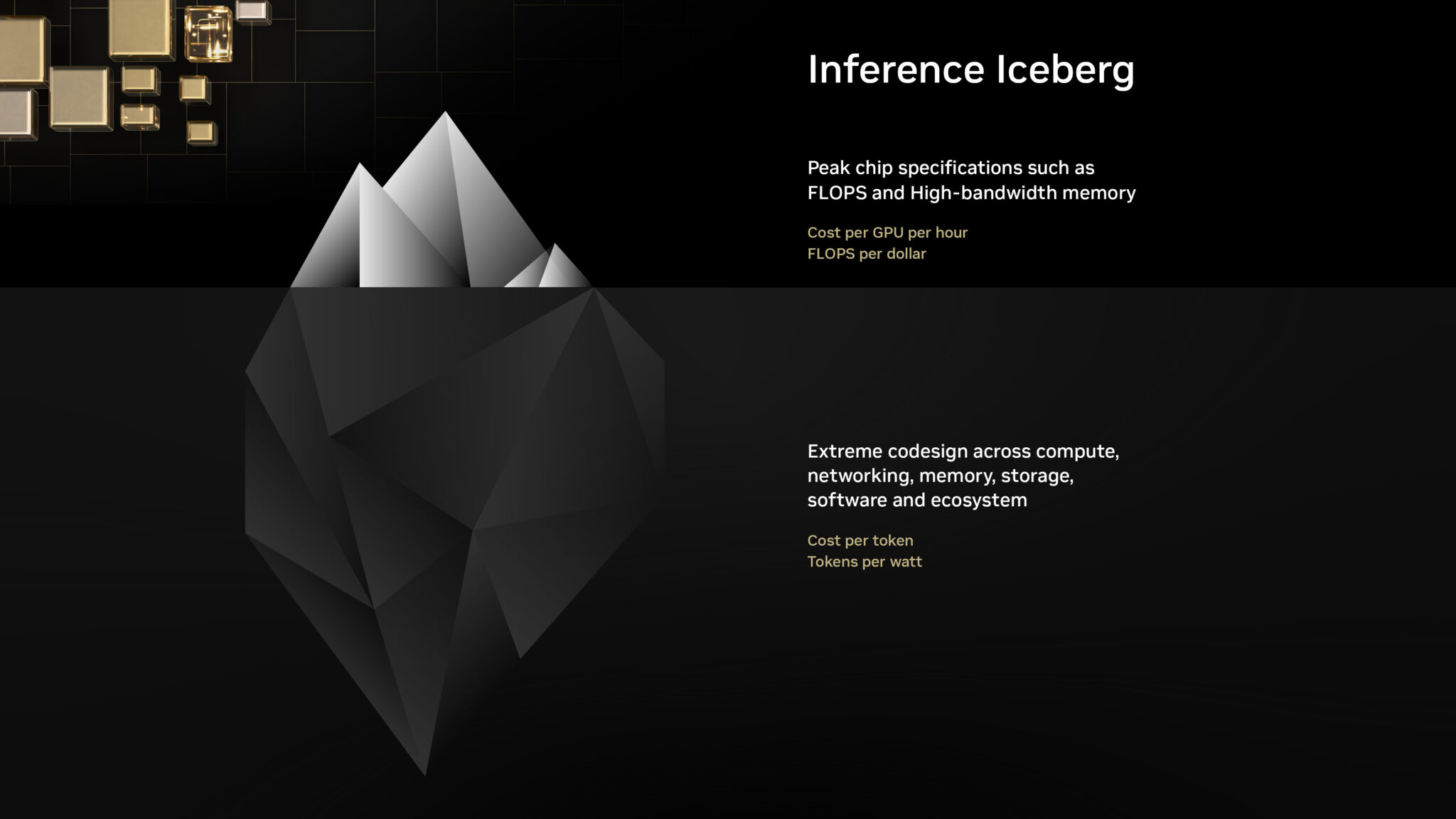
Image describing the "inference iceberg." The top of the iceberg is characterized by peak chip specifications such as FLOPS and high-bandwidth memory (cost per GPU per hour, FLOPS per dollar). The bottom of the iceberg is characterized by extreme codesign across compute, networking, software, memory, storage, software and ecosystem (cost per token, tokens per watt).

  • Surface-level inquiry:
    • What is the cost per GPU hour?
    • What are the peak petaflops and high-bandwidth memory capacity?
    • What are the FLOPS per dollar?
  • In-depth cost analysis:

Every one of these algorithmic, hardware and software optimizations must be active and integrated, or the denominator collapses. A “cheaper” GPU that delivers significantly fewer tokens per second results in a much higher cost per token. AI infrastructure that gets it right across the full stack ensures that every optimization enhances the others.

Why Does Cost per Token Matter Much More Than FLOPS per Dollar?

The following data for the DeepSeek-R1 AI model demonstrates the difference between theoretical and actual business outcomes.

Looking at compute cost alone, the NVIDIA Blackwell platform appears to cost roughly 2x more than NVIDIA Hopper — but compute cost says nothing about the output that investment buys. An analysis of mere FLOPS per dollar suggests a 2x NVIDIA Blackwell advantage compared with the NVIDIA Hopper architecture. However, the actual outcome is orders of magnitude different: Blackwell delivers more than 50x greater token output per watt than Hopper, resulting in nearly 35x lower cost per million tokens. 

MetricNVIDIA Hopper (HGX H200) NVIDIA Blackwell (GB300 NVL72) NVIDIA Blackwell Relative to Hopper
Cost per GPU per Hour ($)$1.41 $2.65 2x
FLOP per Dollar (PFLOPS) 2.85.62x
Tokens per Second per GPU906,00065x
Tokens per Second per MW54K2.8M50x
Cost per Million Tokens ($)$4.20 $0.12 35x lower

Note: Data is sourced from NVIDIA analysis and the SemiAnalysis InferenceX v2 benchmark. 

This massive divergence proves NVIDIA Blackwell delivers a massive leap in business value over the earlier Hopper generation that far outpaces any increase in system cost.

How to Choose the Right AI Infrastructure

Comparing AI infrastructure based on compute cost or theoretical FLOPS per dollar isn’t just insufficient; it doesn’t provide an accurate representation of inference economics. As the data demonstrates, an accurate evaluation of AI infrastructure’s revenue potential and profitability requires a shift from input metrics to cost per token and delivered token output.

NVIDIA delivers the industry’s lowest token cost and highest token throughput through extreme codesign across compute, networking, memory, storage, software and partner technologies. Moreover, the constant optimization of open source inference software such as vLLM, SGLang, NVIDIA TensorRT-LLM and NVIDIA Dynamo built on the NVIDIA platform means that on existing NVIDIA infrastructure, token output continues to increase and the cost per token continues to decline long after it’s acquired.

Leading cloud providers and NVIDIA cloud partners are already delivering this advantage at scale. Partners such as CoreWeave, Nebius, Nscale and Together AI have deployed NVIDIA Blackwell infrastructure and optimized their stacks to bring enterprises the lowest token cost available today, with the full benefit of NVIDIA’s hardware, software and ecosystem codesign behind every interaction served.