


惯性聚合 高效追踪和阅读你感兴趣的博客、新闻、科技资讯
阅读原文 在惯性聚合中打开

推荐订阅源

Engineering at Meta
Engineering at Meta
博客园_首页
WordPress大学
WordPress大学
宝玉的分享
宝玉的分享
罗磊的独立博客
奇客Solidot–传递最新科技情报
奇客Solidot–传递最新科技情报
酷 壳 – CoolShell
酷 壳 – CoolShell
O
OpenAI News
阮一峰的网络日志
阮一峰的网络日志
小众软件
小众软件
S
Securelist
博客园 - 叶小钗
钛媒体:引领未来商业与生活新知
钛媒体:引领未来商业与生活新知
freeCodeCamp Programming Tutorials: Python, JavaScript, Git & More
L
LINUX DO - 热门话题
Jina AI
Jina AI
博客园 - 【当耐特】
C
Cisco Blogs
爱范儿
爱范儿
Scott Helme
Scott Helme
月光博客
月光博客
P
Proofpoint News Feed
OSCHINA 社区最新新闻
OSCHINA 社区最新新闻
人人都是产品经理
人人都是产品经理
cs.CL updates on arXiv.org
J
Java Code Geeks
T
Tailwind CSS Blog
S
Schneier on Security
D
Darknet – Hacking Tools, Hacker News & Cyber Security
P
Privacy & Cybersecurity Law Blog
T
Threatpost
IT之家
IT之家
Threat Intelligence Blog | Flashpoint
博客园 - Franky
V
Vulnerabilities – Threatpost
V
Visual Studio Blog
P
Proofpoint News Feed
C
Cyber Attacks, Cyber Crime and Cyber Security
MongoDB | Blog
MongoDB | Blog
Stack Overflow Blog
Stack Overflow Blog
G
Google Developers Blog
T
Tor Project blog
The Hacker News
The Hacker News
NISL@THU
NISL@THU
腾讯CDC
SecWiki News
SecWiki News
有赞技术团队
有赞技术团队
Blog — PlanetScale
Blog — PlanetScale
Application and Cybersecurity Blog
Google DeepMind News

NVIDIA Blog

Claude Meets Blackwell Ultra: Anthropic’s Models Now Run on NVIDIA GB300 in Azure Firefly Aerospace Operates NVIDIA Jetson in Lunar Orbit for the First Time Open Models, Closed Environments: Palantir Brings Secure AI to US Agencies With NVIDIA Nemotron The Ultimate Summer Sale Pairing: Steam Sale Meets GeForce NOW Discounts NVIDIA and AWS Collaborate to Bring AI to Production at Scale How Businesses Are Building Specialized AI They Can Trust NVIDIA Powers Over 400 of the World’s 500 Fastest Supercomputers NVIDIA Brings Trusted, 24/7 AI Agents to Telecom Operations At ISC, JUPITER Shows What Exascale Science Looks Like NAIRR Science Program Reshapes Scientific Research, Powered by NVIDIA AI Infrastructure From Materials Simulation to Experimental Astronomy, New NVIDIA AI Software Unlocks Scientific Discoveries NVIDIA Vera CPU Opens the Way for Agentic Scientific AI at Los Alamos National Laboratory Eco Wave Power Turns Waves Into Watts With NVIDIA AI Infrastructure and Digital Twins Hotter Than a Hot Tub: The 45°C Breakthrough to Cool AI’s Biggest Machines How FERC’s Large-Load Interconnection Actions Help Address Grid Stress, Improve Affordability At Cannes Lions, NVIDIA Partners Reshape Advertising and Marketing With AI Sync and Stream: GeForce NOW Connects to Members’ Game Libraries Across Devices France Advances Europe’s AI Future With NVIDIA Technologies Hands Free, AIs Forward: NVIDIA XR AI Brings Agents to AR Glasses HPE AI Factory With NVIDIA Expands for the Era of Agents Fastest, Largest, Strongest: NVIDIA Blackwell Sweeps MLPerf Training 6.0 NVIDIA Blackwell Leads on First Agentic AI Infrastructure Benchmark Save Big and Play Bigger: GeForce NOW Summer Sale Brings Major Membership Savings For Robotaxis, Safety Must Be Built In, Not Bolted On NVIDIA Accelerates Google DeepMind’s DiffusionGemma for Local AI NVIDIA Confidential Computing to Help Expand Apple’s Private Cloud Compute How the UK Is Turning Sovereign AI Ambition Into Action With NVIDIA Technologies NVIDIA and LG Group Build an AI Factory to Advance Physical AI, Mobility and AI Infrastructure NVIDIA and Doosan Group Collaborate to Advance Physical AI and AI Factory Infrastructure NVIDIA, KRAFTON, NC and Reigning ‘League of Legends’ Champions T1 Celebrate RTX Spark at Korea’s PC Bangs Seoul Purpose: How NVIDIA and South Korea Are Building the Future of AI Forecast: Fun Ahead — 18 Games Join in June to Stream on GeForce NOW NVIDIA Research Unlocks Advanced Grasping, Smarter Autonomous Driving and Agent Training at Scale NVIDIA Enables the Next Era Of Physical AI Research With Agent Skills For Autonomous Vehicles, Robotics And Vision AI Industrial Software Leaders Build Secure, Autonomous AI Engineers With NVIDIA NemoClaw NVIDIA Partners With Microsoft on Unified Stack for Agentic AI Deployment, From Windows Devices to Cloud to Local Why Financial Institutions Are Converging on Transaction Foundation Models to Build Their Own Intelligence NVIDIA Jetson Brings Agentic AI to the Physical World NVIDIA AI Cloud Ecosystem Expands Worldwide to Meet Global AI Compute Demand NVIDIA Factory Operations Blueprint Gives Factories a New AI Brain Taiwan’s Industry Titans Turbocharge World’s AI Infrastructure Buildout With NVIDIA How Cosmos 3 Helps Physical AI Think Before It Acts NVIDIA Levels Up Local AI Agents Across RTX PCs and DGX Spark NVIDIA Research Advances Robotics From Simulation to the Real World The Name’s Gaming … Cloud Gaming: ‘007 First Light’ Launches on GeForce NOW AI Factories: The New Infrastructure of Intelligence NVIDIA Vera CPU Is ‘Packing a Heavy-Hitting Punch’ Against Competition NVIDIA GTC Taipei at COMPUTEX: Live Updates on What’s Next in AI License to Stream: ‘007 First Light’ Coming to GeForce NOW With an Ultimate Bundle NVIDIA and Google Cloud Empower the Next Wave of AI Builders NVIDIA CEO Jensen Huang at Dell Technologies World: ‘Demand Is Going Parabolic, Utterly Parabolic’ Vera Arrives: NVIDIA’s First CPU Built for Agents Lands at Top AI Labs Sea You in the Cloud: ‘Subnautica 2’ Early Access Dives Onto GeForce NOW NVIDIA, Ineffable Intelligence Team Up to Build the Future of Reinforcement Learning Infrastructure Hermes Unlocks Self-Improving AI Agents, Powered by NVIDIA RTX PCs and DGX Spark NVIDIA and SAP Bring Trust to Specialized Agents Linked and Loaded: Gaijin Single Sign-On Now Available on GeForce NOW NVIDIA and ServiceNow Partner on New Autonomous AI Agents for Enterprises It’s Gonna Be May: 16 Games Hit the Cloud This Month, With More NVIDIA GeForce RTX 5080 Power NVIDIA Launches Nemotron 3 Nano Omni Model, Unifying Vision, Audio and Language for up to 9x More Efficient AI Agents Into the Omniverse: Manufacturing’s Simulation-First Era Has Arrived Tag, You’re It: GeForce NOW Levels Up Game Discovery With Xbox Game Pass and Ubisoft+ Labels Making Sense of the Early Universe From Rainforests to Recycling Plants: 5 Ways NVIDIA AI Is Protecting the Planet NVIDIA and Google Cloud Collaborate to Advance Agentic and Physical AI Autonomous AI at Scale: Adobe Agents Unlock Breakthrough Creative Intelligence With NVIDIA and WPP No Need for Space Gear — Capcom’s ‘PRAGMATA’ Joins GeForce NOW on Launch Day Rethinking AI TCO: Why Cost per Token Is the Only Metric That Matters New Adobe Premiere Color Grading Mode Accelerated on NVIDIA GPUs Strength and Destiny Collide: ‘Samson: A Tyndalston Story’ Arrives in the Cloud National Robotics Week — Latest Physical AI Research, Breakthroughs and Resources From RTX to Spark: NVIDIA Accelerates Gemma 4 for Local Agentic AI Press Start on April: GeForce NOW Brings 10 Games to the Cloud Efficiency at Scale: NVIDIA, Energy Leaders Accelerating Power‑Flexible AI Factories to Fortify the Grid Into the Omniverse: NVIDIA GTC Showcases Virtual Worlds Powering the Physical AI Era Game On: Five New Titles Now Streaming on GeForce NOW The Future of AI Is Open and Proprietary Blowing Off Steam: How Power-Flexible AI Factories Can Stabilize the Global Energy Grid Advancing Open Source AI, NVIDIA Donates Dynamic Resource Allocation Driver for GPUs to Kubernetes Community How Autonomous AI Agents Become Secure by Design With NVIDIA OpenShell NVIDIA GTC 2026: Live Updates on What’s Next in AI Smooth Moves: 90 Frames-Per-Second Virtual Reality Arrives on GeForce NOW From Simulation to Production: How to Build Robots With AI More Than Meets the Eye: NVIDIA RTX-Accelerated Computers Now Connect Directly to Apple Vision Pro NVIDIA, Telecom Leaders Build AI Grids to Optimize Inference on Distributed Networks GTC Spotlights NVIDIA RTX PCs and DGX Sparks Running Latest Open Models and AI Agents Locally Snap Decisions: How Open Libraries for Accelerated Data Processing Boost A/B Testing for Snapchat
Coherent Breaks Ground on Expanded Texas Facility, Scaling AI’s Optical Backbone
NVIDIA Newsroom · 2026-06-17 · via NVIDIA Blog

AI runs at the speed of light. More and more, that light is made in Texas.

Coherent broke ground today on an expanded manufacturing building in Sherman, Texas. 

The company makes the lasers, optical components and compound semiconductors that wire AI systems together — and runs what it calls the world’s first 6-inch indium phosphide fab. 

NVIDIA founder and CEO Jensen Huang and Coherent CEO Jim Anderson were on hand for the ceremony, joined by Sherman Mayor Shawn Temann and Adriana Cruz, executive director of Texas Economic Development and Tourism, who delivered remarks.  

The expanded building will scale production of the same InP wafers that carry data between chips, servers and data centers at the speed of light — the optical backbone of modern AI infrastructure.

It’s the kind of milestone that turns a commitment into construction: a concrete step in expanding advanced semiconductor manufacturing in the United States.

“AI is the ultimate general-purpose technology,” Huang said during a conversation with Anderson at the groundbreaking. “Because intelligence is fundamental — the ability to process information, to reason and solve problems — it affects every single industry.”

Public programs like the CHIPS Act, funded at roughly $50 billion, were designed to bring chip manufacturing back to the U.S. 

As part of today’s event, Coherent is announcing a $50 million CHIPS Act grant to help finance the expanded Sherman facility — building on roughly $17 million in earlier support from the Texas CHIPS program and the Sherman Economic Development Corporation.

NVIDIA’s own commitment to produce up to $500 billion of AI infrastructure in the U.S. through industry partnerships with new sites in Arizona and Texas adds private-sector momentum.

“Coherent is a world-class company, and the work you do is vital to our future, vital to the future of artificial intelligence and vital to reindustrializing the United States,” Huang said.
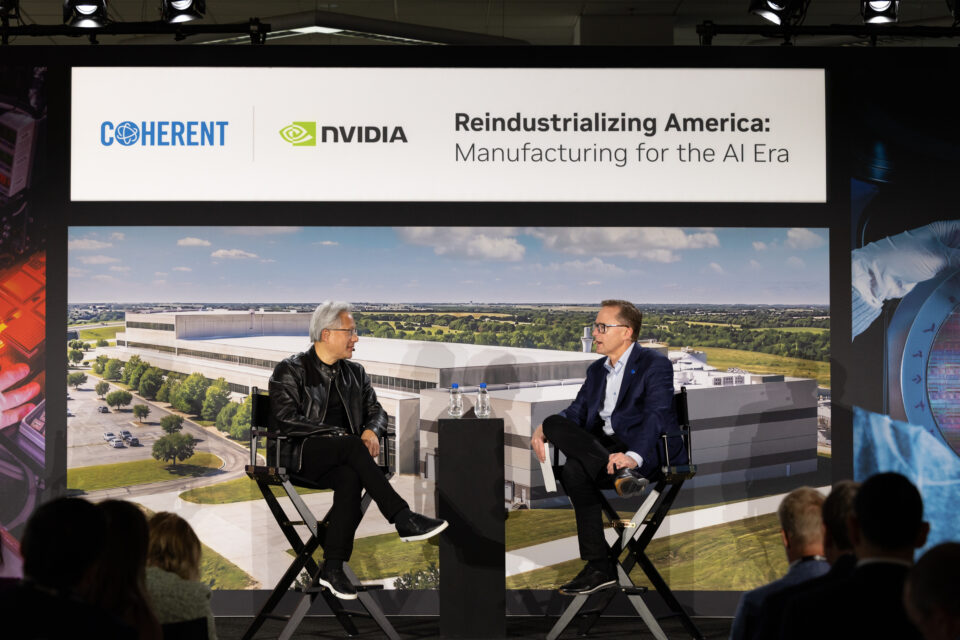
NVIDIA founder and CEO Jensen Huang and Coherent CEO Jim Anderson.

Compound semiconductors like indium phosphide and gallium arsenide — the materials behind the high-speed networking and optical interconnects that modern AI runs on — don’t get the headlines that logic chips do. But their domestic supply chains have been thin for years. Today’s event was an argument that the gap is closing.

When 576 GPUs span eight racks and operate as a single system — as they will in NVIDIA Vera Rubin Ultra NVL576, which links eight NVLink racks of 72 NVIDIA Rubin Ultra GPUs into one 576-GPU domain — copper can’t carry the signal across that distance. 

To connect hundreds of thousands of processors separated by hundreds or thousands of feet across a data center, the only way to solve that problem is silicon photonics, Huang explained. 

As signaling rates climb, the reach of a metal trace shrinks, and spanning eight racks in copper would burn power on retimers and signal conditioning that a data center would rather spend on compute. 

Optics pays a one-time penalty to move from electrical to light, but once paid, distance is nearly free. At NVL576 scale, light is the most power-efficient option. 

NVIDIA and Coherent aren’t new to each other — they’ve worked together for roughly two decades. 

In March, they deepened the relationship into a multiyear strategic partnership: NVIDIA is investing $2 billion in Coherent to support R&D, future capacity and U.S.-based manufacturing, alongside a multibillion-dollar purchase commitment for advanced laser and optical networking products.

Sherman, a city of roughly 45,000 people an hour north of Dallas, has become the latest dateline for the AI era — emblematic of a boom built as much on picks, shovels and manufacturing muscle as on software.

“When we get to full capacity, this site will support more than 550 direct jobs — and thousands of jobs, direct and indirect,” Anderson said.

What the factory ships isn’t a single product dropped into a single slot. It’s the lasers, transceivers and pluggable optical modules that move data across NVIDIA networking — each enabling a different part of the system.

“As AI systems grow larger and more powerful, connectivity is just as important as compute,” Anderson said. “AI runs on compute, but it scales on connectivity — and Sherman is where that connective tissue gets built.”

Today’s event made that visible.

Before the groundbreaking, guests toured the existing fab and previewed the equipment that will populate the expanded building once it’s running. An NVIDIA rack stood on the factory floor, one of the six stops on the tour. 

The tour was followed by a fireside chat with Huang and Anderson, where the two CEOs discussed the partnership and what scaling domestic optical manufacturing means for the AI buildout ahead.

“Today marks an important milestone — not just for Coherent, but for American manufacturing and for the future of AI infrastructure,” Anderson said. 

The semiconductor laser was born in U.S. labs — Bell Labs demonstrated a room-temperature version in 1970 — before the technology and its manufacturing largely migrated overseas.

“We were founded as a manufacturing company in 1971. We’ve always been a U.S. manufacturing company — and after 50 years, the most advanced 6-inch indium phosphide line in the world is right here in Sherman,” Anderson said. 

That manufacturing gap shows up in the wafers themselves: while silicon fabs run on 12-inch wafers, most of the world’s InP production is still stuck on 3- and 4-inch wafers — lower yields and far fewer components per run. 

Moving to 6-inch wafers roughly quadruples the usable area of a 3-inch wafer (area scales with the square of the diameter), driving down cost and unlocking the volume the AI buildout demands.


It took 50 years to build the first line, Huang said — and in one year, they’ve quadrupled it, a measure of the demand for accelerated computing.

Inside, the core processes are familiar: lithography, photoresist, depositing and etching materials, layer by layer. The difference is the material. On an InP substrate, engineers grow exotic compound-semiconductor layers and tune them for precise optical properties — the physics that lets a chip emit and modulate light.

Today, that InP travels inside Coherent’s pluggable optics — transceivers about the size of a USB stick that plug into the front of NVIDIA networking switches and move data between racks across the data center floor, where copper can’t reach. Each module carries an indium phosphide laser. 

Those same modules now help enable NVIDIA Spectrum-X Photonics and Quantum-X Photonics switches with co-packaged optics: Coherent supplies the external laser module that plugs into the switch’s front plate. 

And as NVIDIA works to keep optics from becoming the next bottleneck, demand for those lasers only climbs.

“Ten years from now, I think we’ll look back and realize AI is what made it possible to invest in sustainable energy, upgrade our energy grid and reconstitute a workforce,” Huang said. “You can’t have only information workers in an economy — you also have to have builders. We have an opportunity over the next 10 years to reshape our communities and be much more balanced.”