

惯性聚合 高效追踪和阅读你感兴趣的博客、新闻、科技资讯
阅读原文 在惯性聚合中打开

推荐订阅源

The Last Watchdog
The Last Watchdog
博客园_首页
Martin Fowler
Martin Fowler
S
SegmentFault 最新的问题
美团技术团队
小众软件
小众软件
V
V2EX
博客园 - Franky
K
KPMG report finds enterprise disconnect between AI and its ROI | CIO
The GitHub Blog
The GitHub Blog
Microsoft Security Blog
Attack and Defense Labs
S
Security Affairs
Simon Willison's Weblog
I
Intezer
T
The Exploit Database - CXSecurity.com
有赞技术团队
有赞技术团队
S
Schneier on Security
人人都是产品经理
人人都是产品经理
Security Archives - TechRepublic
cs.CL updates on arXiv.org
K
Kaspersky official blog
PCI Perspectives
PCI Perspectives
AI
AI
钛媒体:引领未来商业与生活新知
钛媒体:引领未来商业与生活新知
罗磊的独立博客
O
OpenAI News
Cyber Security Advisories - MS-ISAC
The Register - Security
V
Vulnerabilities – Threatpost
GbyAI
GbyAI
博客园 - 【当耐特】
C
Cisco Blogs
大猫的无限游戏
大猫的无限游戏
Help Net Security
Help Net Security
Google DeepMind News
S
Securelist
Application and Cybersecurity Blog
P
Proofpoint News Feed
博客园 - 三生石上(FineUI控件)
雷峰网
雷峰网
L
LangChain Blog
SecWiki News
SecWiki News
博客园 - 叶小钗
奇客Solidot–传递最新科技情报
奇客Solidot–传递最新科技情报
V2EX - 技术
V2EX - 技术
让小产品的独立变现更简单 - ezindie.com
J
Java Code Geeks
L
LINUX DO - 热门话题
Cisco Talos Blog
Cisco Talos Blog

NVIDIA Blog

GeForce NOW Turns Up the Heat With New GeForce RTX 5080-Powered Toronto Server NVIDIA Nemotron Achieves Benchmark-Leading Performance With LangChain Deep Agents Harness AI Innovators Adopt NVIDIA Vera — Why Max Single-Threaded CPU at Scale Matters NVIDIA and Hugging Face Bring New Models and Frameworks to LeRobot for the Open Robotics Community How Open Models Are Driving AI Research How Nations Are Deploying AI for Strategic Priorities Joyride Through July With 12 Games Coming to GeForce NOW NVIDIA Unlocks AI Compute at Scale, Inviting Partners to Power the AI Infrastructure Buildout NVIDIA and Partners Build in America, for America NVIDIA BioNeMo Agent Toolkit Brings Accelerated AI to Life Sciences Researchers in Claude Science How NVIDIA’s Inference Software Stack Powers the Lowest Token Cost How Jaiveer Singh Is Helping Robots — and Developers — Move Faster Into the Omniverse: Three Workflows for Improving Vision AI Agent Accuracy With Synthetic Data and Fine-Tuning Claude Meets Blackwell Ultra: Anthropic’s Models Now Run on NVIDIA GB300 in Azure Firefly Aerospace Operates NVIDIA Jetson in Lunar Orbit for the First Time Open Models, Closed Environments: Palantir Brings Secure AI to US Agencies With NVIDIA Nemotron The Ultimate Summer Sale Pairing: Steam Sale Meets GeForce NOW Discounts NVIDIA and AWS Collaborate to Bring AI to Production at Scale How Businesses Are Building Specialized AI They Can Trust NVIDIA Powers Over 400 of the World’s 500 Fastest Supercomputers NVIDIA Brings Trusted, 24/7 AI Agents to Telecom Operations At ISC, JUPITER Shows What Exascale Science Looks Like NAIRR Science Program Reshapes Scientific Research, Powered by NVIDIA AI Infrastructure From Materials Simulation to Experimental Astronomy, New NVIDIA AI Software Unlocks Scientific Discoveries NVIDIA Vera CPU Opens the Way for Agentic Scientific AI at Los Alamos National Laboratory Eco Wave Power Turns Waves Into Watts With NVIDIA AI Infrastructure and Digital Twins Hotter Than a Hot Tub: The 45°C Breakthrough to Cool AI’s Biggest Machines How FERC’s Large-Load Interconnection Actions Help Address Grid Stress, Improve Affordability At Cannes Lions, NVIDIA Partners Reshape Advertising and Marketing With AI Sync and Stream: GeForce NOW Connects to Members’ Game Libraries Across Devices France Advances Europe’s AI Future With NVIDIA Technologies Hands Free, AIs Forward: NVIDIA XR AI Brings Agents to AR Glasses Coherent Breaks Ground on Expanded Texas Facility, Scaling AI’s Optical Backbone HPE AI Factory With NVIDIA Expands for the Era of Agents Fastest, Largest, Strongest: NVIDIA Blackwell Sweeps MLPerf Training 6.0 NVIDIA Blackwell Leads on First Agentic AI Infrastructure Benchmark Save Big and Play Bigger: GeForce NOW Summer Sale Brings Major Membership Savings For Robotaxis, Safety Must Be Built In, Not Bolted On NVIDIA Accelerates Google DeepMind’s DiffusionGemma for Local AI NVIDIA Confidential Computing to Help Expand Apple’s Private Cloud Compute How the UK Is Turning Sovereign AI Ambition Into Action With NVIDIA Technologies NVIDIA and LG Group Build an AI Factory to Advance Physical AI, Mobility and AI Infrastructure NVIDIA and Doosan Group Collaborate to Advance Physical AI and AI Factory Infrastructure NVIDIA, KRAFTON, NC and Reigning ‘League of Legends’ Champions T1 Celebrate RTX Spark at Korea’s PC Bangs Seoul Purpose: How NVIDIA and South Korea Are Building the Future of AI Forecast: Fun Ahead — 18 Games Join in June to Stream on GeForce NOW NVIDIA Research Unlocks Advanced Grasping, Smarter Autonomous Driving and Agent Training at Scale NVIDIA Enables the Next Era Of Physical AI Research With Agent Skills For Autonomous Vehicles, Robotics And Vision AI Industrial Software Leaders Build Secure, Autonomous AI Engineers With NVIDIA NemoClaw NVIDIA Partners With Microsoft on Unified Stack for Agentic AI Deployment, From Windows Devices to Cloud to Local Why Financial Institutions Are Converging on Transaction Foundation Models to Build Their Own Intelligence NVIDIA Jetson Brings Agentic AI to the Physical World NVIDIA AI Cloud Ecosystem Expands Worldwide to Meet Global AI Compute Demand NVIDIA Factory Operations Blueprint Gives Factories a New AI Brain Taiwan’s Industry Titans Turbocharge World’s AI Infrastructure Buildout With NVIDIA How Cosmos 3 Helps Physical AI Think Before It Acts NVIDIA Levels Up Local AI Agents Across RTX PCs and DGX Spark NVIDIA Research Advances Robotics From Simulation to the Real World The Name’s Gaming … Cloud Gaming: ‘007 First Light’ Launches on GeForce NOW AI Factories: The New Infrastructure of Intelligence NVIDIA Vera CPU Is ‘Packing a Heavy-Hitting Punch’ Against Competition NVIDIA GTC Taipei at COMPUTEX: Live Updates on What’s Next in AI License to Stream: ‘007 First Light’ Coming to GeForce NOW With an Ultimate Bundle NVIDIA and Google Cloud Empower the Next Wave of AI Builders NVIDIA CEO Jensen Huang at Dell Technologies World: ‘Demand Is Going Parabolic, Utterly Parabolic’ Vera Arrives: NVIDIA’s First CPU Built for Agents Lands at Top AI Labs Sea You in the Cloud: ‘Subnautica 2’ Early Access Dives Onto GeForce NOW NVIDIA, Ineffable Intelligence Team Up to Build the Future of Reinforcement Learning Infrastructure Hermes Unlocks Self-Improving AI Agents, Powered by NVIDIA RTX PCs and DGX Spark NVIDIA and SAP Bring Trust to Specialized Agents Linked and Loaded: Gaijin Single Sign-On Now Available on GeForce NOW NVIDIA and ServiceNow Partner on New Autonomous AI Agents for Enterprises It’s Gonna Be May: 16 Games Hit the Cloud This Month, With More NVIDIA GeForce RTX 5080 Power NVIDIA Launches Nemotron 3 Nano Omni Model, Unifying Vision, Audio and Language for up to 9x More Efficient AI Agents Into the Omniverse: Manufacturing’s Simulation-First Era Has Arrived Tag, You’re It: GeForce NOW Levels Up Game Discovery With Xbox Game Pass and Ubisoft+ Labels From Rainforests to Recycling Plants: 5 Ways NVIDIA AI Is Protecting the Planet NVIDIA and Google Cloud Collaborate to Advance Agentic and Physical AI Autonomous AI at Scale: Adobe Agents Unlock Breakthrough Creative Intelligence With NVIDIA and WPP No Need for Space Gear — Capcom’s ‘PRAGMATA’ Joins GeForce NOW on Launch Day Rethinking AI TCO: Why Cost per Token Is the Only Metric That Matters New Adobe Premiere Color Grading Mode Accelerated on NVIDIA GPUs Strength and Destiny Collide: ‘Samson: A Tyndalston Story’ Arrives in the Cloud National Robotics Week — Latest Physical AI Research, Breakthroughs and Resources From RTX to Spark: NVIDIA Accelerates Gemma 4 for Local Agentic AI Press Start on April: GeForce NOW Brings 10 Games to the Cloud Efficiency at Scale: NVIDIA, Energy Leaders Accelerating Power‑Flexible AI Factories to Fortify the Grid Into the Omniverse: NVIDIA GTC Showcases Virtual Worlds Powering the Physical AI Era Game On: Five New Titles Now Streaming on GeForce NOW The Future of AI Is Open and Proprietary Blowing Off Steam: How Power-Flexible AI Factories Can Stabilize the Global Energy Grid Advancing Open Source AI, NVIDIA Donates Dynamic Resource Allocation Driver for GPUs to Kubernetes Community How Autonomous AI Agents Become Secure by Design With NVIDIA OpenShell NVIDIA GTC 2026: Live Updates on What’s Next in AI Smooth Moves: 90 Frames-Per-Second Virtual Reality Arrives on GeForce NOW From Simulation to Production: How to Build Robots With AI More Than Meets the Eye: NVIDIA RTX-Accelerated Computers Now Connect Directly to Apple Vision Pro NVIDIA, Telecom Leaders Build AI Grids to Optimize Inference on Distributed Networks GTC Spotlights NVIDIA RTX PCs and DGX Sparks Running Latest Open Models and AI Agents Locally Snap Decisions: How Open Libraries for Accelerated Data Processing Boost A/B Testing for Snapchat
Making Sense of the Early Universe
Brian Caulfi · 2026-04-23 · via NVIDIA Blog

This Spring Astronomy Day, here’s a look at how AI and GPUs are helping astronomers work through unprecedented volumes of cosmic data.

There are more galaxies in the universe than anyone ever expected. Unfortunately, they all showed up at once.

When the first images from the James Webb Space Telescope (JWST) began returning data in 2022, Brant Robertson and his colleagues did what astronomers have always done: They stared at the sky and tried to understand what they were seeing. This time, the sky arrived as terabytes.

“There were galaxies everywhere,” Robertson recalled. “So many, and so far away, that we were genuinely shocked.”

Robertson is a professor of astronomy and astrophysics at the University of California, Santa Cruz, where he leads a team studying how the earliest galaxies formed after the Big Bang. 

It’s the kind of work Spring Astronomy Day was made for — and thanks to the datasets his team releases publicly, anyone marking the occasion this year can explore the early universe in more depth than was possible even a few years ago.

Over the past several years, his group has broken the record for the most distant known galaxy more than once, each time pushing observation closer to the universe’s first light.

Without computation at this scale, the data would just pile up.

Observational limits require calculation. Copernicus used mathematics to resolve observational inconsistencies. Robertson does the same using computational models.

JWST is the most powerful observatory ever launched, observing in infrared, capturing light that has traveled for more than 13 billion years. Each deep-field image is crowded with hundreds of thousands of galaxies, some of them 13 billion years old. 

That abundance is the problem.

“These datasets are far too large and complex for humans to analyze by hand,” Robertson said. “Even teams of experts would take years to do what now needs to happen in days.”


“AI doesn’t just help scientists understand the universe faster — it helps us all access and understand work at the cutting edge — that’s the real breakthrough,” said Dion Harris, senior director of high-performance computing and AI hyperscale infrastructure solutions at NVIDIA. 

At UC Santa Cruz, an analysis pipeline was built to keep up. AI models handle classification. GPUs accelerate nearly every step: data reduction, catalog generation, anomaly detection and simulation. Without that acceleration, much of the work would simply stall.

Some of that computation runs on campus on the UCSC’s Lux cluster — funded by a $1.6 million National Science Foundation grant.

Larger GPU runs move off campus to supercomputers run by the U.S. government. Development work happens closer to hand. In Robertson’s office in the Interdisciplinary Sciences Building, a gold-edition NVIDIA DGX Station system sits beside the desk — whisper-quiet and used for testing models before they’re sent elsewhere to run at scale.

One of the central tools in the pipeline is an AI system called Morpheus, developed by Ryan Hausen, a former graduate student at UCSC who’s now a research software engineer at Johns Hopkins, in collaboration with Robertson and originally applied to earlier galaxy surveys. 

Built on techniques from semantic segmentation — the same approach self-driving cars use to distinguish roads from pedestrians — the system was later adapted and scaled to handle JWST’s far larger and more detailed images.

Rather than classifying an entire galaxy at once, Morpheus examines every pixel, distinguishing a spheroidal bulge from its surrounding disk, even when both occupy the same image.

Morpheus Classification in Action: Demonstration of the Morpheus AI/ML model for galaxy classification. Computed and animated on NVIDIA GPUs.

Applied across JWST data, the system enabled the team’s first large-scale AI analysis of the telescope’s observations, surfacing results that were difficult to reconcile with existing models.

Among the results were rotating disk galaxies — systems resembling the Milky Way — appearing far earlier than expected. The early universe was thought to be a violent place, dominated by mergers and disruption. Disk galaxies were not supposed to be there. They were. 

“At first, people didn’t believe it,” Robertson said. “But the result has now been independently confirmed multiple times.”

Fly-through of a disk galaxy outflow driven by supernovae explosions. Computed and animated on NVIDIA GPUs.

Mapping a Half-Million Galaxies

Modern observatories do more than produce images. They produce catalogs — large datasets describing brightness, color, mass, shape and motion. Hundreds of variables for each galaxy.

Taken together, the measurements form a kind of map — showing which galaxies resemble each other, which don’t and where the outliers sit. A graduate student in the group, Anavi Uppal, built a tool the team calls GalaxyFriends to make that structure visible.

Rather than sorting galaxies one by one, the system organizes just under 90,000 of them into similarity neighborhoods, allowing researchers to move through the dataset in bulk — finding related objects, isolating rare cases and seeing patterns that would otherwise take years to notice.

“It lets us see structure in the universe we couldn’t see before,” Robertson said. “And it tells us when something doesn’t look like anything else we’ve ever observed.”

GalaxyFriends UMAP Applied to JWST Data: Demonstration of the GalaxyFriends UMAP model applied to JWST Data by UCSC graduate student Anavi Uppal. Computed and animated on NVIDIA GPUs.

In practice, the group has become a kind of clearinghouse: turning raw observations into structured datasets that astrophysicists around the world can actually use.

Removing Atmospheric Blur From Ground Telescopes

Some of the most ambitious surveys will not come from space. 

The Vera C. Rubin Observatory, coming online in Chile, will scan the entire southern sky every few nights. Its mirror is too large to launch into space, which means its images must pass through Earth’s atmosphere, introducing blur that space telescopes avoid. Once fully operational, Rubin will generate roughly 20 terabytes of raw data every night.

Robertson’s group is using AI to correct for that.

The approach borrows from an unexpected place: video games. It’s conceptually similar to NVIDIA DLSS technology, which uses AI to reconstruct higher-resolution images in real time. The team trains models on space-based data, then applies them to ground-based images, removing atmospheric distortion and recovering finer detail.
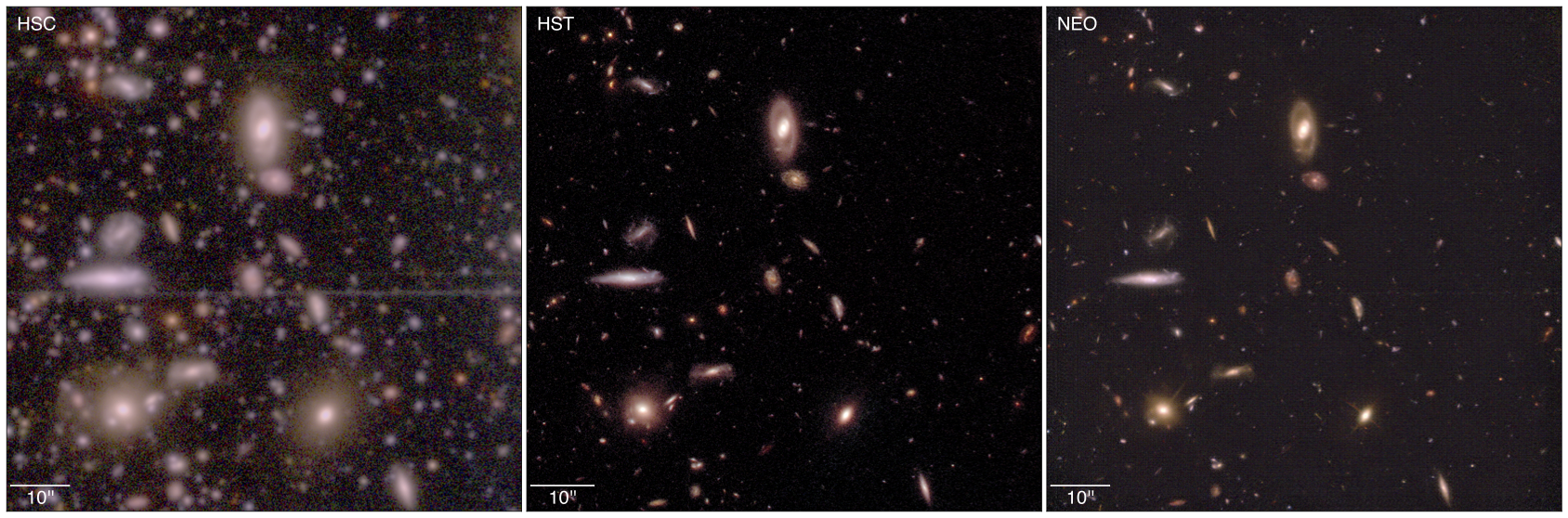
AI techniques conceptually similar to NVIDIA DLSS are being used to remove atmospheric distortion from ground-based telescope images, increasing pixel clarity and resolution. This capability will be critical as observatories like the Vera C. Rubin Observatory, coming online in Chile, begin to scan the southern sky every few nights. Because its Earth-based mirror must observe through the atmosphere, images are subject to distortion, while generating roughly 20 terabytes of data per night.

Because its Earth-based mirror must observe through the atmosphere, images are subject to distortion, while generating roughly 20 terabytes of data per night.

The result is imagery from Earth that begins to approach the clarity of space telescopes. At Rubin’s scale, that process depends on GPUs.

JWST will not be the last instrument to pose this problem. Rubin’s survey will generate a continuous stream of sky-wide data at a scale astronomy has not dealt with before. 

Other observatories are already queued behind it, including NASA’s Nancy Grace Roman Space Telescope and, further out, the proposed Habitable Worlds Observatory, designed to directly image Earthlike exoplanets around nearby stars. 

The volume and quality of astronomical data are increasing quickly, which makes the kind of work Robertson’s group does less of a luxury and more of a baseline requirement.

Using Simulations to Test Observations

GPUs are used to analyze observations, as well as to simulate the universe itself. Robertson’s group runs large-scale simulations — virtual volumes evolving over cosmic time — then compares them against telescope data.

Fly through of a cosmological simulation of large-scale structure formation. Computed and animated on NVIDIA GPUs.

Observations inform theory. Simulations test it. The results loop back, refining what astronomers look for next.

“The data feeds the theory,” Robertson said. “And the theory helps us understand what the data means.”

Robertson did not set out to become an astronomer. He once wanted to be a writer. A NASA scholarship pushed him toward physics. The rest followed.

That background shapes how he thinks about access. His team releases its data publicly — nearly 500,000 galaxies, spanning the full history of the universe. The same images used in analysis can be downloaded by anyone.

“The universe isn’t for professors in ivory towers,” Robertson said. “It’s for everyone.”

Read the latest paper by Robertson and his colleagues. 

Related News