











Attracted by the caretaker’s closed fist, a 26in tall golden snub-nosed monkey swings gracefully through the branches of Shennongjia in Central China’s Hubei province.
When the fist reveals nothing, the monkey — a 55lb male named Beike (meaning “conch”) — taps the caretaker and tugs at his sleeve. He eventually finds two peanuts in the other hand, swiftly seizing and cracking the rare treat.
“This monkey recently won a battle to become the new head of his family,” said Yang Jingyuan, director of the scientific research institute at the Shennongjia National Nature Reserve. He looks on as dozens of monkeys dart through the canopy, grooming one another and occasionally tussling in the dappled sunlight.
After four decades of conservation, the Shennongjia golden snub-nosed monkey, the rarest subspecies of the golden snub-nosed monkey, has bounced back from near invisibility.
Its population has tripled to 1,618 individuals across 11 groups, roaming a habitat of 154 square miles — a resurgence made possible by policy support, scientific management and technological empowerment.
With a life span of around 20 to 25 years, the golden snub-nosed monkey is classified as a first-class State-protected wildlife species.
In 1978, the belief that golden snub-nosed monkeys did not inhabit Hubei due to the region’s climate and geographical conditions was challenged when a group of Chinese scientists unexpectedly collected two specimens in Shennongjia.
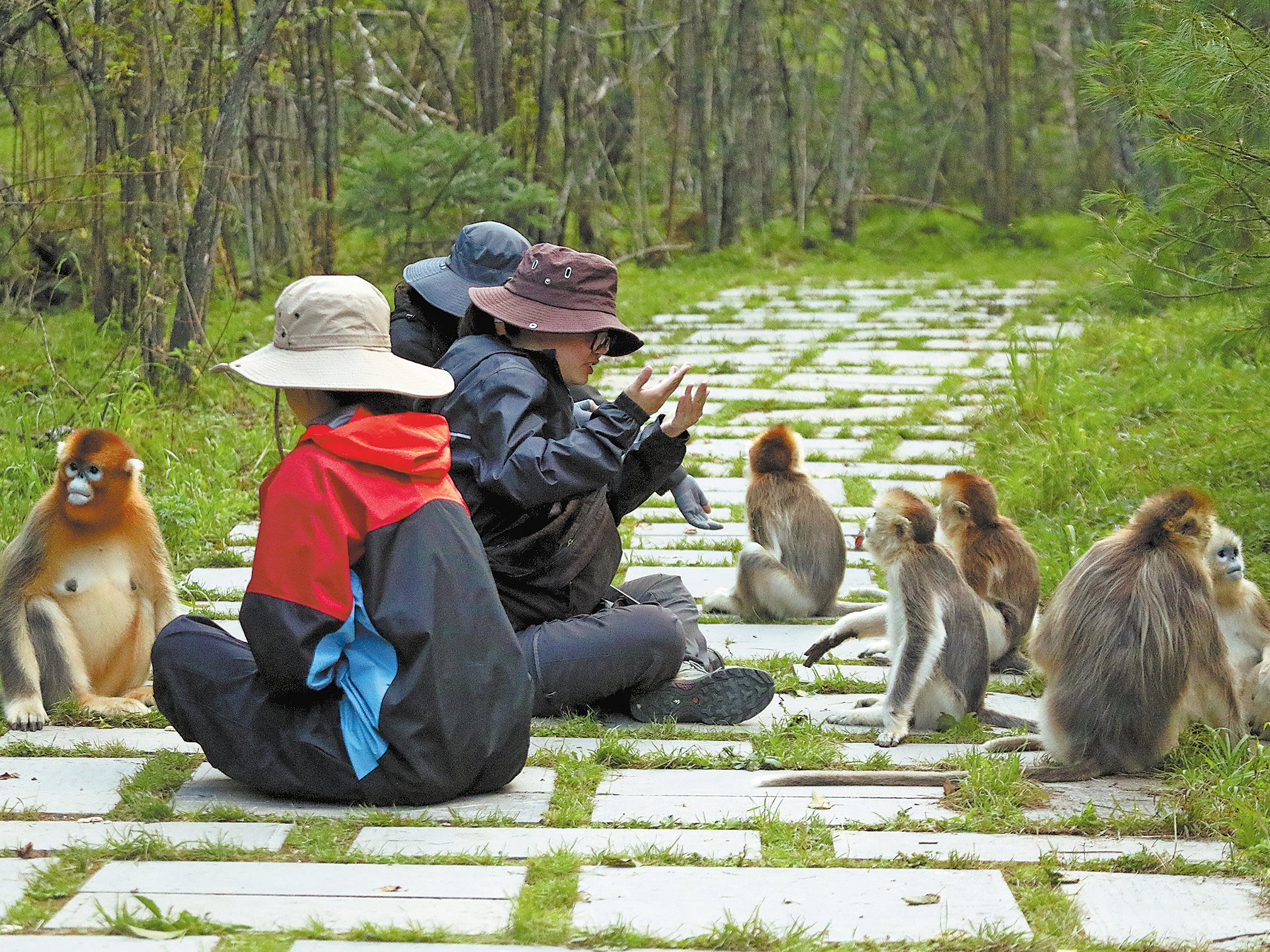
In 1980, Professor Liu Minzhuang from East China Normal University in Shanghai confirmed the presence of golden snub-nosed monkeys in Shennongjia, extending the species’ distribution eastward by around 310 miles from Sichuan province into Hubei.
However, the discovery coincided with a period of severe deforestation and hunting. By the 1980s, the population of this subspecies had plummeted to just 501 individuals clinging to a mere 33 square miles of habitat. To stem the tide, Shennongjia was designated a provincial reserve in 1982 and upgraded to national status in 1986. In 2024, the subspecies was officially designated as an independent conservation management target, reflecting its unique genetic diversity and morphology, including its iconic upturned nose and a tail that often exceeds its body length.
“The 2024 designation recognised both the culmination of decades-long field research and the species’ protection value,” caretaker Yang said. As early as 2005, scientists had selected one of the 11 groups — the very group that includes the family Beike now leads — as their focal study group for long-term behavioural and ecological monitoring.
At that time, the group had 105 individuals and inhabited a natural valley in Dalongtan, northeast Shennongjia. The group had a well-organised social structure of eight family units and one all-male unit.
For close observation, researchers built simple living quarters, set up monitoring plank walks and established the Dalongtan Golden Snub-nosed Monkey Research Base in 2005. Through continuous tracking and observation, they identified winter food shortages as one of the key factors driving the population toward endangerment.
To address the problem, the research team conducted a diet supplement experiment, where apples, oranges and pine nuts were stuck onto branches and coated with moss to mimic wild fruits.
Yao Hui, deputy director of the scientific research institute, said that human intervention remains minimal — researchers only provide a small amount of supplemental food during extreme winter shortages. The overall approach is to let the monkeys live as naturally as possible while working to restore their natural habitat.
Measures included the construction of 25 ecological corridors, which facilitate the reconnection of fragmented habitat patches and promote gene exchange among different monkey populations. Additionally, more than 7 square miles of degraded habitat has been restored to expand their living area.
For residents living in areas where the monkeys are distributed, the reserve has relocated them and organised skills training to help them transition to new livelihoods. Training programmes focus on ecotourism, herbal medicine cultivation and green agriculture, empowering former forest dwellers to step out of the deep mountains and embrace sustainable lives.
“Most rescue cases at the local rescue station are reported by villagers — a vivid microcosm of the shift from loggers to guardians,” Yao said.