


惯性聚合 高效追踪和阅读你感兴趣的博客、新闻、科技资讯
阅读原文 在惯性聚合中打开

推荐订阅源

云风的 BLOG
云风的 BLOG
GbyAI
GbyAI
G
Google Developers Blog
Engineering at Meta
Engineering at Meta
月光博客
月光博客
腾讯CDC
Recent Announcements
酷 壳 – CoolShell
酷 壳 – CoolShell
爱范儿
爱范儿
钛媒体:引领未来商业与生活新知
钛媒体:引领未来商业与生活新知
S
SegmentFault 最新的问题
奇客Solidot–传递最新科技情报
奇客Solidot–传递最新科技情报
阮一峰的网络日志
阮一峰的网络日志
博客园 - 【当耐特】
The GitHub Blog
The GitHub Blog
Last Week in AI
Last Week in AI
让小产品的独立变现更简单 - ezindie.com
aimingoo的专栏
aimingoo的专栏
Google DeepMind News
Y
Y Combinator Blog
OSCHINA 社区最新新闻
OSCHINA 社区最新新闻
Martin Fowler
Martin Fowler
A
About on SuperTechFans
博客园 - 叶小钗

The Independent Asia

Is it safe to travel to Japan? Latest advice after earthquake At least 14 dead and dozens injured after crash between two passenger trains in Indonesia Soaring energy costs threaten wildlife as families across Asia and Africa turn back to charcoal Strait of Hormuz crisis forces Thailand to revive $31 billion ‘Land Bridge’ plan Pakistan lifts central Islamabad lockdown as prospects dim for US-Iran talks Chinese scientists build ‘zero emission’ coal-fired battery 22 Buddhist monks found with 110kg of drugs on Bangkok flight, police say DeepSeek’s latest AI model launch met with muted response Lightning strikes leave 14 dead across Bangladesh amid seasonal storms At least 12 injured after BMW crashes into Bangkok petrol station KFC Japan earthquake: Hokkaido shakes a week after ‘mega-quake’ warning North Korea opens memorial museum for troops killed in Russia-Ukraine war Tributes pour in as legendary Indian photographer Raghu Rai dies at 83 Philippine officials say 2 Americans among suspected communist rebels killed in clash with troops Taiwan’s foreign minister arrives in Eswatini after president’s trip blocked amid China pressure claims Uncertainty clouds US-Iran talks as Iran’s top diplomat arrives in Pakistan Thousands evacuate in Japan as forest fires close in on homes Taiwanese Indigenous artist stripped of national prize after sexual assault conviction At least 194 children dead in just over a month as Bangladesh grapples with deadly measles outbreak Turkey is the latest country to ban children from social media. What are other countries doing? Bang Si-Hyuk: K-pop tycoon behind BTS avoids arrest in South Korean investor fraud probe There’s one way Japan’s ‘Iron Lady’ Takaichi is struggling to emulate her political hero Margaret Thatcher Industrial heritage inspires new creative outlooks Appeal of Chinese-style gold jewellery soars In Jingdezhen, what more can porcelain be? Consumer market attracts global brands First-quarter growth robust at 5% The Tale of KAHO: Haruki Murakami announces release date for first novel in three years Donald Trump faces diplomatic backlash after sharing ‘hellhole’ remark about India and China Passenger dies after collapsing on Cathay Pacific flight from Manchester
New self-destructing ‘living plastic’ may help reduce waste
Vishwam Sank · 2026-05-12 · via The Independent Asia

Chinese scientists have developed a “living plastic” that self-destructs on command without creating microplastics, an advance that could help reduce the increasing burden of non-biodegradable waste.

Many plastic products today are designed for single use and the material can persist in the environment for years.

The “living plastic” contains microbes that release plastic-degrading enzymes and can be activated on command. Two strains of the common bacterium Bacillus subtilis, working together, completely break down the material within six days without creating microplastics, scientists show in a study published in the journal ACS Applied Polymer Materials.

“The realisation that traditional plastics persist for centuries, while many applications like packaging are short-lived, led us to ask: could we build degradation directly into the material’s life cycle?” study author Zhuojun Dai from the Shenzhen Institute of Synthetic Biology said.

“By embedding these microbes, plastics could effectively ‘come alive’ and self-destruct on command, turning durability from a problem into a programmable feature.”

Many microbes are known to break down polymeric chains, the building blocks of plastic, into smaller pieces using their enzymes.

Previous attempts to design “living plastic” relied mainly on a single enzyme. The Chinese researchers added a second one to improve the efficiency of destruction.

They engineered two strains of Bacillus subtilis, each producing a different polymer-degrading enzyme.

One enzyme acts as a random chopper, snipping the long polymer chains into smaller pieces, while the other slowly chews the pieces into their smallest building blocks from each end.
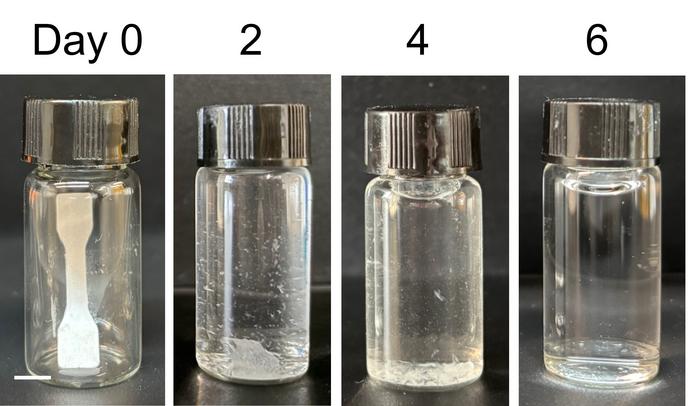
‘Living plastic’ degrades in just six days without creating any microplastics

‘Living plastic’ degrades in just six days without creating any microplastics (ACS Applied Polymer Materials)

Scientists protected the microbes until they were needed for destroying the plastic by using them in their dormant spore form. They incorporated the spores into polycaprolactone, a polymer commonly used in 3D printing and some surgical sutures, with stable mechanical properties.

Once the plastic was added to a nutrient broth and the temperature raised to 50C, the spores activated and the bacteria degraded the material all the way down to its building blocks in only six days.

“The cooperative enzymatic activity within the microbial consortia outperforms that of a single-strain system, enabling near-complete degradation of the polycaprolactone matrix within 6 days,” scientists noted.

In further studies, researchers plan to develop a trigger for the bacterial spores in water, where a large part of plastic waste ends up. They also aim to use a similar strategy for other types of plastic like those commonly found in single-use plastics.