










In an office building in Beijing’s Shijingshan district, a special “school” is in full swing, with nearly 200 human teachers and 100 humanoid robot students.
The instructors wear headsets and move slowly, while 5ft 4in tall humanoid robots mirror their motions. The students repeat everyday tasks such as taking a medicine bottle from a cabinet, sorting parcels on a conveyor belt, and leafing through office files.
The campus is China’s largest humanoid robot data-training centre, co-built by the Shijingshan district government and Lejoin Intelligence (Shenzhen) Co, or Leju Robotics.
Wang Qiang, technical director of Leju Robotics’ embodied training centre, said the facility has built 16 detailed real-world scenarios spanning industrial manufacturing, smart homes, eldercare services and 5G integration.
Occasionally, a robot’s hand slips and a cup falls. Wang said such failure data is vital as robots must learn not only what is correct, but also what is wrong.
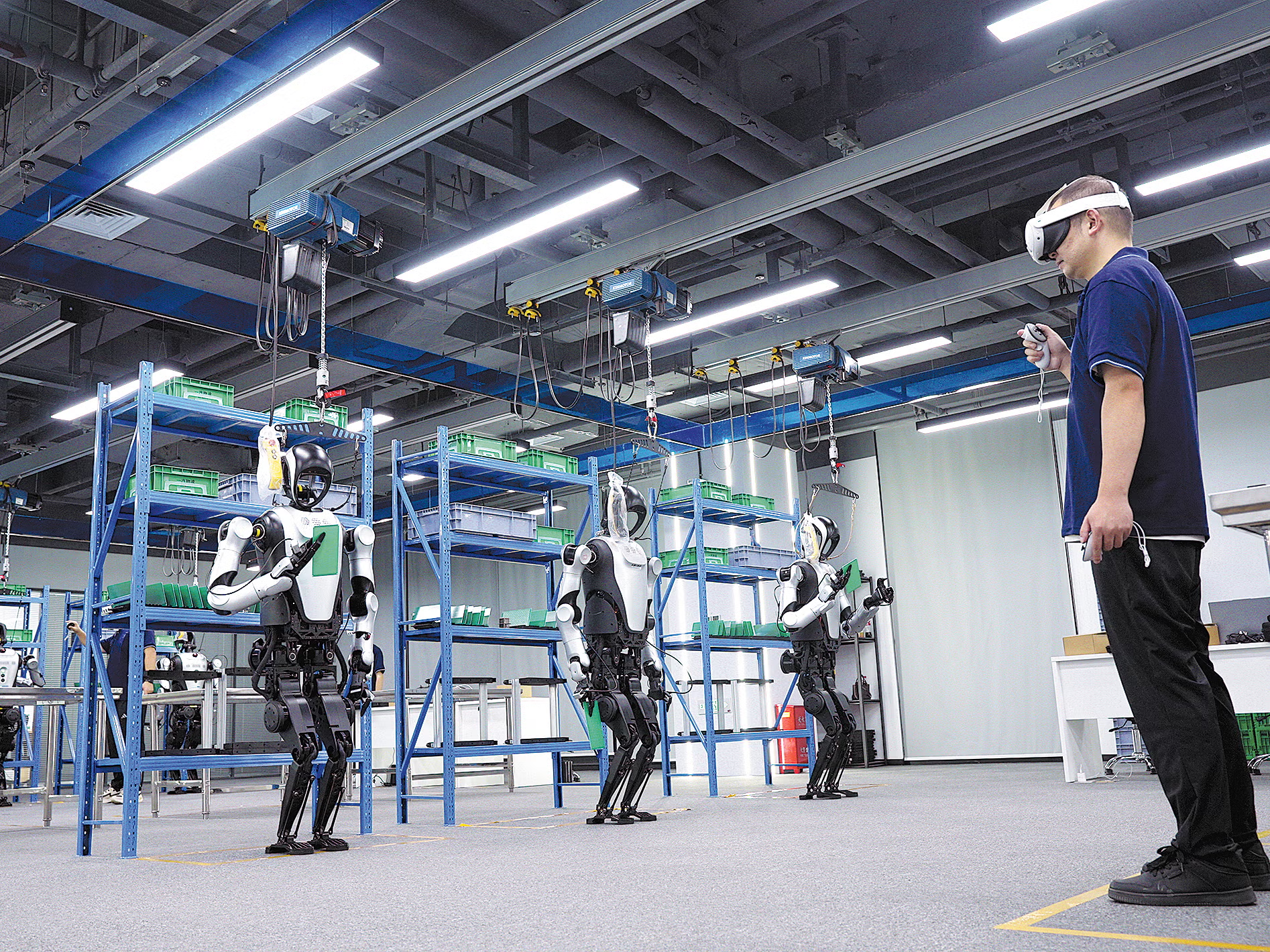
Zhang Yusong, one of the trainers, said training robots can be like teaching a toddler: trial and error, demonstration and correction.
Experts generally agree that before humanoid robots can be widely deployed, they must first attend “vocational schools” to develop a functioning “brain”. Engineers describe humanoid robots as having three layers: a “brain” for perception and decision-making; a “cerebellum” for motion coordination; and a “body” equipped with motors and sensors.
While the public recently witnessed robots performing backflips during the televised Spring Festival Gala in China, scientists said the gap between stage performances and a functional household helper remains wide.
“Repeated rehearsals can produce a one-time perfect performance,” said Yan Weixin, chief scientist at the Shanghai Artificial Intelligence Research Institute. “But replicating the same feats in factories and homes, where unexpected situations arise, is a different matter.”
The primary bottleneck is not the body but the brain. Researchers aim for “embodied intelligence”, where AI inhabits a physical form to perceive and act in the real world.
“AI models act as the brain, responsible for thinking, while robots are responsible for moving and doing,” said Leng Xiaokun, founder and chairman of Leju Robotics. High-quality data will determine whether robots can leave the lab, he said.
Wang from the data centre said the centre can produce more than 8 million multimodal data records annually. The data supports in-house development and is supplied to AI model companies to continuously optimise robot brains.
Once mature, these models are deployed so robots can acquire new skills. The advantage of the humanoid form is the ability to adapt to environments designed for people without needing modifications. “They can directly use spaces and tools made for people — things like door handles,” said Chang Ning, who leads the embodied intelligence simulation engine team at Feijie Kesi Intelligent Technology (Shanghai).
The first group of robots trained at the Shijingshan centre has already started factory work. Currently, their efficiency is about 70 per cent of that of a skilled worker. They take on heavy, standardised work such as moving boxes or sorting parts. Wang noted that robots can operate around the clock, filling physically demanding roles that are often hard to staff.
However, home environments remain a challenge. With robots weighing more than 220 pounds, a misstep could cause serious injury, said Chang of Feijie Kesi Intelligent Technology.
The market is moving fast. Omdia, a tech research firm, estimated 13,000 humanoid robots would be shipped worldwide in 2025, with China accounting for 90 per cent of the total.
Across the country, training grounds now hum with robot “students” learning skills in medical care, energy exploration, and emergency rescue — each trial a step towards bridging the gap before the robot era begins.