






The flames leapt quickly in the dry April heat of southern India, where Tamil Nadu’s chief minister MK Stalin stood before a crowd dressed in black, holding a copy of a government bill and a lighter. The so-called “black law”, which would expand the size of India’s lower house of parliament from 543 seats to as many as 850, curled into ash as party workers chanted slogans against the federal government.
The protest wasn’t just political theatre. It marked the opening salvo in what could become one of the most consequential political battles in India in decades – a fight over representation, power and the very architecture of the world’s largest democracy.
At the centre lies prime minister Narendra Modi’s push to redraw parliamentary constituencies and expand the lower house, a move that his BJP party says is necessary to implement a 2023 law mandating that 33 per cent of all seats in federal and state legislatures must be filled by women.
Critics say the two issues don’t need to be linked – that minimum quotas for women MPs could simply be applied to the existing structure of parliament. They argue the proposal’s true aim is something much more strategic: a recalibration of power ahead of the next general election in 2029.
India hasn’t significantly reallocated parliamentary seats since the 1970s. The exercise, carried out by the Delimitation Commission, a statutory body, was last undertaken after the 1971 census.
In 1976, when India’s population stood at about 550 million, the number of Lok Sabha seats was frozen at 543. The move was meant to ensure that states which reduced birth rates were not punished with diminished representation as the size of constituencies was pegged to population. That freeze was due to end after the 2001 census, but was extended until at least 2026 by the previous BJP government of Atal Bihari Vajpayee.
The Modi government was moving to end the long-standing status quo.
Its delimitation bill seeks to expand the Lok Sabha (lower house) to as many as 850 seats and redraw constituencies based on the last census done in 2011. It also ties the rollout of the women’s reservation law, passed in 2023 but not yet implemented, to this exercise. A three-day special session of the parliament from 16 to 18 April was called to debate the amendments needed to put the changes in place ahead of the 2029 election.
However, the Constitution (131st Amendment) Bill, 2026, failed to secure the two-thirds majority required for the constitutional change. A total of 298 MPs voted in favour and 230 against the bill.
"The amendment bill has fallen. They used an unconstitutional trick in the name of women to break the Constitution," opposition leader Rahul Gandhi said in a post on X, minutes after the bill failed to get through.
The government dismissed that accusation and said it would continue to campaign for women's quotas. "The women of this country will not forgive you," Interior minister Amit Shah said in parliament, before the bill was put to a vote.
Modi launched a scathing attack on the opposition on Saturday in an address to the nation. “Every citizen of India is watching how dreams of our women have been crushed,” the prime minister said during his address. “Fight for empowering India’s women has been stalled due to selfish politics of opposition parties,” he added.
Modi likened the opposition’s stance to “bhrun hatya” (female foeticide), accusing parties such as the Congress, DMK, Samajwadi Party and Trinamool Congress of having “killed” the proposal for women’s reservation when it was first introduced, according to reports. “A woman may forget many things, but she never forgets her insult,” he said.
Opposition parties maintained that they backed women’s reservation, but opposed tying its rollout to a nationwide delimitation process using older population data while the 2026–27 census is in progress. They also said dependence on 2011 figures could weaken the relative representation of southern and north-eastern states, where population growth has slowed more quickly than in several northern states.
“India has functioned on 1971 data, effectively silencing the voices of millions,” BJP spokesperson Radhika Khera tells The Independent. “The 2026 delimitation is not just about numbers, it’s about democratic equilibrium.”
She describes the expansion of the Lok Sabha as a “buffer”, ensuring that while more populous states gain representation, others don’t lose their existing strength. “By increasing the total pool, we ensure that high-population states get their due representation.”
“Fairness,” she says, “means ensuring that no citizen’s vote is worth less than another’s, regardless of geography.”
As for its decision to use the 2011 census, the government claims that waiting for the next population count – supposed to be completed in 2021, but now expected only by 2027 – would delay implementing women’s reservation to at least 2034.
“We are choosing immediate empowerment over indefinite delays,” Khera says.
But the proposal triggered deep unease in southern states, where the ruling BJP generally has a less strong presence. At the heart of their concern is a simple equation: if parliamentary seats are allocated purely on the basis of population, states with higher population growth – mainly in northern India – will get more MPs while southern states will see their relative influence shrink.
P Wilson, a parliamentarian from Tamil Nadu’s ruling Dravida Munnetra Kazhagam party, sees it as a direct breach of a decades-old political compact.
“States were told: control population and delimitation will follow later. Now that has been thrown to the winds,” he says.
“You are rewarding states which violated population control and punishing those which followed it scrupulously,” Wilson says. “Where is equality now?”
States like Tamil Nadu, Kerala and Karnataka boast lower fertility rates and stronger socioeconomic indices. They also contribute more significantly to the Indian economy than the northern states with higher populations. Their leaders argue a headcount-based redistribution ignores these achievements.
Saral Patel, a spokesperson for the opposition Congress party, echoes their concern, calling it “a structural shift in India’s federal balance of power”.
“If only population is used as the sole metric then you are punishing states for good governance.”
For the opposition, the timing of this move raises further questions. “The urgency is the election. They are always election-oriented,” Wilson alleges, referring to the BJP.
“In terms of elections, they will do anything.”
He argues that the BJP’s relatively weaker presence in southern states is shaping the government’s policy. “Southern states have rejected them,” he says. “So, they don’t want the voice of the southern states to be heard.”
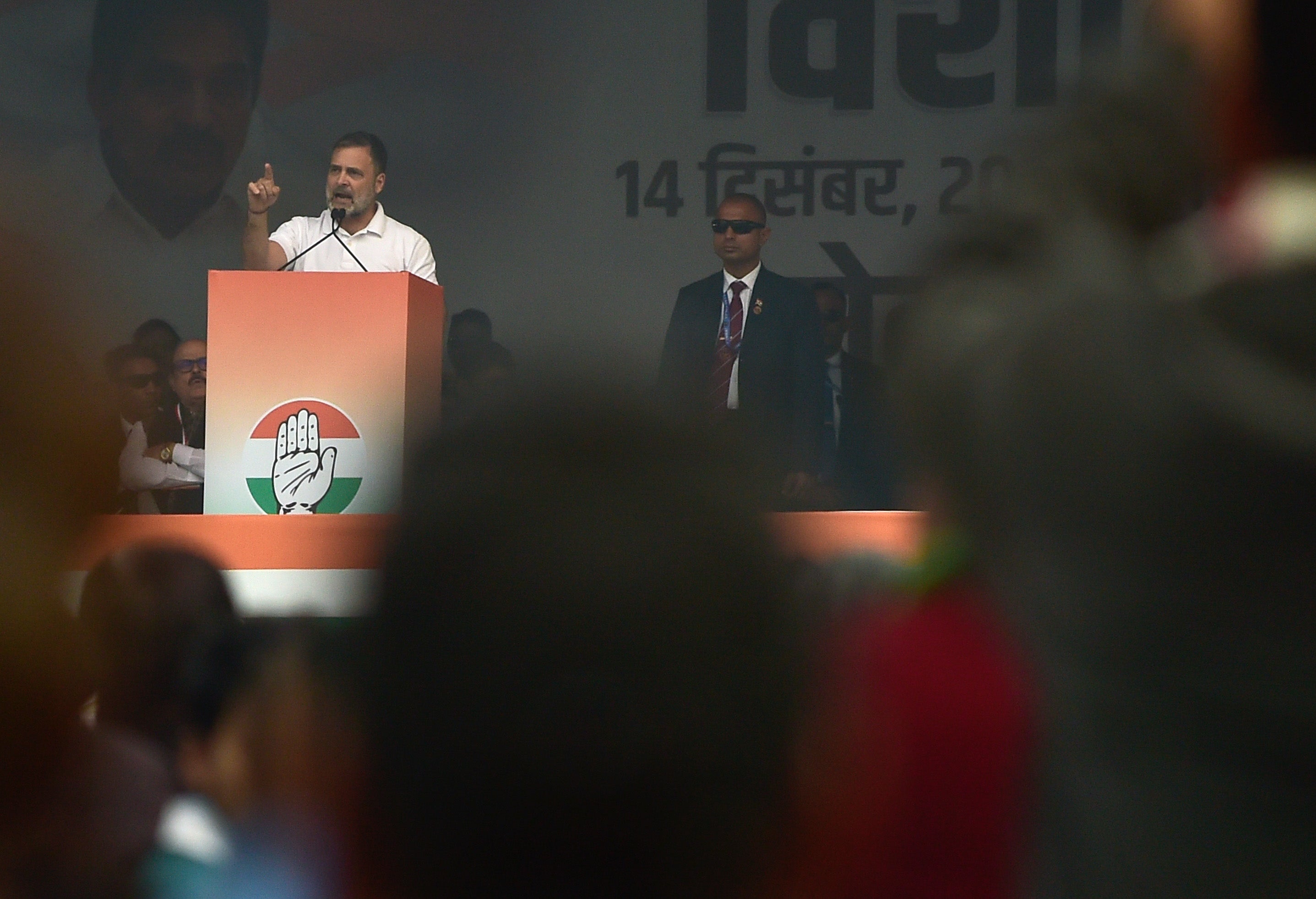
Congress leader Rahul Gandhi has gone further, describing the proposal as an “attempted power grab” through the manipulation of electoral boundaries.
Opposition leaders also point to the sequencing: delays in conducting the decadal census, the passage of the women’s reservation bill and the linking of that reform to delimitation. “When you see this entire exercise chronologically,” Patel says, “it looks like the process is being fast-tracked for political timelines rather than genuine policy requirements.”
The government rejects this criticism. “To suggest that representation should be suppressed because it might favour a party is fundamentally anti-democratic,” Khera argues. “We aren’t engineering polls, we are re-engineering a stagnant system.”
Few disagree on the need for greater female representation. Women make up just 14 per cent of the lower house, less than half of the proposed quota. But tying this reform to delimitation is one of the most contentious aspects of the bill.
“Any reasonable person knows that they are hiding behind women’s reservation,” Wilson says. “Who prevents you from implementing it within 543 seats?”
Patel says that there are workable alternatives. “There is no structural barrier,” he says. “It could have been done through rotation or internal allocation. Linking it to delimitation creates a situation where opposing one appears like opposing the other.”
The BJP, however, insists that delimitation is necessary to implement the quota fairly. “Representation must be based on clearly defined territorial constituencies. You cannot simply appoint women to seats. We are embedding the quota into the very fabric of new constituencies,” Khera says.
Beyond the political clash, unresolved technical questions remain. Critics of the proposed legislation are concerned about the cap of 850 seats, the absence of a clear methodology for distributing seats among states, and how constituencies will be chosen for the women’s quota – particularly given quotas already exist for people from Scheduled Castes and Scheduled Tribes, traditionally downtrodden groups.
“There is no methodology,” Wilson says of the proposed cap, as he questions the “arbitrary” ratio of MPs to constituents. “You fix a number, and then accommodate more seats where it suits you.”
Khera defends the proposed expansion as a measured compromise between representation and practicality.
“While a strict one-to-one ratio based on current population might suggest around 1,200 seats,” she says, “we must balance representation with functionality.”
“A parliament of that size would be administratively unwieldy and could dilute the quality of debate.”
She describes the proposal as “a calibrated expansion, not an uncontrolled explosion”. While it is too early to comment on final numbers, she says, the government is committed to ensuring that no state loses representation.
The delimitation commission – expected to be led by a retired Supreme Court judge – is set to wield sweeping powers to redraw boundaries, raising further concerns about transparency and oversight.
The whole exercise, Patel argues, “is about who holds power in India for the next few decades”.
Back in Namakkal, Tamil Nadu, the ashes of the burned bill lay scattered on the ground as protesters vowed to stand up against the changes. While parliament sits to debate the bill, similar demonstrations are expected to take place across the country in the coming days.