


惯性聚合 高效追踪和阅读你感兴趣的博客、新闻、科技资讯
阅读原文 在惯性聚合中打开

推荐订阅源

让小产品的独立变现更简单 - ezindie.com
爱范儿
爱范儿
H
Help Net Security
V
Visual Studio Blog
J
Java Code Geeks
Stack Overflow Blog
Stack Overflow Blog
Microsoft Security Blog
Apple Machine Learning Research
MyScale Blog
MyScale Blog
The Cloudflare Blog
Martin Fowler
Martin Fowler
D
Docker
腾讯CDC
F
Fortinet All Blogs
雷峰网
雷峰网
GbyAI
GbyAI
G
Google Developers Blog
Cyber Security Advisories - MS-ISAC
Recent Announcements
OSCHINA 社区最新新闻
OSCHINA 社区最新新闻
Blog — PlanetScale
Blog — PlanetScale
Engineering at Meta
Engineering at Meta
博客园 - 聂微东
博客园 - 叶小钗

The Independent Asia

Is it safe to travel to Japan? Latest advice after earthquake At least 14 dead and dozens injured after crash between two passenger trains in Indonesia Soaring energy costs threaten wildlife as families across Asia and Africa turn back to charcoal Strait of Hormuz crisis forces Thailand to revive $31 billion ‘Land Bridge’ plan Pakistan lifts central Islamabad lockdown as prospects dim for US-Iran talks Chinese scientists build ‘zero emission’ coal-fired battery 22 Buddhist monks found with 110kg of drugs on Bangkok flight, police say DeepSeek’s latest AI model launch met with muted response Lightning strikes leave 14 dead across Bangladesh amid seasonal storms At least 12 injured after BMW crashes into Bangkok petrol station KFC Japan earthquake: Hokkaido shakes a week after ‘mega-quake’ warning North Korea opens memorial museum for troops killed in Russia-Ukraine war Tributes pour in as legendary Indian photographer Raghu Rai dies at 83 Philippine officials say 2 Americans among suspected communist rebels killed in clash with troops Taiwan’s foreign minister arrives in Eswatini after president’s trip blocked amid China pressure claims Uncertainty clouds US-Iran talks as Iran’s top diplomat arrives in Pakistan Thousands evacuate in Japan as forest fires close in on homes Taiwanese Indigenous artist stripped of national prize after sexual assault conviction At least 194 children dead in just over a month as Bangladesh grapples with deadly measles outbreak Turkey is the latest country to ban children from social media. What are other countries doing? Bang Si-Hyuk: K-pop tycoon behind BTS avoids arrest in South Korean investor fraud probe There’s one way Japan’s ‘Iron Lady’ Takaichi is struggling to emulate her political hero Margaret Thatcher Industrial heritage inspires new creative outlooks Appeal of Chinese-style gold jewellery soars In Jingdezhen, what more can porcelain be? Consumer market attracts global brands First-quarter growth robust at 5% The Tale of KAHO: Haruki Murakami announces release date for first novel in three years Donald Trump faces diplomatic backlash after sharing ‘hellhole’ remark about India and China Passenger dies after collapsing on Cathay Pacific flight from Manchester
The Independent
Vishwam Sankaran · 2026-06-19 · via The Independent Asia

Minutes after the massive 2011 Japan earthquake and tsunami that killed nearly 20,000 people, “a previously unrecognised” phenomenon may have caused the whole country to shift further eastwards, a new study reveals.

Such megaquakes are often followed by events that cause additional ground motion, which are related to aftershocks.

But exactly all the different ways in which aftershocks arise aren’t very clear, scientists say.

In a new study, researchers assessed satellite data to study the magnitude 9-Tohoku-Oki earthquake and its seismic aftereffects.

Researchers found that the devastating quake led to a sudden sliding of blocks of rock past each other along the fault line.

It also led to seismic waves travelling through the Earth, bouncing off the planet’s core, and traveling back to the surface to reactivate the region’s tectonic plate boundaries.

These were “shear waves” that travelled through the Earth's interior and caused rock particles to vibrate in a "shear" or side-to-side motion.
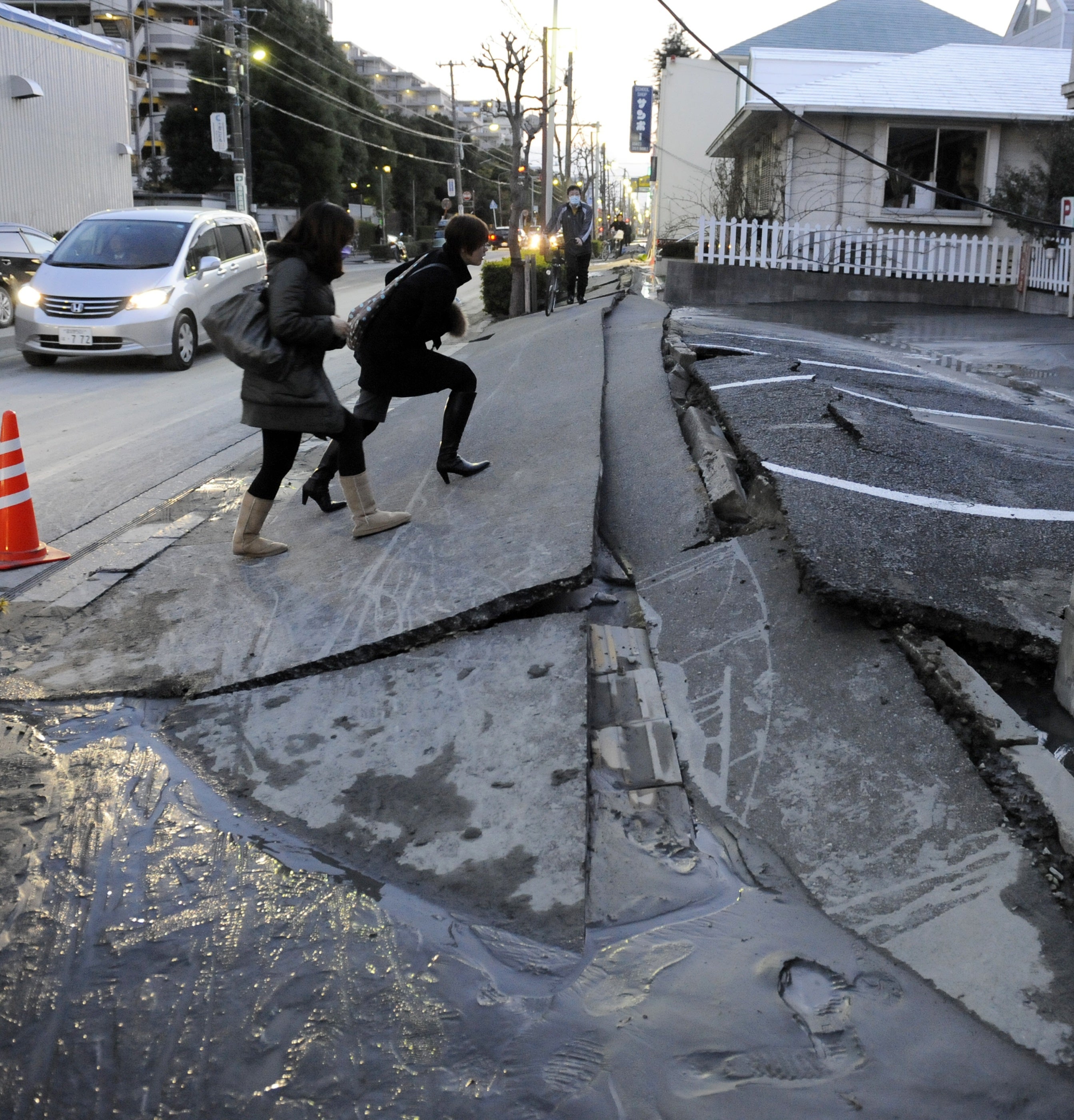
A pedestrian road has collapsed in the massive 8.9-magnitude earthquake

A pedestrian road has collapsed in the massive 8.9-magnitude earthquake (AFP via Getty Images)

The latest findings reveal a previously unknown hazard that could potentially activate or reactivate the main area of a quake, according to the study published in the journal Science.

“We report an extraordinary observation of ground motion in Japan after the moment magnitude 9 2011 Tohoku-Oki earthquake attributed to a multiplate-interface slip event triggered by a shear wave that travelled to the Earth’s core and back,” researchers wrote in the study.

In the study, scientists re-examined satellite data to look for subtle movements in the minutes surrounding the 2011 quake.

They found that seismic waves travelling through the Earth and bouncing off the core shifted the whole of Japan by as much as 5-6mm.

While this may not be a lot and is a common amount of ground movement following large earthquakes, what surprised scientists was the area of land that had actually shifted.

The triggered slip “has the broadest rupture area of any single event yet documented”, researchers wrote.

“Its overall length is similar to that of mainland Japan (~3,000 km), exceeding the mainshock rupture length by 6‒7 times and more than doubling that of the 2004 great Sumatra Earthquake,” they wrote in the study.

As this ground movement was spread out over several minutes, people may not have felt it happen under their feet, researchers say.

Yet, this new type of seismic hazard needs to be further studied, researchers say.

“I think we should be aware of the fact that there could be this potential triggering of an event many minutes after [an earthquake’s] main shaking has passed,” study author Sunyoung Park told Scientific American.