


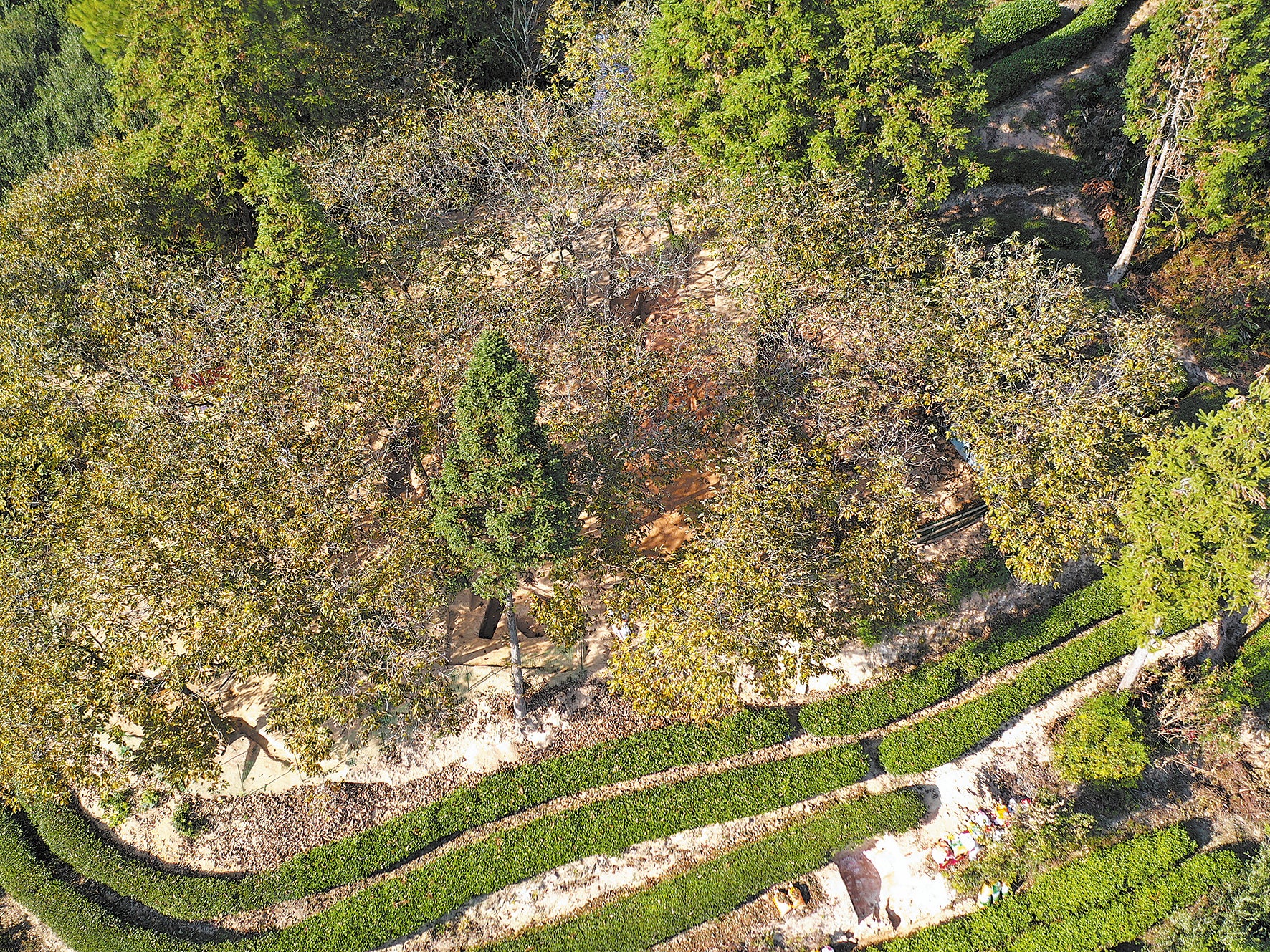
On a hillside in Fujian province’s Mount Wuyi, the grass still grows over two dark-red scars in the earth. They are all that remain of a fire that burnt out 3,000 years ago. But what that fire produced and where those products ended up, archaeologists say, has rewritten a chapter of Chinese ceramic history.
This is the only known kiln site in China from the early-to-middle Western Zhou period (c. 11th century-771 BC), and the best-preserved “living fossil” of proto-porcelain production from the pre-Qin era (before 221 BC).
Proto-porcelain is the precursor to mature porcelain. Fired at temperatures above 1,100 C, hundreds of degrees hotter than ordinary pottery, it was coated with a glassy glaze. Differences in raw materials and firing stability set it apart from true porcelain, experts explain.
For decades, the chronological sequence of proto-porcelain in China contained a puzzling gap. More than 100 pre-Qin kiln sites have been discovered across the country, concentrated mainly in the north of East China’s Zhejiang province, spanning the Xia (c. 21st century-16th century BC) and Shang (c. 16th century-11th century BC) dynasties, the late Western Zhou, and the Spring and Autumn (770-476 BC) and Warring States (475-221 BC) periods.
But the early-to-middle Western Zhou, a crucial three-century period around 3,000 years ago, remained a blank spot.
“It was as if a complete history of ceramics was missing its central chapter,” says Zheng Jianming, a professor of archaeology at the Shanghai-based Fudan University.
The gap also fuelled a long-running academic debate: did proto-porcelain originate in northern or southern China?
That missing chapter has now been found in the bamboo-shaded hills of Mount Wuyi. In 2025, archaeologists launched a new excavation of Kiln No 1 at the Zhulinkeng site. Radiocarbon dating confirmed the kilns were active around 3,000 years ago, squarely in the early-to-middle Western Zhou period.
Tests conducted by a team from the Jiangsu province-based Nanjing University on samples from the Zhulinkeng kiln complex measured firing temperatures of approximately 1,220 C for the proto-porcelain and 1,190 C for the stamped hard pottery found alongside it.
The figures matter because ordinary earthenware is typically fired at only 700-800 C. Crossing the threshold to 1,100 and above represents a qualitative leap.
“From pottery to proto-porcelain was a true technological revolution in the history of porcelain,” says Yang Zelin, deputy director of the Fujian Provincial Institute of Archaeology and lead archaeologist of the excavation.
Even more striking was what the analysis revealed about material selection. According to the archaeological team, potters at Zhulinkeng deliberately adjusted their clay recipes to suit different types of vessels.
For larger containers, such as jars, they increased the alumina content to prevent warping. For smaller pieces, including stemmed bowls, they used a more plastic clay.
Experts say this reflects a sophisticated understanding of material properties. Different kilns within the complex also produced distinct wares, with variations in glaze and firing techniques.
One of the most distinctive features of Zhulinkeng’s wares is their thick walls and thin glaze.
Yang explains that this was a deliberate choice, unrelated to firing temperature. Instead, it reflected the glazing process and the glaze’s chemical composition.
Zhulinkeng’s potters chose a fluid glaze that spreads thinly and evenly, producing a distinctive blue-green surface marked by fine crackles, he says.
For decades, archaeologists had unearthed substantial quantities of early Western Zhou proto-porcelain at major northern sites, including Zhouyuan in Shaanxi and Liulihe in Beijing, but could not determine where it had been produced.
The Nanjing University team compared the chemical composition of Zhulinkeng’s wares with samples from those northern sites. The match was unmistakable.
“It is like fingerprint analysis. We can now say with confidence that a significant proportion of the early-to-middle Western Zhou proto-porcelain found in northern China was produced at Zhulinkeng,” Yang says.
The discovery shows that the kilns of northern Fujian were integrated into supply networks serving the Zhou political centre.
“Fujian’s contribution to pre-Qin civilisation has often been overlooked,” Yang says. “This discovery shows that, more than 3,000 years ago, the people of northern Fujian built a bridge of cultural exchange between south and north.”