







Across the United States, the average organization faced slightly fewer cyber attacks per week in May 2026 than it did a year earlier, according to Check Point Research — the national figure was essentially flat year over year. In the Central US, however, the trend ran the other way. Organizations there faced more attacks than a year ago, and more than the national average — as they did in every month of 2026.
Through the first five months of the year, the typical Central US organization faced about 1,552 cyber attacks per week, roughly 7% above the national average of 1,455. In May the gap was wider still: 1,612 versus 1,442, a difference of nearly 12%. And while the national figure slipped 0.4% year over year in May, the Central US rose 3%.

The Central US, for this research, includes: Ohio, Michigan, Wisconsin, Illinois, Indiana, Kentucky, Minnesota, West Virginia, Pennsylvania, Texas, Oklahoma, Arkansas, Iowa, Missouri, Kansas, Nebraska, North Dakota, and South Dakota.
The pattern has held all year. The Central US average sat above the national line in every month from January through May. The gap was about 45 attacks per week in January and nearly closed in February — just 3 attacks separated the two (1,480 versus 1,477) — before widening steadily through the spring to roughly 170 by May. Both figures peaked in April — the Central US at 1,645 attacks per week, the national average at 1,497.
Year over year, the two regions began 2026 in similar shape. Both posted double-digit gains in January (the Central US up 15%, the US up 17%) and rose again in February. Both fell in March. From April on, they diverged: the Central US rose 2% in April and 3% in May, while the national figure was flat to slightly negative — up 0.5% in April and down 0.4% in May.
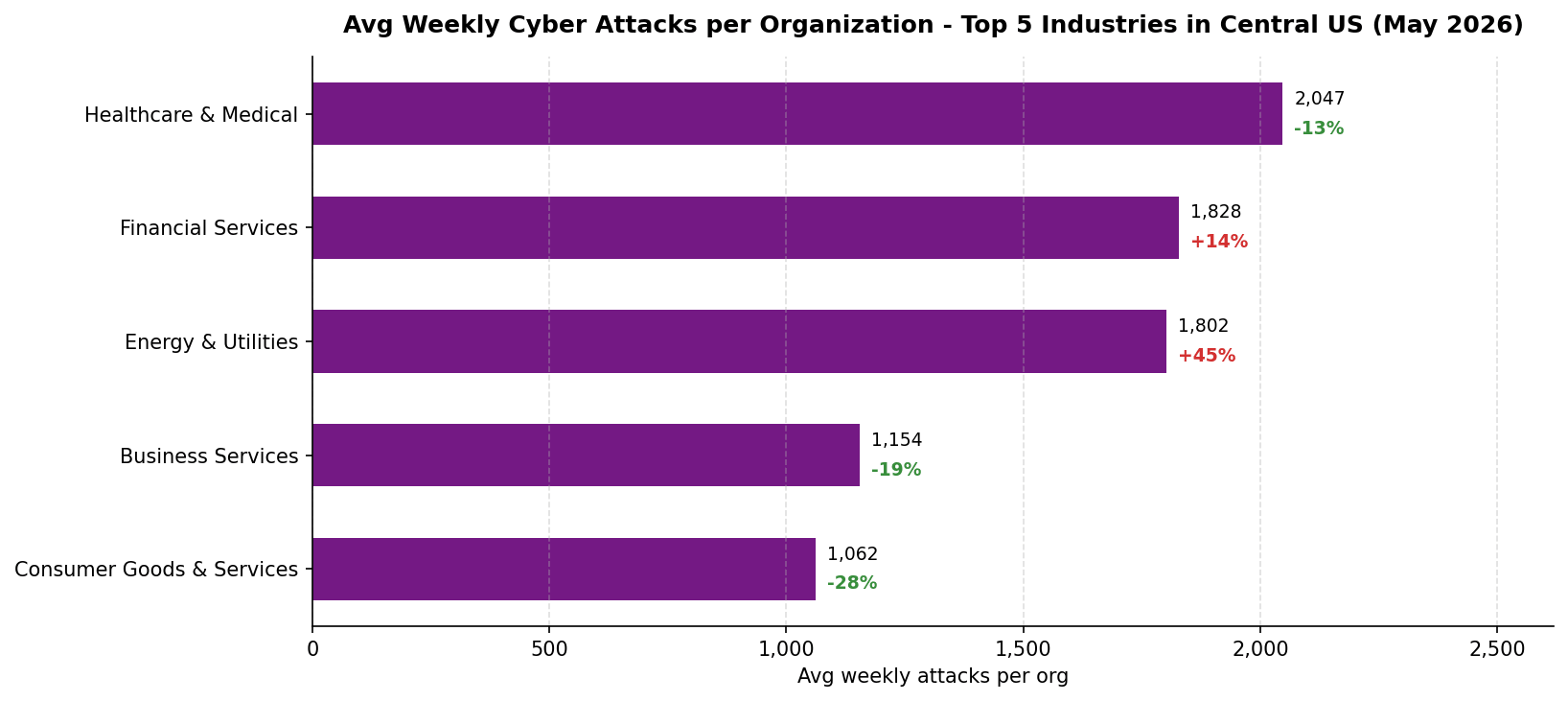
Three industries stood out in the Central US data for May 2026.
Energy and utilities saw the largest year-over-year increase of the major industries in the Central US data — up 45%, from 1,245 to 1,802 weekly attacks per organization. It now runs about 3% above the national figure for the sector (1,755 attacks per week).
Healthcare and medical was the most-attacked sector by raw volume, at 2,047 weekly attacks per organization — 44% above the national healthcare average of 1,424. That figure is down 13% from a year earlier, but healthcare remains the region’s most-targeted industry.
Financial services rose 14% year over year and sits 12% above the national finance figure of 1,626.
These three sectors are perennial targets, for reasons that have little to do with geography. Healthcare organizations hold tremendous amounts of personal and medical data; they also run life-sustaining systems that can’t tolerate downtime. This makes healthcare a prime target for ransomware and extortion. Energy and utilities are both critical infrastructure, which attracts financially motivated attackers and nation-state actors seeking disruption. Financial services provides access to money and high-value customer data. These industries tend to absorb heavy attack volume wherever they operate.
Two of the region’s top sectors moved the other way. Business services fell 19% year over year and sits 30% below its national counterpart; consumer goods and services fell 28%, and sits 34% below national.
The numbers measure the average volume of cyber attacks per organization, as reported by Check Point Research. The finding is consistent across the period: through May 2026, Central US organizations faced a higher weekly attack volume than the country as a whole, in every month and across most major industries.
The same pattern holds across most of the region’s major industries, led by energy and utilities, where attacks rose 45% year over year, and healthcare, which carried the heaviest weekly volume of any sector. The national headline has been flat. The regional one has not.
此内容由惯性聚合(RSS阅读器)自动聚合整理,仅供阅读参考。 原文来自 — 版权归原作者所有。