


A zero day flaw in a trusted supply chain software turned a legitimate government collaboration tool into a malware delivery platform.
At the start of 2026, Check Point Research uncovered a targeted cyber espionage campaign that challenges long held assumptions about trust inside enterprise and government networks. Dubbed Operation TrueChaos, the campaign did not rely on phishing, stolen credentials, or exploitation of internet facing servers. Instead, attackers abused a previously unknown zero day vulnerability in a trusted, widely deployed enterprise videoconferencing platform to quietly distribute malware across multiple government agencies at once.
The vulnerability, tracked as CVE 2026 3502, impacted the TrueConf Windows client, a collaboration platform used extensively by government, defense, critical infrastructure organizations and reputable businesses such as banks due to its on premises, offline capable architecture. By exploiting weaknesses in TrueConf’s update validation process, attackers were able to weaponize the software’s trusted update mechanism, transforming it into a supply chain style malware delivery channel.
This research highlights a sophisticated pattern in modern cyber operations: attackers increasingly target the invisible trust relationships inside secure environments, rather than attempting to break in from the outside.
TrueConf is not consumer software. It is designed specifically for secure, separated, and sovereign environments, allowing government agencies to communicate without internet connectivity. This makes it particularly attractive for ministries, defense institutions, and critical infrastructure operators.
In Operation TrueChaos, the attackers gained control of a central on premises TrueConf server, operated by a government IT organization, and replaced a legitimate client update with a malicious one. Every connected agency that trusted that server automatically became vulnerable.
This approach offers attackers extraordinary scale and stealth:
Once installed, the malicious update quietly deployed tools that enabled reconnaissance, persistence, privilege escalation, and communication with attacker controlled command and control servers – without alerting the victim.
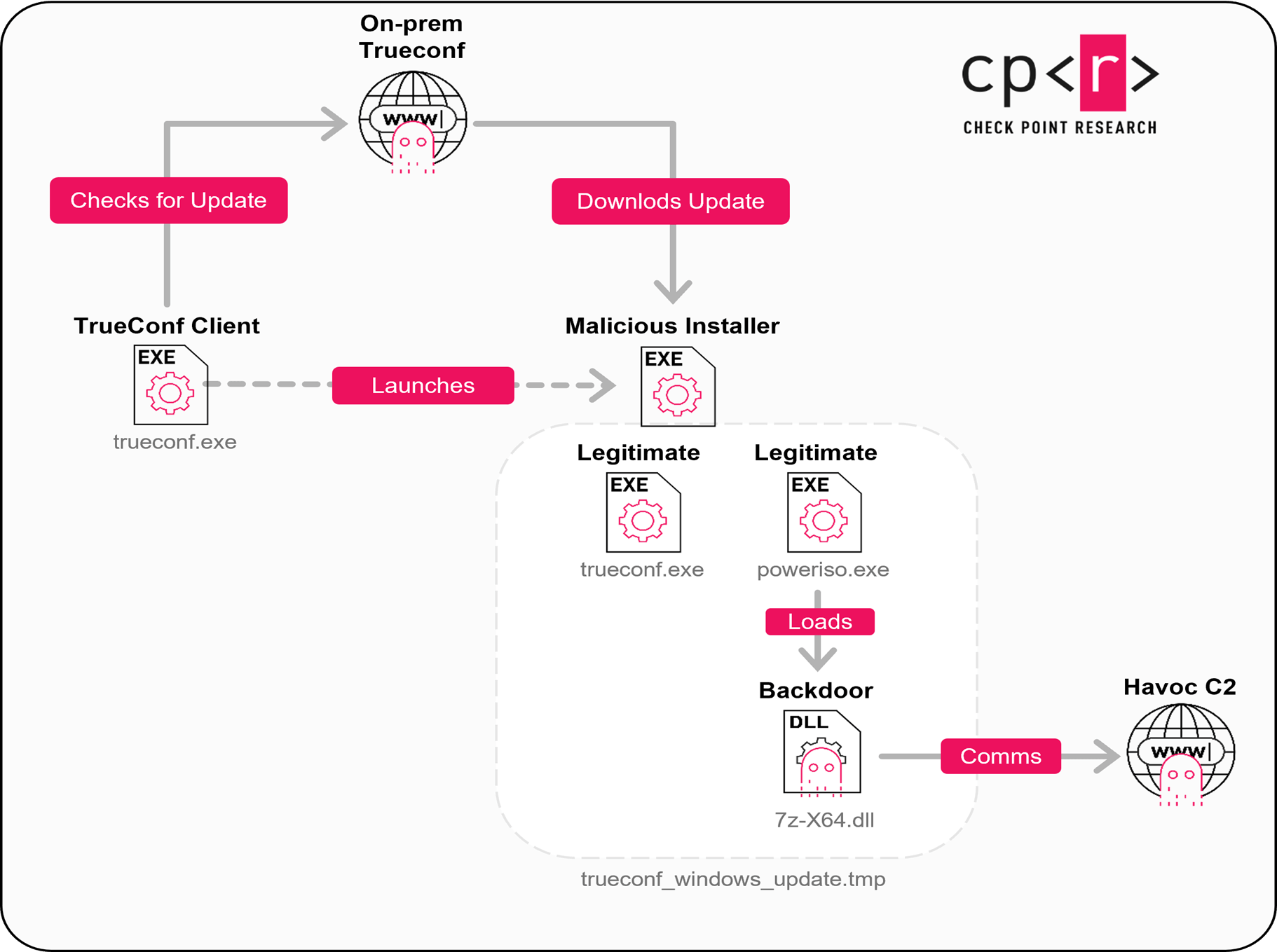
Malicious Client Update Attack Chain
At the heart of Operation TrueChaos is a flaw in how the TrueConf Windows client validated software updates delivered from an on premises server. In secure enterprise and government environments, update mechanisms are often implicitly trusted, particularly when they operate entirely within a private network. That trust became the attacker’s entry point.
When a TrueConf client starts, it automatically checks its connected on premises server for newer versions. If the server advertises a newer client build, the user is prompted to download and install the update directly from the internal server. Critically, researchers found that the client did not sufficiently verify the integrity or authenticity of the update package before execution.
This meant that:
As the attack chain leveraged a legitimate application, trusted internal update workflow and User approved installation prompts, the initial infection blended seamlessly into normal enterprise activity. Most notably, the attacker did not need to compromise each endpoint individually. Every device connected to the compromised server, and trusting it for updates, became a potential infection point. What is usually considered a strength of centralized management became a force multiplier for the attacker.
The malicious update was carefully constructed:
This vulnerability has since been fixed, with TrueConf introducing improved validation controls in updated client versions. However, the incident underscores a broader challenge: software update mechanisms themselves have become high value targets for advanced attackers.
Zero day vulnerabilities, flaws unknown to vendors and defenders, remain one of the most powerful tools in advanced cyber operations. What makes CVE20263502 particularly significant is where it sits in the attack chain.
Rather than exploiting browsers or operating systems, this flaw targeted a trusted internal software update process – a mechanism most organizations implicitly rely on and rarely monitor.
This marks a broader industry issue: as organizations harden their perimeters, attackers increasingly target software supply chains, management tools, and internal trust relationships – especially in environments assumed to be “secure by design.”
Several indicators suggest Operation TrueChaos was motivated by intelligence collection rather than financial gain:
Operation TrueChaos exposes a blind spot across many organizations, not just those using TrueConf.
What this means for the industry in summary is:
While zero day vulnerabilities cannot always be prevented, their impact can be significantly reduced. Organizations – especially governments and critical infrastructure operators – should take the following steps immediately:
Operation TrueChaos is more than a single zero day disclosure – it is a warning. As attackers continue to evolve, trust itself has become the attack surface. Collaboration tools, management servers, and update mechanisms now sit squarely in the crosshairs of advanced threat actors.
For governments and enterprises alike, the lesson is clear: Security isn’t just about blocking access – it’s about continuously validating what you already trust.
Staying ahead of today’s threats means securing not only endpoints and networks, but also the invisible systems that bind them together.
Read the full research report here.
此内容由惯性聚合(RSS阅读器)自动聚合整理,仅供阅读参考。 原文来自 — 版权归原作者所有。