






In March 2026, global cyber attack activity showed early signs of moderation while remaining at historically elevated levels. The average number of weekly cyber-attacks per organization reached 1,995, representing a 4% decrease month over month and a 5% decline compared to March 2025.
Despite this easing, the overall threat environment remains intense. Nearly 2,000 weekly attacks per organization continue to reflect sustained adversary pressure, driven by automation, broad attack surface expansion, and persistent exposure risks tied to cloud adoption and GenAI usage. Check Point Research data indicates that while short term fluctuations are emerging, cyber threats have not returned to pre-surge baselines and remain a constant operational reality for organizations worldwide.
The education sector remained the most targeted industry in March, experiencing an average of 4,632 cyber-attacks per organization per week, a 6% decrease year over year. Large user populations, highly distributed access environments, and limited security resources continue to make educational institutions attractive targets, even as overall volumes decline slightly.
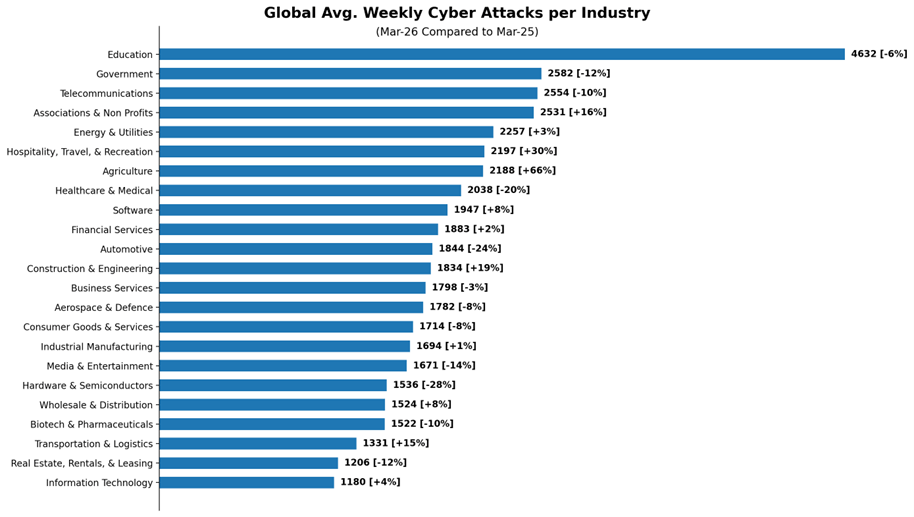
The government sector ranked second, averaging 2,582 weekly attacks, reflecting a 12% year-over-year decrease. While the drop suggests some short-term relief, government organizations remain consistent targets due to mission-critical services and high-value data. Telecommunications followed closely, with organizations facing 2,554 weekly attacks, down 10% year over year, yet continuing to attract threat actors seeking large scale disruption or supply chain access.
An important outlier emerged in Hospitality, Travel & Recreation, which recorded a 30% year-over-year increase in attacks. As these organizations prepare for spring and summer travel surges, attackers appear to be accelerating activity ahead of peak seasonal demand, exploiting increased transactional volume, customer data exposure, and operational dependencies.
Regional analysis underscores continued imbalance in global cyber pressure, with attack reductions unevenly distributed. Latin America recorded the highest attack volume globally, averaging 3,054 weekly attacks per organization, alongside a 9% year-over-year increase. Notably, Latin America was the only region to experience growth compared to February, reinforcing its position as an expanding target amid rapid digitalization.
APAC followed with 3,026 weekly attacks, reflecting a 4% year-over-year decline, while Africa averaged 2,722 attacks, experiencing the sharpest reduction at -22% year over year, though remaining among the most targeted regions overall.
| Region | Weekly Attacks per Organization | YoY Change |
| Latin America | 3,054 | +9% |
| APAC | 3,026 | -4% |
| Africa | 2,722 | -22% |
| Europe | 1,647 | -7% |
| North America | 1,384 | -8% |
Europe and North America both recorded moderate year-over-year declines, yet continue to face substantial baseline attack volumes, reinforcing that even mature markets are not immune to sustained cyber pressure.
Enterprise GenAI adoption remained widespread throughout March 2026, intensifying data leakage risk despite reductions in overall attack volumes. Key GenAI exposure indicators in March include:
While GenAI usage expanded, the proportion of high-risk interactions increased compared to February, highlighting persistent governance and visibility gaps. Without centralized controls, organizations remain vulnerable to credential leakage, intellectual property exposure, internal data mis-sharing, and unintended third-party risk amplification.
In March 2026, 672 ransomware attacks were reported globally. This represents an 8% decrease year over year, yet a 7% increase compared to February, indicating renewed attacker momentum following short-term declines earlier in the quarter.
North America remained the most affected region, accounting for 55% of reported incidents, followed by Europe at 24% and APAC at 12%. Europe’s share rose significantly from 17% in February, suggesting a rebalancing of attacker focus toward high-value EU targets.
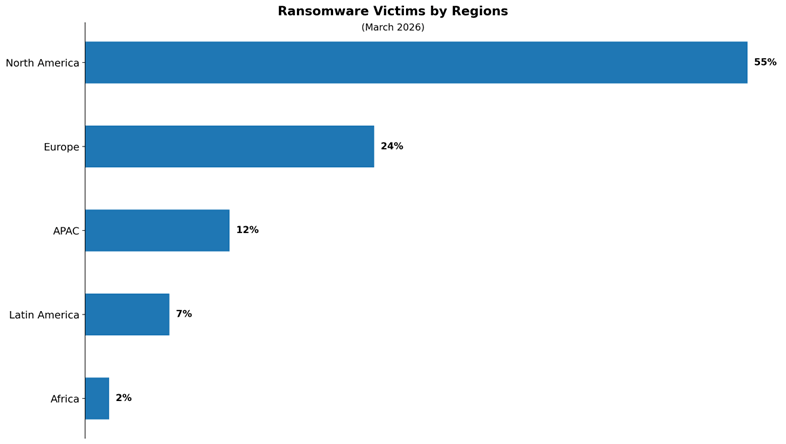
*This data is derived from ransomware “shame sites” operated by double-extortion groups. While inherently biased, these sources provide valuable insight into ransomware operations and trends.
Business services remained the most targeted sector, accounting for 35% of ransomware victims, followed by consumer goods & services (14%) and industrial manufacturing (13%). Together, the top three industries represented 61% of all reported ransomware incidents, underscoring attackers’ focus on sectors where downtime and data exposure translate directly into financial leverage.
The mid-tier cluster, including financial Services, government, and healthcare & medical—accounted for a combined 14% of victims, with each sector increasing its share compared to February, signaling broader distribution beyond traditional ransomware strongholds.
| Industry | Ransomware Victims |
| Business Services | 34.5% |
| Consumer Goods & Services | 14.0% |
| Industrial Manufacturing | 13.0% |
| Financial Services | 5.2% |
| Government | 4.6% |
| Healthcare & Medical | 4.6% |
| Automotive | 3.7% |
| Transportation & Logistics | 3.6% |
| Information Technology | 3.4% |
| Education | 2.5% |
| Media & Entertainment | 2.1% |
| Energy & Utilities | 1.8% |
| Telecommunications | 1.3% |
| Real Estate, Rentals, & Leasing | 1.3% |
| Hospitality, Travel, & Recreation | 1.0% |
Country-level analysis shows ransomware activity remains heavily concentrated in North America but continues to span multiple continents. The United States accounted for 51.8% of reported attacks, followed by Germany (4.8%), France (4.5%), and the United Kingdom (3.7%).
| Country | Ransomware Victims |
| United States | 51.8% |
| Germany | 4.8% |
| France | 4.5% |
| United Kingdom | 3.7% |
| Canada | 3.6% |
| Italy | 3.4% |
| Spain | 1.9% |
| Brazil | 1.8% |
| Thailand | 1.5% |
| Colombia | 1.2% |
The top impacted countries span North America, Europe, Asia, and Latin America, reinforcing ransomware’s global reach despite regional concentration.
Ransomware activity in March remained fragmented yet dominated by a small number of high-output groups. Qilin led activity, responsible for 20% of published attacks, followed by Akira (12%) and DragonForce (8%). While the top three accounted for 40% of incidents, a total of 47 different ransomware groups publicly impacted organizations worldwide last month.
March 2026 suggests that cyber threats are entering a phase of compressed volatility rather than sustained escalation. Overall attack volumes declined modestly, yet ransomware activity rebounded month over month, GenAI-driven exposure intensified, and targeted sector pressure shifted rather than disappeared.
At Check Point Software, our research shows that temporary declines do not signal reduced risk. Attackers continue refining precision, timing, and targeting, exploiting seasonal cycles, emerging technologies, and operational blind spots. In this environment, reactive security models remain insufficient. A prevention-first, AI-driven, multi-layered security strategy—spanning cloud, network, endpoint, and user environments—is essential to controlling exposure and building long-term cyber resilience. Staying ahead now requires anticipating attacker behavior, not merely responding to incidents after impact.
此内容由惯性聚合(RSS阅读器)自动聚合整理,仅供阅读参考。 原文来自 — 版权归原作者所有。