







Hybrid SASE is not a label – it is an architectural commitment.
Many enterprises pay twice for SASE: once for the platform, and again for the overhead of integrating and managing components never designed to work as one architecture. Check Point’s Hybrid SASE takes a different path: a single operating model that unifies access and policy. That distinction decides whether traffic is secured and routed predictably – or whether teams spend years working around architectural seams.
Take a typical workday. A remote employee connects from a managed laptop, a branch office user accesses a private application, and a contractor opens a corporate app from an unmanaged device. If each path depends on a different product, policy model, console, or tunnel architecture, “hybrid” becomes another integration project. Hybrid-by-design SASE avoids that trap by applying one operating model across users, devices, branches, applications, gateways, and private connectivity.
This is where the difference between hybrid as a deployment option and hybrid as an architectural principle becomes clear.
For many vendors, “Hybrid SASE” means little more than supporting cloud gateways for some users and on-premises appliances for others. That definition treats hybrid as a connectivity option, not an architectural principle. A more useful way to assess maturity is across three tiers:
The third model treats networking and security as one architecture, not a collection of integrated components.
When vendors retrofit cloud or mesh capabilities onto an existing architecture, whether it began as a pure-cloud proxy, a hub-and-spoke appliance stack, or an SD-WAN-first overlay, the result often inherits constraints:
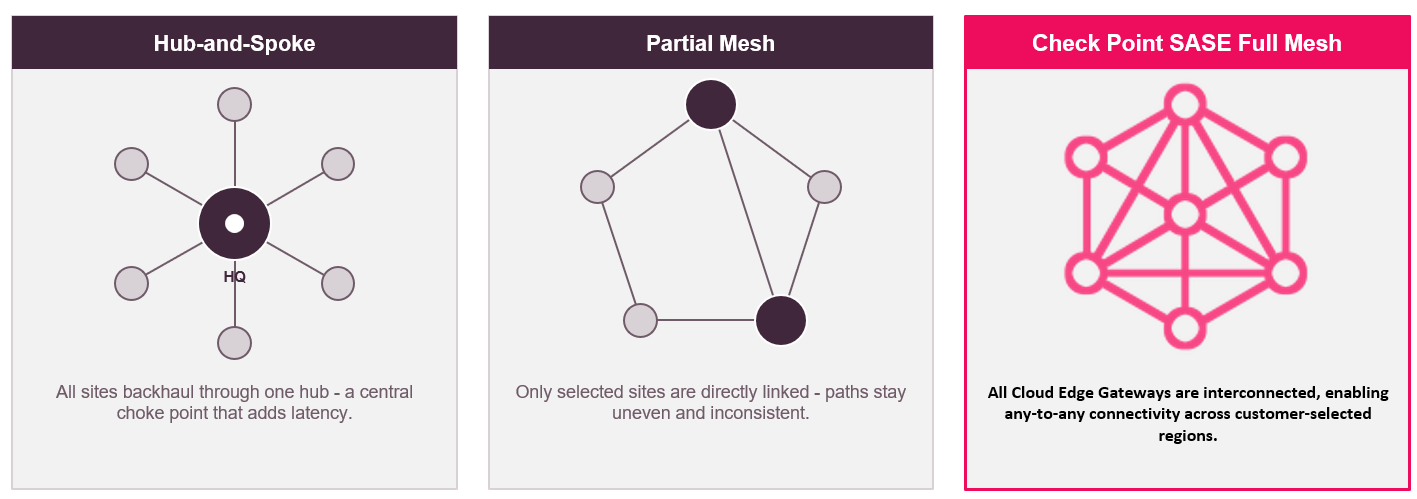
Check Point SASE Full Mesh: A customer-selected region, backed by the global PoP footprint, hosts Cloud Edge Gateways that terminate tunnels, enforce Private Access, and route traffic over policy-authorized backbone paths between entry and destination regions.
Check Point SASE takes a hybrid-by-design approach supporting secure access for remote and branch office users to private applications, SaaS, and the internet through unified SASE architecture.
Three foundational capabilities characterize the platform:
Why this matters for performance: Users connect to the nearest PoP rather than backhauling to a central site, and private traffic travels Check Point’s private backbone along the most efficient path instead of the public internet. The platform continuously monitors latency, jitter, and packet loss. Built-in redundancy, autoscaling, and high-availability tunnels mean no single point of failure, for a more predictable experience and a simpler operating model.
Why this matters for security: Because enforcement happens where it is most effective, on the endpoint via the SASE Agent and at Cloud Edge Gateways (rather than being funneled through a single choke point), security scales with the architecture instead of fighting it. That prevention-first design is confirmed by independent testing: the 2026 Miercom Hybrid Mesh Network Security Benchmark ranked Check Point No. 1 for the fourth consecutive year, with 99.8% overall security effectiveness, 99.9% malware prevention, 100% phishing protection, and 99.9% protection against known exploited vulnerabilities.
Read the full report here: 2026 Miercom Hybrid Mesh Network Security Benchmark
Branches connect via secure tunnel to selected Check Point SASE regions and tenant Cloud Edge Gateways. Policy determines whether private, SaaS, or internet traffic is routed through Check Point SASE, while existing SD-WAN can continue to handle underlay path selection. Check Point SASE recognizes more than 10,000 applications for routing and policy decisions, with automated steering and link failover. For traffic routed through the SASE architecture, security controls and private connectivity can apply based on policy, topology, and configuration. This allows organizations to modernize branch access without treating SD-WAN and SASE as disconnected architectures.
A full mesh, hybrid-by-design SASE architecture can reduce operational complexity and may reduce network and cloud connectivity costs by:
Actual savings depend on topology, traffic mix, data residency needs, configuration, and existing contracts. The point is architectural: when full mesh private connectivity and unified security are built into the platform, customers do not need to assemble multiple components to achieve one operating model.
Real Hybrid SASE requires networking and security to operate consistently across users, devices, branches, applications, networks, and cloud resources. Check Point SASE delivers this through one operating model – Private Access, Internet Access, SASE Agent enforcement, Cloud Edge Gateways, private connectivity, branch integration, policy controls, threat prevention, monitoring, and security events. That is what separates built-in Hybrid SASE from bolted-on approaches: consistent policy and unified operations by design.
此内容由惯性聚合(RSS阅读器)自动聚合整理,仅供阅读参考。 原文来自 — 版权归原作者所有。